 August 7, 2026
 Love Vs. Logic


Parshas Re’eh
“See, I present before you today a blessing and a curse” (11:26).
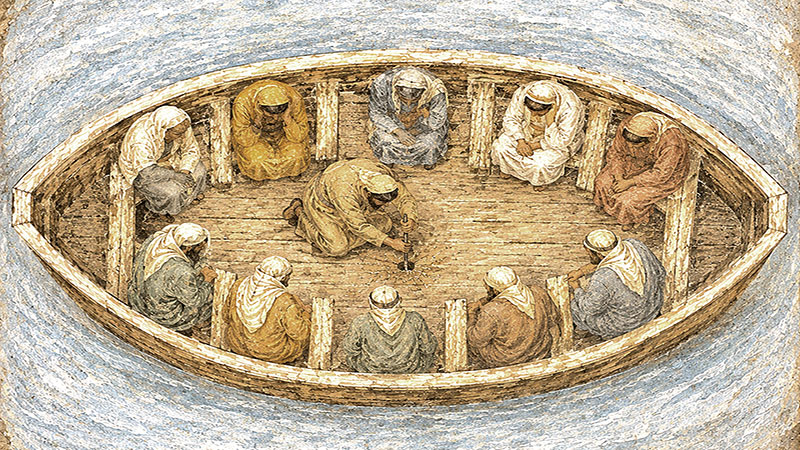
The word the Torah uses for “see” is re’eh, in the singular. The word the Torah uses for before you is “lifneichem,” in the plural. The point the Torah is making is that up to this time, each person was responsible for his own deeds. But now, each Jew had to prepare himself for the new concept of collective responsibility. The misdeeds of one person would become the responsibility of and have repercussions on the entire nation, just like the passenger on a boat who drills a hole under his own seat and drowns not only himself, but all of the passengers.
When the Torah uses the word beracha, it usually means wealth (Rashi, Bamidbar 6:24). G-d bestows wealth for a purpose. It is given to us in order to help us perform His mitzvos. If we are given money by G-d, it is for the purpose of giving charity. Sure, we may derive side benefits from distributing His wealth, like the waiter who serves the public and enjoys a good meal in the kitchen after his service. But we have to recognize the source of our blessings. If we do, we will not misuse the money for profane purposes.
There are two sources of wealth. One is the riches that G-d gives us and the other is the fortunes we take for ourselves. What G-d gives us will not lead us astray. But what we grab for ourselves might spoil us. G-d promised Avraham that when the people of Israel would leave Egypt in the future, they would depart with great wealth (Bereishis 15:14 and Shemos 12:35). This G-d-given wealth was used for building the Mishkan. But then there were the ornaments of gold, silver and precious stones that the Jews gathered from the drowned Egyptians at the Red Sea which they were not instructed to take and which were more valuable than the assets they removed from Egypt (Rashi, Shemos 15:22). What they seized for themselves was used to build the golden calf, as it says, the silver and gold were used for idols (Hoshea 2:10, Koheles 5:12, Shir HaShirim 1:11).
And in addition to the wealth that G-d gives us with which to perform his mitzvos, there is another blessing. It is the blessing of life itself. It is the blessing contained in the word “tishmeu” (11:27), which is written in the future tense. The blessing is that you will be able in the future to continue performing the mitzvos. There is a future to keeping mitzvos. Spurning them, leads to a dead end. “I have placed life and death before you, blessing and curse, and you shall choose life so that you will live” (30:19). Each Rosh Hashanah and Yom Kippur we pray that we will be around next year, to hear the shofar, to say the tefillos of the day and then to sit in the sukkah. And when next year arrives and we are still around to do so, that is our reward, the reward of life itself.
It is like the mitzvah of bringing bikkurim, first fruits to the kohen, which the Torah tells us to observe and perform (26:16). Rashi explains the words “You shall observe and perform” in the following way: “A Heavenly voice blesses him, ‘You brought bikkurim this year; you will be around to do so again next year.’”
“Do away with all the places where the nations whom you are driving out worship their gods on the high mountains, on the hills or under any luxuriant tree. Tear down their altars, break up their sacred pillars, burn their Asherah trees and chop down the statutes of their gods. You shall not do so to Hashem your G-d,”(12:2-5).
Of course the people of Israel would not do that to Hashem, their G-d. But what the Torah is doing here is reinforcing the message and importance of community and collective responsibility. Don’t bring your voluntary sacrifices in your backyards, in the privacy of your homes. Don’t copy the idol worshipers who brought offerings to their gods wherever they felt like it, on the mountains, the hills and under any tree. Come to the central communal places where offerings are brought by all the people. Yes, those sanctuaries might be temporary like the Mishkan of Shiloh, or Givon or Nov (Rashi 12:11). Life might be difficult as you fight your wars. But come anyway in between times when you have some menucha (12:9), respite from fighting. Don’t wait another 440 years for the permanent nachalah, for the Beit HaMikdash to be built.
“You should not listen to a false prophet who performs miracles and predicts the future, even if his predictions come true. G-d is testing you to see if you are able to truly love G-d with all your heart and all your soul” (13:4).
Who are the false prophets of today? They are the scientists who can prove to you that the Torah is incorrect, that the world created itself billions years ago and that man descended from monkeys. There may be no logical answer to these scientific claims. The only answer is the commitment of love one has toward G-d and His word. Love defies logic and overcomes questions. And until the scientists are proven wrong, which may not happen until we reach the next world, these false prophets are sent to test us to see how deeply we love G-d and his Torah and whether we can make this love bridge the gap between temporary hypothesis and permanent truth. The love of G-d does not come from logic, it comes from learning. As Rashi points out, the words, “you should love G-d” (6:5) are followed immediately by the sentence, “and these words which I am commanding you today must remain on your heart” (6:6). It is only by studying the words of the Torah and doing what they say, that you will discover the love for G-d which will enable you to live with questions.