 October 16, 2026
 Accurate Accentuations & Elul Acrostics


Parshat Sho-f’tim – Elul
Last year’s Sho-f’tim column had a full discussion about my transliteration of this week’s sedra. So, I’ll keep it short. Most English speakers mispronounce the name of the sedra in two ways. First, they (used to be me too) think the first syllable is Shof and the second one is Tim. Second, most accent the word on the first syllable (known as Mil-eil) – SHOF-tim. It turns out that the first syllable is Sho – the letter Fei with a Sh’va under it is attached to and begins the second syllable, F’tim.
(To get technical, the Sh’va under the Lamed in Shulchan (table) is a Sh’va nach. Only the consonant sound of the Lamed is heard; the Sh’va nach (resting Sh’va) does not contribute a vowel sound at all. Table is shul-CHAN. On the other hand, the Sh’va under the Bet of B’nei (as in B’nei Yisrael) is a Sh’va na (a traveling Sh’va) and adds a very short vowel sound to the consonant sound of the Bet.)
In Sho-f’tim, the Sh’va under the Fei is na (so it is pronounced), and does not finish off the syllable that comes right before it; rather, it attaches to the following syllable, as mentioned above. And the word is accented on the last syllable (known as Milra). Bottom line (actually, it is the first line – the opener of the sedra): The correct pronunciation is sho-F’TIM, or, if I don’t call attention to which syllable is accented, just Sho-f’tim.
That was the first word in the sedra, followed by “v’sho-t’rim.” In this word, both the opening Vav and the Tet have a Sh’va na under them and are attached to the syllable that follows them.
I know what you’re thinking – dikduk wasn’t my favorite subject either.
* * * * *
We’ll get back to the sedra in a bit; let’s talk Elul first. Rosh Chodesh is (or was, depending when you’re reading this) Thursday-Friday this week. Most commonly, the two Elul customs – shofar at the end of Shacharit and “L’David Hashem Ori” (Psalm 27) at the end of Shacharit and Mincha or Maariv, depending on what nusach your shul (and you) follow – begin on Friday, the second day of Rosh Chodesh, the first of Elul. Some communities might begin on Thursday.
* * * * *
Do you know the difference between an acronym and an initialism? Both consist of the first letters of a phrase, but there is a difference in the way we say them. The Federal Bureau of Investigation is known as the F.B.I. Each letter is sounded as a letter. F.B.I. is an initialism. NATO, on the other hand, is an acronym for North Atlantic Treaty Organization. NASA is an acronym for National Aeronautics and Space Administration. U.S.A. is an initialism. So are A.T.M. (automated teller machine) and V.I.P. (very important person).
Sometimes you find an abbreviation that some people treat as an acronym and others, as an initialism. ASAP: If you read it as a word – asap – then it is an acronym. If you say the four letters – A, S, A, P – then it would be an initialism.
In Hebrew, there are also two terms for words that abbreviate phrases, but they are not analogous to the English terms above.
Rashei teivot is a word created as an abbreviation. For example, Tzahal, the Israel Defense Forces, is an acronym for Tzava Hagana L’Yisrael. In this first example, the rashei teivot are pronounced as a word. The Israel Security Agency is known as the Shin Bet (that would be an initialism) or as the Shabak (for Sheirut HaBitachon HaK’lali), an acronym. Many times, abbreviations are not even pronounced or spelled out – you just know or figure out or ask what they mean. Chol HaMo’ed is often abbreviated Chet-Vav-Hei-Mem. It isn’t pronounced; it isn’t spelled out. It is just an abbreviation. Sort of like Aug. for August. No one reads it as aug or as A.U.G.
And then we come to nutrikon. This is an existing word with a meaning, to which has been added an additional meaning taking the word as rashei teivot. The word Sh’ma has its own meaning. But as an acronym (technically a nutrikon), it can stand for Shacharit, Mincha, and Arvit, or the phrase from the end of the haftara of Shabbat Nachamu – “S’u Marom Eineichem” (Lift your eyes heavenward).
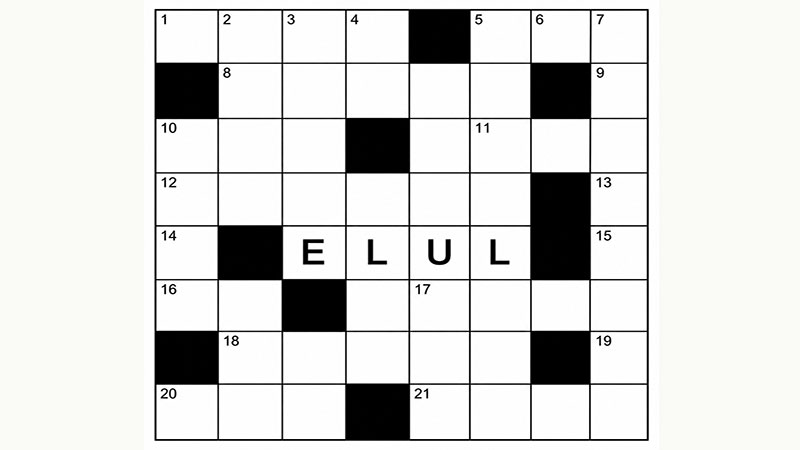
All of the above was a lead-in (hope you learned something on the way) to the name of the month just begun, the month that brings us into the Rosh Hashanah and Yom Kippur period of the year. I am talking, of course, of Elul. It is the name of the month but it is also a Nutrikon for more than you probably think.
Let’s start with the well-known classic – “Ani L’Dodi V’Dodi Li,” I am my beloved’s, and my beloved is mine... This quote from Shir HaShirim (6:3) is well-known by its rashei teivot, which spell Elul. The phrase describes the mutual love between G-d and the People of Israel, which serves as an encouraging basis for our Elul-time task of sincere repentance.
Other phrases from Tanach are also associated with Elul. Notable among them are two other phrases that join Ani L’Dodi to represent the three kinds of acts that help us avert an evil decree: t’shuva (repentance), t’fila (prayer), and tz’daka (chesed).
One of the p’sukim in the Torah that deals with the topic of t’shuva indicates G-d’s help in the process: “U’mol HaShem Elokecha et l’vovcha v’et l’vav zarecha” – And Hashem your G-d will circumcise your heart, and the heart of your offspring, to love Hashem your G-d with all your heart, and with all your soul, that you may live. This pasuk (D’varim 30:6) is read on the Shabbat before Rosh Hashanah and contains a four-word sequence – Et L’vavcha V’et L’vav – whose initials spell Elul.
Then there is a pasuk in Megilat Esther which contains an Elul acrostic and features interpersonal acts of kindness: “Laasot otam...y’mei mishteh v’simcha umishlo’ach manot Ish L’rei-eihu U’matanot La-evyonim” – to make them days of feasting and joy, and sending portions one to another, and gifts to the poor.
And here are a few more:
Vayikra 12:8 & 5:7 – “Echad L’Olah V’achad L’Chatat” and “Echad L’Chatat V’Echad L’Olah.” These p’sukim speak of two types of korbanot – two types of sacrifices for different kinds of sins. The Chatat is for shogeg (inadvertent) violation of some prohibitions; the Olah is for non-fulfillment of positive mitzvot. Both failings must be on our Elul agenda!
Prayer is an essential element of Elul. In Divrei HaYamim Alef 29:13, we find, “Now therefore, our G-d, we thank you, and praise your glorious name,” with Elul embedded therein: “V’Ata Elokeinu modim Anachnu Lach Um-hal’lim L’Sheim tifartecha.”
And look at this pasuk from Yirmiyahu (31:33), with Elul embedded in it too: “Ki Eslach La’avonam Ulchatatam Lo ezkor od” – For I will forgive their iniquity, and I will no longer remember their sin.
Yirmiyahu 12:15 shows us the other part of “return”: “V’haya acharei natshi otam ashuv v’richamtim vahashivotam Ish L’nachlato V’ish L’artzo” – And it shall come to pass... and I will have compassion on them, and will bring them back, every man to his heritage, and every man to his land.
One more. I had heard an Elul shiur by Rabbi Yitzchak Breitowitz. He presented three Eluls – Ani L’dodi, Et L’vav’cha, and this is his third one.
In Parshat Mishpatim, we are introduced to the Ir Miklat, the city of refuge. Anyone who kills another person goes to an Ir Miklat. The one who did not intend to kill but was negligent in some way that caused the death is confined to Ir Miklat (the details are a bit more complicated than that...). In it, he is protected and punished, but he also undergoes a process of introspection, t’shuva, and ultimately, kapara. Sh’mot 21:13 says: “If he did not plan to kill [his victim], but G-d caused [allowed] it to happen, then I will provide a place where [the killer] can find refuge.” The words “Ina L’yado V’samti L’cha” have the rashei teivot of Elul.
The month of Elul is an Ir Miklat – not in space, but in time – for each of us. When we sin, we are taking part of our life away – in essence, killing ourselves – but we are provided the Ir Miklat of the month of Elul to help us with introspection, t’shuva, and hopefully, with receiving kapara and a new lease on life.
On the lighter side, the gematria of the word Elul is 67. So is the gematria of Kol tuv – All good.
* * * * *
Finally, Sho-f’tim. Look at the fluctuation in rankings among the sedras of the Torah:
This sedra is written on 191.6 lines; it ranks 27th, just about the average for the whole Torah. It has 97 p’sukim, ranking 36th, last among the second third of sedras. In words, it ranks 28th, just below average. Letters: a further drop, to 31st place.
Sho-f’tim has relatively long p’sukim, like most of D’varim, but is an average-sized sedra.
It has 41 mitzvot – 14 positives and 27 prohibitions. That’s more than 6.5% of the Torah’s mitzvot! It ranks 6th among the sedras in number of mitzvot. The top 6 mitzva-sedras contain 55% of the Torah’s mitzvot.
* * * * *
Mitzvot 495 and 496 are a matching pair – a positive mitzva and a prohibition that are two sides of the same coin. They are both from D’varim 17:11 in Parshat Sho-f’tim. We are commanded to listen, accept, and follow the dictates of the Sanhedrin throughout the generations. And we are forbidden to deviate from what they say, neither to the right nor to the left (to paraphrase the pasuk).
Who commands us to eat matza on Seder night? G-d. In the Torah. Who forbids us from speaking lashon hara? Same answer. Who forbids us to eat mixtures of meat cooked with milk? Same answer.
Who forbids us to eat chicken and milk together? Rabbinic Law, backed by G-d in the Torah – specifically, D’varim 17:11. Who commands us to light candles for the eight nights of Chanuka? Rabbinic Law, backed by G-d in the Torah.
The Torah forbids us to add to the Torah. Rabbinic Law seems to do just that. But there is all the difference in the world. Our Sages would not be allowed to redefine the Torah’s prohibitions of meat in milk by stating that the Torah’s ban includes chicken. That would distort the Torah and violate bal tosif (the prohibition against adding to the Torah). But the Torah gives the authority to the Sanhedrin to legislate in many different ways, and the Torah requires us to follow their laws.
Halacha is a composite of the Written Word, the Oral Law (as transmitted through the generations), and Rabbinic Law as legislated by our Sages. D’Oraita and D’Rabbanan go hand-in-hand in shaping a Torah way of life. Minhag (time-honored customs) and other features of Jewish practice round out the picture.
Obviously, the intricacies are more complicated, but this is the basic framework.
Shabbat Shalom and Chodesh Tov. Use the month of Elul wisely and well.