 October 23, 2026
Categories: Business/Finance / Money Matters
Late Bloomers
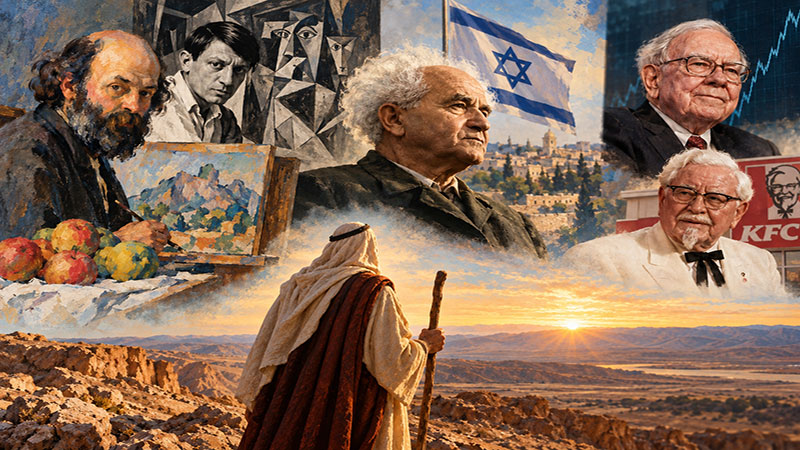


Paul Cézanne's most valuable paintings are the ones he made in the last year of his life, at sixty-seven. Pablo Picasso's are the ones he made at twenty-six. David Galenson, an economist at the University of Chicago, ran both painters’ auction records through a regression. A Cézanne from age sixty-seven sells for roughly fifteen times as much as a Cézanne of the same size from age twenty-six. Picasso’s curve runs the other way. It peaks in 1907, the year of Les Demoiselles d’Avignon, and slopes downward for the rest of his life.
Galenson’s explanation, in Old Masters and Young Geniuses (2006), is that there are two kinds of innovators. Conceptual innovators know what they want before they begin. They plan, execute, and peak young. “I don’t seek,” Picasso said. “I find.” Experimental innovators do not know. They proceed by trial and error, discard most of what they make, and accumulate. “I seek in painting,” Cézanne wrote a month before his death. One kind of genius starts with a concept. The other starts with a search and earns its expertise one experiment at a time.
The same curve appears in company founders. In 2018, Pierre Azoulay of the Massachusetts Institute of Technology, Benjamin Jones of Northwestern, and two co-authors used United States Census records on 2.7 million founders to find the age of the people who built the fastest-growing firms. Among the fastest-growing 0.1% of firms, the mean founder age was forty-five. A fifty-year-old founder was 1.8 times as likely as a thirty-year-old to build such a firm. The strongest predictor of success was prior experience in the same industry. Accumulation, again.
Harland Sanders began franchising his chicken restaurant in his sixties, living on $105 a month from Social Security. He sold Kentucky Fried Chicken at seventy-three for $2 million. Warren Buffett appeared on the first Forbes 400 list in 1982 with $250 million. He was fifty-two, and more than 99 percent of his fortune has been made since. He handed the chief executive’s chair at Berkshire Hathaway to Greg Abel this January, at ninety-five.
Years ago, on a hike in the Negev, we visited David Ben-Gurion’s grave. What struck me was his birth date: October 16, 1886, one hundred and forty years ago this month. He was sixty-one when he declared the State of Israel. At the age most people retire, he started the job he is remembered for. His first forty-two years in the country were trial and error on a national scale: a labor federation, a party, a shadow government, each built for a state that did not yet exist. Everything after the declaration drew on those decades of preparation. Prime minister at sixty-one, he resigned at sixty-seven and retired to a kibbutz in the Negev, returned to the premiership at sixty-nine, directed the Sinai Campaign at seventy, and left the prime minister's office for good at seventy-six. The State was not the work of a young genius. It was the late work of an old master.
A Biography That Begins at Seventy-Five
The Torah’s account of Avraham runs on the same clock.
Consider what the Torah records about Avraham before this week’s parsha. His father was Terach. He married Sarai. “Sarai was barren; she had no child” (Bereishit 11:30). That is the whole file: seventy-five years of a life in three verses of genealogy. Then Lech Lecha opens, and the text stamps the moment with an age. V’Avram ben chamesh shanim v’shiv’im shanah b’tzeito meiCharan, “Avram was seventy-five years old when he left Charan” (12:4).
Notice where the age is attached. Not to his birth. To the departure. The Torah dates Avraham’s life from the day he acted on an instruction, at seventy-five. It tells us why G-d chose Noach: he was an ish tzadik tamim, a righteous and complete man (6:9). It never tells us why G-d chose Avraham.
The Rambam supplies what the text withholds (Hilchot Avodah Zarah 1:3). Avraham had no teacher. His mind, in the Rambam’s phrase, began to roam. He watched the heavens turn, reasoned, rejected, reasoned again, and at forty recognized his Creator. Then he spent decades arguing with the people of Ur and Charan and gathering the persuaded. In Galenson’s vocabulary, Avraham is the experimental innovator. He did not receive the truth and act on it. He sought it, by trial and error, for forty years, and the call came thirty-five years after that. Revelation came through the search.
Eighty for Strength
The parsha is bracketed by two ages. It opens at seventy-five and closes at ninety-nine, with the brit milah (17:24). Everything that makes Avraham falls between them: the covenant between the pieces, the war against the four kings, the new name, the promise of a son who arrives at a hundred (21:5). The Mishnah’s ladder of ages puts binah, understanding, at forty, the Rambam’s year for Avraham’s recognition. It puts koach, physical power, at thirty. Gevurah, strength, it saves for eighty: ben shmonim l’gevurah (Avot 5:21). The source is Moshe’s own psalm, “and if with strength, eighty years” (Tehillim 90:10), and Moshe stood before Pharaoh at exactly that age (Shemot 7:7). The Torah’s founders started their careers past the age at which most of us retire.
G-d’s first word to a man of seventy-five was not “rest.” It was “go.” Forty years of searching and thirty-five of arguing were not Avraham’s prologue. They were his material. The Torah starts counting the day he put it to work.
That is the arithmetic behind Cézanne’s prices. The canvases from sixty-seven hold forty years of trial and error. Ben-Gurion’s state rested on forty-two years of institutions built before it existed. If your work is built by accumulation, the years behind you are not your record. They are your capital. The Torah does not date a life from its birth. It dates it from the departure. Lech lecha. Go.