 November 13, 2026
Categories: Headline / Columns
Attending Kindergarten in Jerusalem
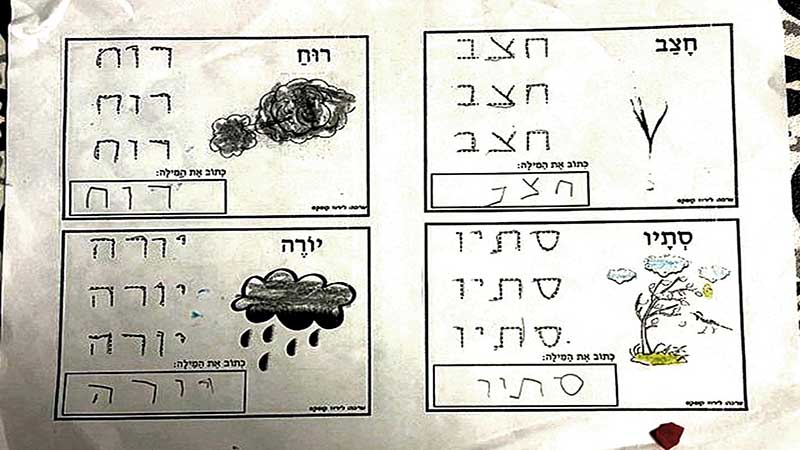


We’ve been in Israel with our children for almost three months, so it’s time to reflect on how things are going.
Between the dislocation of moving from America to Israel and the new language, culture, and community, we didn’t expect this to be easy, especially for our kids. And there have been some challenges, as you’d expect. Every child has their own mix of challenges and successes, and I won’t go into detail here, especially about our older children, who can (and very well might) read this column. Our attitude has been that whatever difficulties this year brings, the long-term payoff is substantial.
For this column, though, I want to focus on our five-year-old daughter. (If she reads it someday, I expect she’ll take it in stride.)
As I mentioned in an earlier column, our search for a gan chovah (kindergarten) for her ended with a charedi gan. In some cases, such as boys’ high schools, there are major differences between charedi and non-charedi institutions, like whether the school teaches secular studies at all. For gan chovah, the differences in curriculum are far less significant.
The gananot, all charedi women, are committed to their students and teach the standard kindergarten curriculum: a little about the parsha and chagim, some basic Jewish concepts, the alef-bet, the seasons. Lots of singing, parties on erev Shabbat and Rosh Chodesh, plenty of coloring. The usual.
Our daughter is consistently excited to get to gan and participates happily throughout the day. She stays for aftercare (at a price unimaginable to us as Americans) until 4 pm every day, with a prepared lunch included. She enjoys the full day there.
Watching her learn the language and the content has been nothing short of amazing.
A few weeks in, my wife and I noticed that she was speaking Hebrew with an Israeli accent. It’s both hilarious and humbling: grown adults can try for years to develop some sort of self-respecting Israeli accent, while a five-year-old picks one up in under a month without trying.
She has been learning vocabulary at a dizzying pace, coming home with new words every day and often asking us how to say other words in Hebrew because she wants to learn more. A couple of times she forgot an English word and asked us how to say a Hebrew word in English. She makes plenty of mistakes, mostly with gender, as you’d expect, but we correct her and she keeps going. She isn’t self-conscious or embarrassed at all, just excited to keep picking up the language.
To be fair, she had a bit of a head start. I’ve been speaking Hebrew to the kids at home for years, which has helped their comprehension, though I’ve never managed to get them to answer me in Hebrew. That was true of our five-year-old too, and because she was so young, her comprehension was fairly limited. So I expected her to have an easier time than a typical five-year-old arriving in Israel, but I kept my expectations modest. I would not have predicted that her spoken Hebrew would go from zero to semi-functional so quickly!
Now, at home, she mostly speaks Hebrew to her parents, by conscious choice. She still reverts to English with her siblings or when she’s not in the best mood, but when she’s trying to be her best self, she speaks Hebrew fairly consistently.
She’s clearly picking up much of her Hebrew at gan, helped by a very good policy: the ganenet doesn’t allow the children to speak English or French, so that they don’t split into cliques by language. As a result, our daughter not only hears Hebrew all day but has also made Israeli friends. (By Israeli, I mean kids who don’t understand English at all.) They have playdates and communicate in her new and still rudimentary Hebrew, and it works. In some ways, it’s just so easy to be a kid.
Sometimes the new word of the day comes from the teachers; other times from her classmates. The other day it was “Ani lo chayevet” – “I don’t have to!” A healthy streak of independence is fine, but we had to explain that this claim has certain limits.
One day I heard her muttering something that sounded like “sofer STaM,” but I knew that couldn’t be what she said because – who learns that term in kindergarten? I don’t think I knew what a sofer STaM was until middle school. So I asked her what she’d said, and sure enough, they had learned about sofer STaM in gan. They were about to start learning the Torah from Bereishit the following week, so first they learned how a Torah is made.
Last night she came over with her siddur and said she wanted to daven. “Great,” I said. “Let’s say Shema together, since it’s nighttime.” She jumped right in: first a short Hebrew limerick about not touching our hair or getting distracted but focusing during tefillah, then straight into Kel Melech Ne’eman and the first paragraph of Shema.
She basically knows the entire daily davening recited in school by heart, along with a number of other songs, religious and otherwise, that they sing in class. It really is true what they say about the Girsa Deyankusa (see Shabbos 21b) or the tabula rasa, or the blank slate (see Avos 4:20) – the mind just absorbs everything.
These are just a few snapshots, but it’s been remarkable to watch her develop over these months, picking up the language, the religious texts and ideas and fitting right in. It’s incredible how adaptable kids are at this age.