September 11, 2026
 Categories: Arts / Book Reviews / Headline
A Deep Dive into the Mitzvah of Shofar
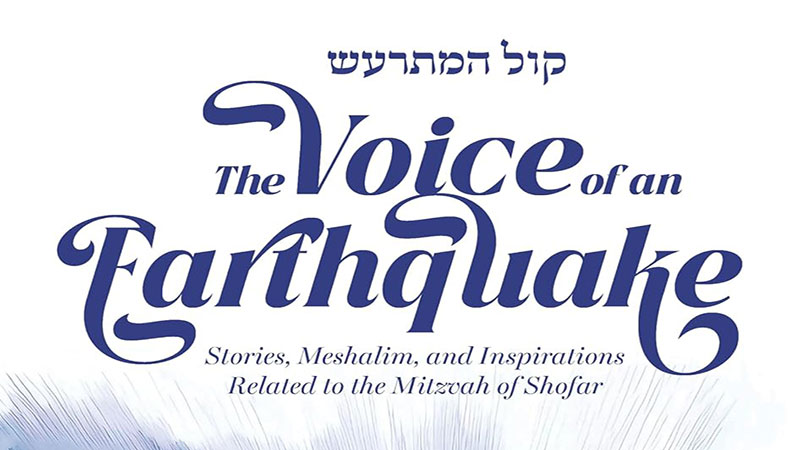


Title: The Voice of an Earthquake
By: Bentzion Ettlinger
Mosaica Press
248 pages
The Code of Federal Regulations (CFR) is the official compilation of the rules and regulations issued by U.S. federal government agencies. The CFR currently runs to over 175,000 pages. If one were to read through it all, I doubt they’d find a single story. It’s all dry legal code. Reading it is more perspiring than inspiring.
Contrast that with the Talmud, which has 5,422 pages, roughly 15-20% of whose content consists of stories (Aggadah). The Talmud’s authors wrote a legal work, but understood the power of a story.
In The Voice of an Earthquake, Rabbi Bentzion Ettlinger (full disclosure – he is my brother-in-law) has gathered scores of stories that show the power of the shofar. With Rosh Hashanah so close, this highly readable book can deepen readers’ understanding of the day.
While the shofar is one of the most familiar sounds in Jewish life, it is perhaps one of the least understood. We hear it every Rosh Hashanah, know the basic laws surrounding its blasts, and recognize its central place on the Day of Judgment. Yet the shofar can easily become another feature of a crowded davening, something we hear rather than truly experience and engage with. The stories in the book aim to change that.
As an indication of how much there is to write about the topic, this is Ettlinger’s third book devoted to the shofar, building on his earlier works, The Shofar and 100 Shofar Blasts. Here, he brings Torah insights, stories, parables, historical tidbits, and his own experiences as the long-term baal tokeia at K’hal Adath Jeshurun (Breuer’s) in New York. The book includes many stories about Rav Shimon Schwab, with whom Ettlinger had a particularly close relationship for many decades.
The title itself captures the book’s central idea. Among the fascinating subjects discussed is the kol hamisraash, literally the “voice of the earthquake,” a particularly evocative way of thinking about the shofar. An earthquake is not merely a sound. It is a force that shakes the ground beneath us and reminds us that what we regard as permanent and secure can suddenly be unsettled. The shofar, Ettlinger suggests, is meant to do something similar to the human soul: It is supposed to shake us out of complacency.
Rather than treating the shofar primarily as a dry, technical mitzvah, he approaches it as an encounter. A shofar is not simply an instrument that produces a prescribed sequence of sounds; it is a summons to wake up, to reflect, and ultimately, to change. The book therefore fits naturally into the spiritual atmosphere of Elul and Rosh Hashanah, when the central challenge is not merely to perform the season’s rituals but to let them affect us.
Ettlinger knows the shofar inside and out, literally. He has spent decades collecting shofars, studying their manufacture, documenting customs, and now, gathering stories about this mitzvah.
The shofar is ancient, familiar, and repetitive. Precisely for that reason, it is easy to stop hearing it. Ettlinger seeks to restore its power and help the reader appreciate that the shofar is meant to penetrate the spiritual complacency that accumulates over the year. The Voice of an Earthquake encourages the reader to hear an old sound in a new way.