 October 9, 2026
 Categories: Features On The Jewish World
A Mohel’s Ledger Is Window Into European Jewish Life Over a Century Ago


A fascinating book I was recently consigned to sell tells a poignant and historically-rich story. The volume itself is unassuming enough: an 1872 Vienna printing of Sod Hashem, a classic work used by many a mohel for generations. But tucked within its worn boards lies something far more arresting, a remarkably detailed manuscript circumcision ledger kept by a Polish mohel whose pen preserved nearly four decades of Jewish life at the fragile seam between tradition, modernity, and assimilation in late 19th- and early 20th-century Central Europe.
Beginning in 1883 in the towns surrounding Ribnik, which lies some 42 miles west of Lodz and 71 miles east of Breslau, and continuing through Breslau until 1920, the mohel recorded his circumcisions with an almost obsessive precision. These were not merely names and dates. They were miniature human dramas, chronicled with the careful eye of a communal functionary who understood that the covenant of circumcision often stood at the center of much larger questions of identity, legitimacy, medicine, and Jewish continuity.
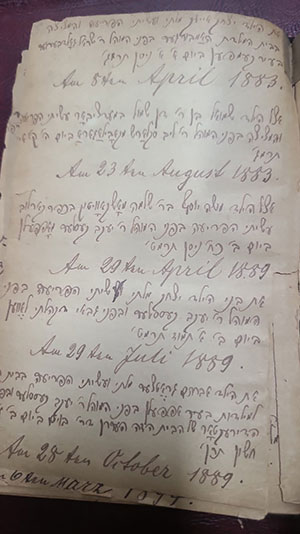
Particularly striking is his repeated notation that certain circumcisions were performed “in the presence of a doctor,” reflecting the growing tension in European Jewish communities between traditional ritual practice and emerging medical scrutiny, a concern underscored further by a fascinating note penned on the front flyleaf discussing the health controversies surrounding metzizah, including mention of the antiseptic Lysol, a modern intrusion into an ancient rite.
The ledger’s most haunting passages concern children born of mixed unions and uncertain Jewish status. In 1919, the mohel records circumcising a child born to a gentile woman after the father solemnly swore to bring the child before a Bet Din for proper conversion. A year later, in 1920, he circumcised both the eight-year-old son and the newborn infant of “Director Stall,” whose gentile wife, the mohel notes with palpable hopefulness, sincerely intended to convert “in the near future.”
Most poignant of all is an entry from 1912 in which he circumcised the son of “The Maiden...” – the ellipsis itself preserving some long-forgotten discretion or shame. Then, eight years later, in 1920, he records that same Maiden returning with a second child.
What survives here is not merely a mohel’s register, but an extraordinary ethnographic document of Jewish life in transition: provincial Polish Jewry confronting secularization, intermarriage, medicalization, and modern bureaucracy, all through the intimate and sacred act of brit milah.