 October 16, 2026
 Categories: Featured / Parsha / Torah
A Moment of Inspiration


The Talmud tells us (Shabbos 88a) that when the Jewish nation called out “Naaseh v’nishma – we will do and we will listen,” 600,000 angels came and tied two crowns on each person, one for naaseh and one for nishma. Rashi elaborates that these crowns were created from the brilliance of the shechina. The Maharsha comments that the crowns symbolized malchus (kingdom) and kehunah (priesthood), as we learn (Shemos 19:6), “And you shall be to Me a kingdom of princes and a holy nation.”
We learn that Moshe Rabbeinu, the greatest of all people, was afraid of the angels. When he went up to Shamayim to receive the Torah he told Hashem, “Master of the universe, I am afraid they will burn me with the breath of their mouths.” Can we fathom that the Jewish people would not be afraid?
Yet at that moment, all the impurity of the Jewish people disappeared, the decree of death was removed, and all the ill people were healed. Everyone was healthy. The Torah lifted everyone spiritually and physically.
R’ Chaim Kamil, rosh yeshiva of Ofakim, asks: What was the purpose of this inspiration? Hashem knew that in another 40 days they would sin with the Golden Calf, at which time 1,200,000 angels of retribution descended and removed the crowns. Impurity, illness and death returned once more among the Jewish people. The Tosfos HaRosh notes that twice the number of angels were necessary to remove the crowns because the destructive angels have less strength than the ministering angels, as it says (Yuma 76a), “Greater is the measure of reward than the measure of punishment.”
What benefit was there then to all the miracles of Matan Torah, if everything returned shortly to the way it had been?
It was chizuk, encouragement. Chizuk even for a short time serves a purpose. It was worthwhile for Hashem to send the 600,000 angels to demonstrate that their resolution to accept the Torah removed their fear of the angels. It was worthwhile for Hashem to perform all those highly-visible miracles and to heal the ill in order to prove that any encouragement that was derived thereby was precious to Hashem. Any spiritual enhancement or increase, even if it was only for a small amount of time and it would eventually disappear, was productive.
Therefore, notes R’ Chaim Kamil, one has to seize the moments of chizuk – moments of heightened awareness – that come up in his life to make a resolution to do something better. With this chizuk one can merit all the blessings. That is the essence of Matan Torah.
A talmid chacham from Bnei Brak related an interesting experience.
Suchy was basically a secular Jew. There was no evidence of Yiddishkeit in his life, and apparently, he had never been formally exposed to Torah and mitzvos. Even living in Bnei Brak, a city imbued with holiness, seemed to have no effect on him. Despite numerous attempts by many over the years to draw him closer to Yiddishkeit, no one had been successful in reaching Suchy.
Suddenly a change was noticed. Suchy began to observe some of the mitzvos. He seemed to be joining the ranks of a chozer b’teshuvah.
One of the rabbis who was able to relate to individuals from all backgrounds invited Suchy to his home. “I cannot contain my curiosity,” he told Suchy. “What is it that brought about this wonderful change that people are beginning to see?”
Suchy was glad to share the information and related, “I had been planning to go to India but my plans fell through. Instead, I took a trip to Poland a few weeks ago, sponsored by the organization Roots. I was hesitant to join because I was afraid that they would try to convince me to become observant. But when they guaranteed that it was only a historical trip and there would be no outreach or indoctrination, I agreed to participate. After all, my mother’s family came from there, and I was interested to see where my mother grew up as a young girl.
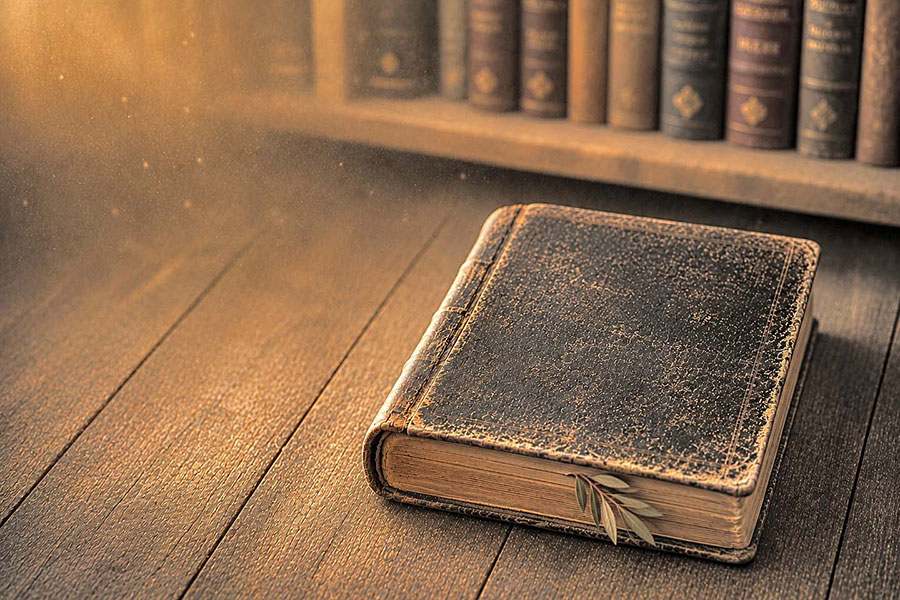
“It was a deeply emotional experience for me. One day, I unexpectedly found myself right in front of the old shul in the city. The building is still standing, although it is in very poor condition. I went inside and, inquisitive by nature, I began to explore the building. I climbed into the attic where I found old sifrei kodesh stored. I was going through the piles of sefarim – I have no idea what I was hoping to find – when I suddenly realized that the antique siddur I was holding in my hands had the name of my maternal grandfather engraved on the front cover.
“All the stories my mother had told me about her father, a righteous person, became real. I began to flip through the pages of the siddur and I found a small leaf from the hadas preserved between the pages of the Mussaf of Shalosh Regalim, which must have fallen there decades ago. It broke my heart. I began to feel within me a direct connection to my grandfather, to the previous generation.”
Suchy was extremely overwhelmed by the overt display of Divine providence. He had wanted to go to India but at the last-minute plans changed. He had no intention of visiting the shul, yet a hidden Hand pushed him there. He didn’t come to look through sefarim, but he did. He had no idea what he would find, yet he discovered the siddur of his own grandfather.
The neshama of a Jew is connected to the past. Hashem devises ways to return the lost soul and bring a person closer to Him. It could be a mitzvah, a prayer, a leaf or a bridge to the past that inspires the heart to return to Hashem.