 October 23, 2026
A Rediscovered Manuscript of The Ramban on Chumash


Centuries after it was written, a remarkable medieval manuscript of Ramban’s commentary on the Torah has resurfaced, offering new insights into one of the most influential works of Jewish scholarship.
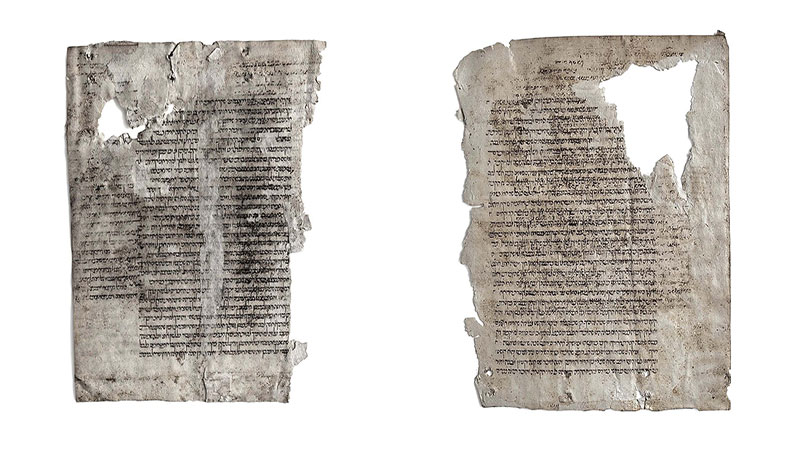
The manuscript, written in a Sephardic semi-cursive hand and dated to the fourteenth century, or possibly the late thirteenth century, preserves substantial portions of the commentary on Bereishis and Shemos. Preliminary comparison with existing manuscripts and printed editions has identified numerous textual variants, some of which may contribute to a more precise understanding of the commentary’s transmission and revision.
The significance of the manuscript must be considered in the context of the Ramban’s standing in the history of Torah scholarship. As Rabbi Chaim Dov (Charles) Chavel observed in the introduction to his edition of Perush HaRamban al HaTorah, few works composed by the great Torah scholars who followed the Rambam achieved such broad acceptance among the various sectors of the Jewish nation, among Torah scholars and researchers alike, as the Ramban’s commentary on the Torah. Its sustained influence makes the establishment of its text a matter of considerable scholarly interest, particularly given the evidence that the commentary circulated in differing textual forms during the medieval period.
The recovered material consists of parchment leaves and substantial fragments written in brown ink, generally comprising 27 to 28 lines per page. The script is a compact Sephardic semi-cursive hand, and the leaves exhibit extensive wear and staining resulting from their subsequent use as binding material. Portions of the original text have been rubbed away or cut off, while fragments of other Hebrew books remain attached to the parchment. Despite these losses, the surviving sections of Bereishis and Shemos are preserved almost in their entirety. The text appears to represent the Mahadura Batra, or later recension, of the Ramban’s commentary.
The textual history of the Ramban’s commentary is particularly relevant to the evaluation of this manuscript. Composed initially in Spain, the work continued to undergo revision after the Ramban’s arrival in Eretz Yisrael. He expanded and amended his commentary, and copies of his additions were transmitted abroad for incorporation into manuscripts already in circulation. Consequently, the surviving manuscript tradition reflects different stages in the development of the work. Some witnesses preserve readings or passages that are absent from other copies, while differences between manuscripts may reflect not only scribal transmission but also the successive revisions made by the author himself. The distinction between the earlier and later forms of the commentary is therefore essential to any assessment of individual readings.
The newly identified leaves appear to belong to this complex tradition. Their script has been noted as similar to that of Ramban manuscript fragments preserved at Nonantola, although palaeographical similarity alone cannot establish a direct relationship between the witnesses. More importantly, preliminary collation has identified numerous differences from the standard printed texts. Some readings appear textually preferable to those found in current editions, while certain variants do not appear to have been recorded in Rabbi Chavel’s edition or the Oz Vehadar edition. These observations remain preliminary and would benefit from systematic collation against the relevant manuscript witnesses and printed editions. Nevertheless, they indicate that the recovered material may have a meaningful contribution to make to the textual study of the commentary.
One example concerns a Targum cited by the Ramban in the section of Bereishis. In the standard printed editions of the commentary, the quotation does not exist in the corresponding versions of the Targum. The newly recovered manuscript appears to preserve a reading that agrees with the text of the Targum as it is printed today. This correspondence raises the possibility that the reading in the standard printed Ramban reflects a corruption introduced during transmission. Such a conclusion, however, requires further examination of the relevant textual witnesses, including the possibility of variant Targum traditions or changes arising at different stages in the transmission of the commentary. The example nevertheless illustrates the potential value of manuscript evidence for assessing readings that have become established in printed editions.
The circumstances in which the manuscript survived are also of bibliographical interest. At some point, the original codex was dismantled, and its parchment was reused in the binding of another book. The recovery of medieval Hebrew manuscript fragments from European and Middle Eastern bookbindings is a well-documented phenomenon, sometimes described collectively as the “European Genizah.” The term refers to manuscripts that survived not through deliberate preservation, but through their secondary use as binding material. Parchment and paper from discarded Hebrew books were cut, folded or pasted into later volumes, often preserving fragments of works that would otherwise have been lost. Manuscripts of Ramban’s commentary are among the Hebrew texts recovered in this manner, including fragments dating to the fourteenth and fifteenth centuries found in Italian bindings.
The present group provides a further example of this practice. Attached to one of the Ramban leaves are fragments of printed Hebrew text identified as Ketubos 22b from the Guadalajara edition of the Talmud, produced around 1480 and attributed to Solomon ibn Alkabetz, the grandfather of the better-known Rabbi Shlomo Alkabetz. The Guadalajara edition belongs to the early history of Hebrew printing, and surviving fragments are of interest for the study of early printed Talmud editions as well as the later reuse of printed material. The association of these fragments with the Ramban manuscript demonstrates how handwritten and printed Hebrew texts could subsequently become part of the same binding structure.
The Guadalajara fragment also establishes a chronological limit for the reuse of the material. Assuming the identification and dating are correct, the Ramban parchment and the printed fragment could not have been joined before the Talmud fragment was produced, around 1480. This provides a terminus post quem for their association in the binding, although it does not by itself establish when or where the manuscript was dismantled. The combination of manuscript and printed material thus offers evidence both for the history of the Ramban text and for the later material circulation of Hebrew books.
The original codex is no longer extant, and the surviving fragments cannot fully reconstruct its original form or provenance. Their textual significance, however, does not depend on the survival of the complete volume. As witnesses to a manuscript tradition characterized by authorial revision and textual variation, they preserve readings that can be compared with other surviving copies and with the established printed text. Further collation may clarify the relationship of these leaves to the known recensions of the commentary and determine the extent to which their variants are shared with other witnesses.
The manuscript therefore represents a useful addition to the corpus of surviving Ramban materials. Its importance lies in the combination of substantial textual remains, a potentially early date, and evidence of readings that differ from those in established editions. At the same time, the precise implications of these readings must be determined through continued textual and palaeographical study. The recovery of the leaves provides another opportunity to examine the transmission of Ramban’s commentary before the stabilization of its text in print and to refine our understanding of the manuscript tradition through which this central work of Torah scholarship was preserved.