 October 9, 2026
 Categories: Arts
A Rewritten Ketubah Demonstrates Rav Moshe’s Humility
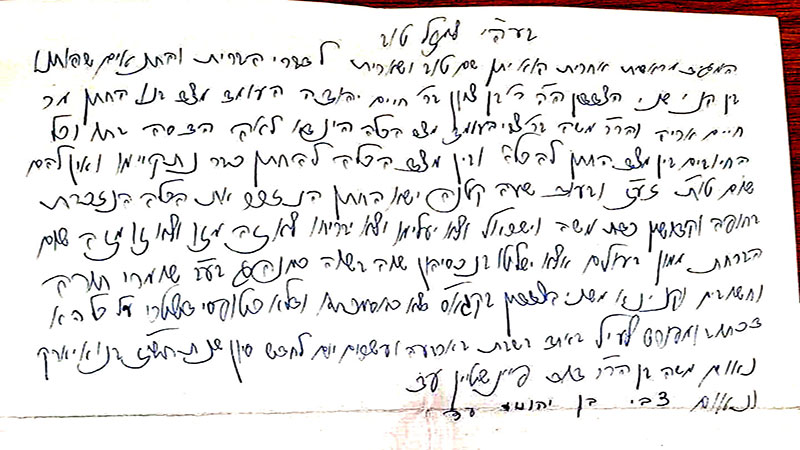


Among the many documents that pass through the hands of collectors, every so often one encounters an item that is far more than simply a piece of paper. It is a window into a moment in Jewish history and, sometimes, into the character of a gadol. I was recently commissioned to sell a fascinating set of documents that does precisely that. Dating to 1957, these documents offer a remarkable glimpse into the greatness and humility of Rav Moshe Feinstein, zt”l, and demonstrate in a remarkably tangible way a quality that is sometimes difficult to capture in words: the extraordinary humility of a man who had already become one of the undisputed Torah giants of American Jewry.
The story begins with a wedding. The kallah was a neighbor and close friend of the Feinstein family, and Rav Moshe had a particularly personal connection to her family. He had officiated at her first wedding and had subsequently been involved in the proceedings surrounding her divorce. Several years later, when she was to marry again, Rav Moshe once again served as the mesader kiddushin. By 1957, Rav Moshe had already officiated at countless weddings. He had an established procedure and, as was customary, arrived at the wedding with a printed ketubah form that he traditionally used. There was nothing unusual about the document; it was simply the standard printed ketubah that Rav Moshe had used on other occasions, and he proceeded to fill it out as he had done many times before.
As Rav Moshe sat writing the ketubah, however, a relative of the kallah, a chassid with his own traditions, was seated beside him. The relative noticed several aspects of the way Rav Moshe was filling out the ketubah that he believed should be changed, and he respectfully pointed them out, offering a number of corrections and revisions. Under ordinary circumstances, one could easily imagine such a situation ending with the person making the suggestions quietly backing away. After all, this was Rav Moshe Feinstein. By this time, he was already widely recognized as the leading posek in America. His reputation was firmly established, his Torah authority was recognized throughout the country, and Jews from all corners of American Orthodoxy turned to him with their most difficult halachic questions. Rav Moshe could easily have brushed aside the suggestions, explained that he had his own established practice, or simply continued writing the ketubah as he had done countless times before. Instead, what he did next is precisely what makes these documents so extraordinary.
Rav Moshe took the printed ketubah and drew a large X across it. He did not argue with the relative or attempt to demonstrate that his original version was correct. He did not invoke his stature or authority. Instead, he simply set aside the ketubah on which he had already begun writing and turned to the reverse side. There, on the back of the very same printed form, Rav Moshe proceeded to write the entire ketubah by hand. He did not merely make the requested corrections or alter a few lines; he started over and wrote the ketubah in its entirety. Another printed ketubah was then used in a similar fashion, with its reverse side serving as the place where the tena'im were written. What survives today, therefore, is an extraordinary physical record of this otherwise seemingly ordinary wedding: a printed ketubah with a large X across its face, and on its reverse side the handwritten ketubah of Rav Moshe Feinstein himself.
Rav Moshe had no need to prove that he was right. He could have pointed to his years of experience, his knowledge, or his extraordinary standing in the world of halacha. He could have explained why his original wording was acceptable. Yet when another Jew sitting beside him raised a concern, Rav Moshe was willing to stop, set aside what he had already written, and begin again. The fact that the person making the suggestions was a relative of the kallah and not someone of comparable stature in the world of Torah makes the episode even more striking. Rav Moshe's response was not one of embarrassment or defensiveness. It was simply humility in action.