 October 9, 2026
 Categories: Headline / Parsha / Torah
A Supernal Song & the Value of Vidui



Parshat Ha’azinu - Shabbat Shuva - Yom Kippur
I hope your Rosh HaShana went well, in all of its aspects.
As I’ve mentioned many times in this column, 295 of the 385 possible dates of the Jewish Calendar fit a pattern of three days of the week they cannot fall on and four days of the week that they can fall on, with one of those four options occurring much less frequently than the other three. If that confused you (or even if it didn’t), let me spell it out for the current dates.
Note that in the outline below, RH means the first day of Rosh HaShana, Shuva means Shabbat Shuva, YK means Yom Kippur, Shab means Shabbat, and Sk means the first day of Sukkot. The days of the week are also abbreviated. The percentage listed on each line is how often that option occurs:
(1) RH Mon; Shuva-Vayeilech; YK Wed; Shab Ha’azinu; Sk Mon (28.03%)
(2) RH Tue; Shuva-Vayeilech, YK Thu; Shab Ha’azinu, Sk Tue (11.51%)
(3) RH Thu; Shuva-Ha’azinu, YK Shab; Sk Thu (31.89%)
(4) RH Shab; Shuva-Ha’azinu, YK Mon; Sk Shab (28.57%) – this is how it falls this year, 5787.
Notice that in (1) and (2), there is a Shabbat between YK and Sukkot. Ha’azinu is read on that Shabbat, and so Nitzavim-Vayeilech is split, with Nitzavim alone on the last Shabbat of the year and Vayeilech read on the first Shabbat of the new year, Shabbat Shuva.
In (3) and (4), there is no Shabbat between YK and Sukkot; Ha’azinu is read on Shabbat Shuva, and Nitzavim-Vayeilech are combined for the last Shabbat of the year.
Also note the numbers: (1) or (2) occur collectively in 39.54% of years and (3) or (4) occur collectively in 60.46% of years.
* * * * *
Now let’s turn to Ha’azinu Stats:
▪ It is the 53rd of the 54 sedras of the Torah; the 10th of 11 in D’varim.
▪ It is written on 92 lines, ranking 51st. (The number of lines would be lower if it were not for a lot of blank space within the sedra – details in a moment.)
▪ Ha’azinu consists of three parshiyot – all of them open (extra open, as we’ll soon see).
▪ The sedra has 52 p’sukim, ranking 51st in the Torah; 8th in D’varim.
▪ It has 614 words and 2,326 letters, ranking 52nd in the Torah; 9th in D’varim. Its p’sukim are relatively very short.
▪ Ha’azinu has two possible haftarot, depending on whether it is read on Shabbat Shuva (as it is this year) or between YK and Sukkot.
▪ The mitzva count for Ha’azinu is zero, according to the Sefer HaChinuch.
Rambam, however, counts one mitzva, the prohibition of yayin nesech, wine made for sacramental service of other religions.
This is the only mitzva on Rambam’s whole list of 613 that the Chinuch does not count. (And there is one mitzva on the Chinuch’s list that Rambam merges with another mitzva and doesn’t count separately, thus keeping both lists at the iconic number of Taryag.)
A rabbinic extension of yayin nesech is wine produced or handled by non-Jews. This is called stam yeinam – their wine. This prohibition is not only an extension of the yayin nesech ban, but is also based on concerns about socialization with non-Jews that can lead to intermarriage.
Note that kosher wines are often labeled as to whether they were m’vushal – processed with heat (such as in pasteurization). If a wine is m’vushal, then a non-Jew handling an open bottle does not make it off-limits to us. If it is lo m’vushal, then there is a problem with a non-Jew, such as a waiter, handling an open bottle. Caveat bibens – let the drinker beware!
* * * * *
The Torah is poetically called a shira, a song. In the context of the mitzva to write a Sefer Torah, the word shira refers to the whole Torah. However, the word also has a more exclusive meaning when it refers to Shirat Hayam, the Song of the Sea, in Parshat B’shalach, and to Shirat Moshe in Parshat Ha’azinu.
To be a bit more specific: The song part of Parshat Ha’azinu comprises 44 p’sukim. The last eight p’sukim return to the prose style of the Torah.
Ha’azinu’s Song is written in a different way from the rest of the Torah. The Song of the Sea (Shirat Hayam) in Parshat B’shalach is also written differently from the rest of the Torah. And Ha’azinu’s Song and the Shirat Hayam are written differently from each other.
The most common Sefer Torah today is written in 245 columns of 42 lines each.
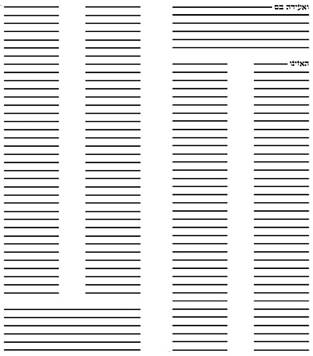
Ha’azinu’s Song is written in a Torah scroll on 70 lines, divided evenly (35+35) in two columns. The column that contains the first half of the song begins with the words “V’a’ida bam,” from D’varim 31:28 towards the end of Parshat Vayeilech. Vayeilech and perek 31 finish on the top six lines of the V’a’ida column. Then there is a line left blank, and the first 35 lines of Ha’azinu finish the column. The second 35 lines continue at the top of the following column, followed by a blank line and then six more lines of the non-song text that continues Parshat Ha’azinu. The following column finishes Ha’azinu in 14 more lines. V’zot HaB’racha then finishes the whole Torah with the 28 remaining lines of the column and all 42 lines of the final column of the Torah.
The accepted tradition is to read the Song for the first six aliyot, and then Sh’vii consists of the final eight p’sukim of the sedra. The last five of those p’sukim are reread for the maftir.
Each line of the Shira consists of a phrase, a blank space, and a phrase. The two columns of the Shira look like this:
As it begins, Moshe Rabbeinu calls upon Heaven and Earth to hear what he is about to say. The second pasuk translates as: “My lesson will drop like rain; my words will flow like dew; like storms on vegetation and like showers on grass.” Rain, dew, storm, shower – different intensities of falling water. Water is to the physical as Torah is to the spiritual. This is a wide-ranging analogy in many teachings. Here it indicates that different people handle Torah-learning differently. There are individuals who can “learn up a storm.” They spend most of their waking hours learning Torah extensively and intensely. There are others who have the time and can handle a shiur here and a shiur there. Some need the light touch of short Divrei Torah. Some can learn on their own; others need guided lessons. Some can learn straight Gemara. Others use Artscroll or other translations and commentary. Torah is taught and learned on many different levels, just as rain and dew differ.
We then come to a familiar pasuk. “Ki Sheim Hashem ekra…” When I call out the name of G-d, ascribe greatness to our G-d. This pasuk is said by some (possibly most) as the introductory pasuk to the Amida of Mincha, Musaf, and Ne’ila (but not for Arvit or Shacharit).
Among other things that are learned from this pasuk is the practice of bentching me’zuman. If at least three men are eating together – or, without three men, if at least three women are eating together – then one invites the others to say Birkat HaMazon together. Zimun anashim is required; zimun nashim is voluntary. The minimum of three for zimun is learned from this pasuk – “When I [singular] call out... you [plural, minimum plural is two] ascribe greatness...”
One more comment about Ha’azinu. The eighth line begins with the letter Hei written extra-large and distanced from the following letter Lamed by a space, even though it is part of the word. The word in question is Hei-Lamed-Yud-Hei-Vav-Hei and is pronounced Hal-Ado-nai. In other words, we have a K’ri u’k’tiv situation in which the word is written with the Hei by itself followed by the rest of the word, but it should not be read as Ha [pause] L’. Many Torah readers mispronounce Hal-Ado-nai, so if you can, you might want to tip yours off before leining.
I realize that I’m not leaving a lot of space for Yom Kippur, but I want to highlight one more Ha’azinu pasuk – “Z’chor y’mot olam…” Remember the days of old; reflect upon the years of [other] generations. Ask your father, and he will tell you; your elders, and they will inform you.
Judaism should never have what we used to call the Generation Gap. Our strength is in the flow of tradition, the flow from one generation to the next. We live in the past and in the present and in the future.
* * * * *
Considering that this column is called Torah by the Numbers, we should take note that a major number of Yom Kippur is five. Every weekday of the year, we daven three times a day. On Shabbat, Rosh Chodesh, and Yamim Tovim (holy days), we add Musaf, making four davenings. On Yom Kippur, we have five – Maariv (a.k.a. Arvit), Shacharit, Musaf, Mincha, and Ne’ila.
The other five of Yom Kippur are the Inuyim, the afflictions that are obligatory on the tenth of the seventh month, Tishrei: not eating or drinking, not washing or bathing (except for cleaning away actual dirt), no use of lotions or cosmetics (unscented deodorant is permitted), no wearing of leather shoes, and no marital relations.
And here are some other Yom Kippur numbers. Vidui, the formal verbal confession (which should be supplemented by your own sincere words – in any language) includes the 24 terms of sinning (some specific and some general categories) beginning with “Ashamnu, bagadnu…” followed by the 44 Al Cheits (“For the sin we have committed before You…”) and a set of “V’al hachata’im…”
Vidui is an important component of the t’shuva process – sometimes the culmination of the process – following recognition that you have sinned, stopping that sinful act or behavior, regret for the past violations, and acceptance for the future not to repeat the sin. But sometimes, vidui or even a word or line therein can be the trigger for the t’shuva process. Saying the name of a sin and/or reading a footnote or comment about it can lead to the realization that you have t’shuva to do.
To be sure, one feels trepidation during the Days of Awe and on Yom Kippur particularly. But there is also a special joy mixed with the awe and fear of the day – the joy of the realization that G-d wants our repentance; He does not want to punish us.
Important note: The Vidui we say in the silent Amida is at the end, after we have completed the seven brachot of the Amida. It is attached to the Amida, but it is not an integral part of it. This is significant for those of us who daven slower than our fellow shul-goers. If you find yourself in the middle of Vidui when the chazan begins the repetition, continue with your Vidui. If you need to join in for Kedusha, say “Yihyu l’ratzon imrei fi…,” join in K’dusha with the congregation, and then continue with your Vidui. At the end, say Yihyu l’ratzon again. Also note that your Vidui is more important than the other parts of Chazarat HaShatz that you might miss (except for K’dusha).
As usual, there’s plenty more I’d like to share with you, but for now let me with you and yours a Shabbat Shalom (v’shakeit – and quiet) and a G’mar Chatima Tova.