יום שישי, כ״ח תשרי תשפ״זFriday, October 9, 2026



Follow Us


Israel Mizrahi is the owner of Mizrahi Bookstore in Brooklyn, NY, and JudaicaUsed.com. He can be reached at JudaicaUsed@gmail.com.
Read More

It is dated 1866, and written by the famed Rabbi Haim Palachi (1787-1868), the rabbi of Izmir, and author of over 80 published works and many others lost to the infamous recurring fires in Izmir.
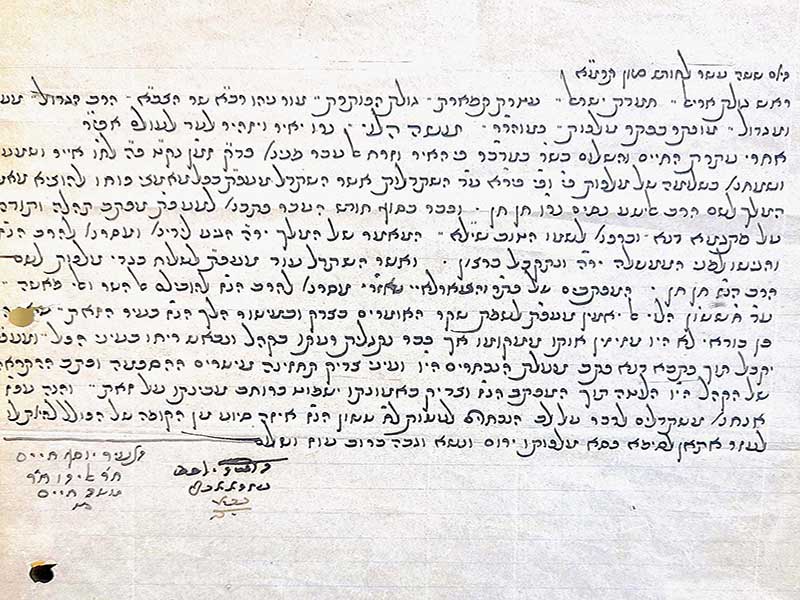
This letter was written in the month of Sivan, 1881, coinciding with the heat of chaos and turmoil that enveloped the Iraqi Jewish Community.
Leeser is best remembered for his extensive English translations and prolific writing for the American Jewish community, having authored numerous books and translations, edited a newspaper and full translations of the siddur and Tanach in an era where books written by Jews in English were nearly non-existent.

The map is rather rudimentary, with just a border and a few place names, but its appearance in print was a major achievement, anything other than text was very labor-intensive to include in the printing blocks of the day and thus costly.
Another well-known example that I obtained recently is the first edition of the Shu"t Meshiv Davar, containing the responsa of R. Naftali Zvi Yehuda Berlin (1816-1893), best known by his acronym the Netziv, who served as rosh yeshiva of the Volozhin Yeshiva for decades.
It appears that while the original responsa presented here was the original response that was sent, in preparation for printing many changes were made and effort was made to make the text easier to understand.
The fragment I sold was from the commentary of the Ralbag, Levi ben Gershon's (1288-1344) commentary on the book of Iyov, with handwritten annotations and additions in the Ralbag's own handwriting!
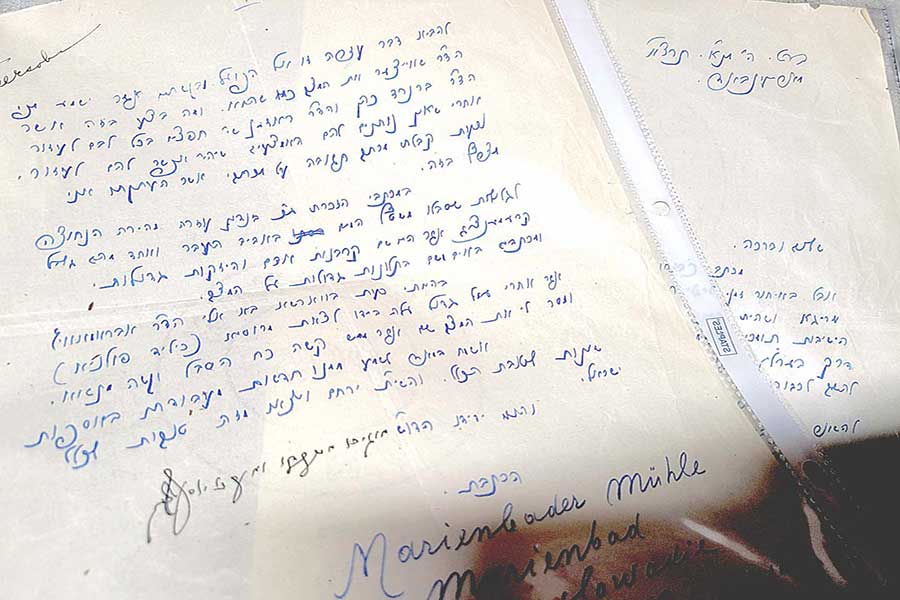
While nearly every correspondence of the Rayatz was collected and published for posterity in his Igrois Kodesh, this letter appears to be unpublished and the discussion within lost until now.

What I found most interesting about this letter that Rav Meir Shapiro also wrote down for himself many inscriptions. One side lists an outline for a sermon or shiur he was giving, with a brilliant array of sources jotted down in brevity, stringing together a concept and theme for his lecture.

While I wasn't able to find confirmation as to his appearance at the event, it is worth noting that R. Kahaneman kept a relationship with the Rayatz's successor, R. Menachem Mendel Schneersohn, and there are records of their meeting and friendship until the passing of the Ponovezher Rav, in 1969.

The New World was ripe for change, isolated from the old communities in Europe and with a steady stream of immigrants, it wasn't long before efforts to create change in the Jewish tradition were being pushed.
Though safely outside Iran when the revolution broke out in Jan 1979, Habib returned to Iran to be with his community and lead them through the turmoil.
Titles pages weren't in use in printed book until decades later, but the opening page features a beautiful floral border.

A small piece of paper with his handwriting that I sold this week was a result of an unusual scenario which he wrote about in his Mor Uktzia (siman 218 in his commentary on Shulchan Aruch).

For centuries, this work was feared lost, until in the last decades a condensed version of this extensive work was discovered and published in 1982, under the title Mekor Chaim.
A string of letters I had acquired recently, sent by Rav Baruch Ber Leibowitz (1862-1939) to a famed American Philanthropist and supporter of Yeshivas throughout the world, Abraham Meyers, details the conditions that a European yeshiva in the 1932-1933 period had to endure.
Based in a large part on such works in German that were popular at the time, the author was tasked with describing things in Hebrew that were yet to be written about in the language.
The word mugah can indeed be found in many of the copies of the early editions of the Chofetz Chaim's publications, both in books that he authored himself or books that he had published, such as those of the Sha'agat Aryeh and Asifat Zekenim.
It is interesting to see how the network developed a life of its own and perhaps due to the distance and slow communications, decisions and the hiring of new emissaries was done without the knowledge of the organization's heads back in Jerusalem.
While the Jewish community in Amsterdam was founded first by Jews escaping from Spain and Portugal, the city was relatively tolerant at the time, and became a refuge to many Jews from different lands. In a short time, there was a substantial Ashkenazi community as well.
Despite the Brisker Rav's known anti-Zionist stance, it is interesting to see the respect and honorary titles he bestows upon Rav Herzog, the official Chief Rabbi of Israel at the time.
This book has ownership markings and signatures of Milka Paks, wife of Meir Paks, the protagonist of a famous agunah case that the Chasam Sofer presided over during his period of rabbinate in Mattersdorf.
Chief Rabbi Heller was tasked with collecting the fines from the local Jewish community, with the brunt of the cost being placed on the wealthier class of the community. This led to much friction and complaints from the rich merchants who felt they were being burdened disproportionately.
This prayerbook, with an English translated by Isaac Pinto, is the very first prayerbook printed in the New World and the first translation into English.
The very first Hebrew book printed in London for Jewish use, this publication was named Ma'aseh Rav, and was printed by a gentile printer.
The impact of his work was great, to the extent that several Christian Hebraists translated the work, and several such manuscripts are still extant.
Finding the signature of the Chida (or Chid”a, as it is an acronym), R. Haim Yosef David Azulai (1724 – 1806), is one of the pleasures in life that I am to repeat to infinity.
He also gave thousands of dollars each to existing 23 Jewish congregations in 14 states – especially the Newport, RI synagogue, where he endowed the cemetery in which he was laid to rest, the final surviving member of the Touro family line.
Antiquarian booksellers are often propelled by the excitement that occurs when you stumble across an important discovery that sheds light on otherwise unknown areas.
An unpublished manuscript I acquired recently by one of the greatest Italian Rabbis of the 18th century was an exciting find for me. Being a collection of halachic rulings and chiddushim, it was written by Rabbi Yishmael Ha-Kohen, rabbi of Modena.
In some of his book catalogs that have survived, as well as ads he placed in newspapers promoting his bookstore, we find many titles from European presses of the day, indicating that he was in close contact with the printing presses of Europe.
He was a prolific writer, writing more than 160 books, many of which were printed.
These calendars, printed in the late 19th and first half of the 20th century, shed a bright light on the life in these unique communities and cultures and the language spoken by the Jews within, Ladino (Judeo-Spanish).
In the Shulchan Aruch, the Rema forbids marriage with Karaites, though historically, we have many records of Karaites rejoining the Rabbinate community and numerous rabbinical authorities have been recorded as allowing such marriages.
This Letter was written by Rabbi Chaim Oizer Grodzinsky, dated 1938, a few months before his passing.
While the provenance of this handwriting was good, having been owned and kept within the family of the Ruzhin/Sadigura rebbes, authenticating such handwriting can be a challenge, being that almost no handwriting of his is known.
Other than the main subject of this sefer – brilliant commentary on the Mishneh Torah of Maimonides – the volume's pages were filled by the author with various other content, which I found most fascinating.
Despite odds stacked against the work being written and published, it managed to survive and has become a classic in Torah commentary, being both brilliant and original in its content.
Best known for his publication of many works of the Vilna Gaon, he was also the first to publish a Jewish edition of the Bible that was published by religious Jews and for religious Jews in Eretz Yisrael.
The papal decree also shifted the center of Talmudic studies to Poland, where the Jews were still allowed to study Talmud and many of the classic commentaries on Talmud were written and printed here in this era.
Reading through correspondence of great Jewish leaders of old never fails to inspire, though for me, the most exciting letters are the ones that are personal in nature and that deal with challenges of the communities they led.
While it is often compared to the Mishnah Berurah, as it served as the alternative to the Mishnah Berurah throughout the Sephardic world, it differs greatly both in structure and approach to halacha.
Despite thousands of years of exile and persecution of the Jewish people, the Tanach we have today is remarkably intact and precise and demonstrably the same text used by our ancestors thousands of years ago.
This tome can thus serve as a study of the evolution of the Sephardic Hebrew script, so very different from those used by the Ashkenazi Jews in the nearby countries of Central Europe.
The author had messianic ambitions and the book contained many prophecies and doomsday projections of what will befall world Jewry if they do not repent.
I reiterate the statement I have made on numerous occasions... that a synagogue with a mixed seating arrangement forfeits its sanctity and its halachic status of mikdash me'at (a sanctuary-in-miniature), and is unfit for prayer...
The document was written by the Noda Beyehuda, to his employers, the parnassim (community leaders) of Prague, confirming receipt for his salary as Chief Rabbi of the city.
Occasionally there are extraordinary purchases, which cause even an experienced bookseller to get emotional.
R. Tzvi Hirsch Katzenelebogen was born in to a wealthy family in Vilna, though a rabbi and associated with many of the greatest Orthodox rabbis of the day, he was also from the first to embrace Haskalah worldview.
At the end of Vayikra, several blank leaves were bound, containing eight handwritten pages, with a detailed report of the extreme weather conditions during the autumn and winter of the following years: 1839, 1842, 1844, 1847, 1850, 1852, 1854, 1855, 1856, 1860 and 1861.
At end of his writings in this volume, R. Guttentag writes in Hebrew "These comments were written in the city of Kolshek, in 1903, in my stay there for a few days while in hiding from the ambushing Russians who were searching for me to conscript me to the Army."
The Jews of Ponovezh were from the first to suffer. In the spring of 1915, the Germans had approached the Baltic coast, Zeimelis and Bauska. Nikolai Nikolaevich, the Tsar’s uncle, had to explain the defeat and he accused all Jews as being spies and expelled them all in 24 hours.
The Jewish Agency has accepted upon itself the responsibility for the children of the diaspora, to bring them to Eretz Yisrael and settle them in Eretz Yisrael.
His few months in Riga, from Dec 1939 to early 1940 when this letter was sent, found the Rebbe in the midst of a huge displacement of Jews and every attempt was made to ensure the escape of every person possible.
Omaha's relative isolation as a Jewish community allowed Rav Grodzinsky to focus more of his time on his writings, and in the ensuing decades, he wrote and published an impressive array of halakhic works.
In 1939, escaping the Nazi invasion of Poland, Rav Baruch Ber, already in ill health, led the Yeshiva to the safe haven at the time of Vilna. Shortly after his arrival, he passed away, and tens of thousands attended his funeral in the main shul in Vilna.
While demographic shifts and the rise of the internet has eradicated any Jewish book-row, this visitor log allowed me to recreate in my mind the world that was, and perhaps one day will be again.
Despite its importance, the book was not reprinted from the 16th century until the latter half of the 20th century.
Using the most modern method of recording, his recording device being the first such in the Holy Land, he found a group of Yemenite Jews to sing for him in return for payment.
By WWII, there were four synagogues – one still exists today – and a well maintained Jewish cemetery.
R. Asher Anshel ben Mordecai Ashkenazi (1833-1901) was a grandson of the renowned R. Moses David Ashkenazi (c. 1780–1856) who was born in Galicia where his father Asher served as rabbi.
When the German Army took Lublin during World War II, they stripped the interior and burned the vast library in the town square.
The issue Stybel encountered was crooked book dealers who were buying quantities in Poland at reduced rates and then selling them in the States at a reduced price relative to the price Stybel was attempting to sell it at.
While the Malbim's fame rests on his commentary on the Bible, he was first and foremost a posek and defender of halacha against the many attacks it was facing from the Reform in his era.
The Lodz Ghetto, the second largest after that of Warsaw was sealed off from the world on April 30, 1940, with the Jews and Roma locked within.
In Sansan Leyair published by the Hid"a first in 1794, a version of this prayer appears but from a man's perspective, of a man praying on his wife's behalf.
The book's theme is the Jewish star, the Magen David, and it features prominently on the cover and title page of the book.
Despite being the highest paid chazzan in history at the time, Rosenblatt was forced to declare bankruptcy in 1925.
This document was written on behalf of a shada"r, (i.e. shelucha d’rabanan – rabbinical agent), an emissary sent by the Safed community to procure funds for the Jewish community.
Shatzkes would read the book to friends and it was very well received and became known in the circle of Jewish writers in Kiev.
The mission of Am Olam was to establish agricultural colonies in America and encourage Jews from Eastern Europe and Russia to move there and work the land.
Though the mitzvah is understood to apply only when the Jews are all residing in Eretz Yisrael, the Aderet in this work and in an additional book he wrote on the subject encouraged to idea of reviving the mitzvah of Hakhel in modern times.
"More German than the Germans" is what aptly described many German Jews from the 19th century up to and occasionally including the Hitler Era.
Describing the situation in 1918, R. Itshe Mater Korman, a Breslov hasid from Poland recalled, Then began the great dangers surrounding the Gathering in Uman – even from within the Ukraine – due to the bands of murderers, may their name be blotted out.
R. Haim Meir Mizrahi overcame many tribulations to be able to print this volume. A large portion of his writings were destroyed in the great fire in Izmir, which occurred on the 11th of Av, 1851.
Many authors who had no living descendants had a particular urge to write a book, both to leave a legacy and in the hope that the publication may serve as a merit to be blessed with offspring.
Beginning in 1934, all Jews who were able to emigrate from Germany were blocked from removing any major assets or funds. In lieu of their assets, they were issued "Konversionskasse," a sort of promissory note supposedly backed by the Reichsbank...
Following the great tragedies and deaths, many of the survivors were left destitute and homeless, with many traveling west or south. An indirect result of the tragedy was the arrival of many great rabbis as refugees in the Jewish communities of Central and Western Europe.
The title page tells of the interesting background to the writing of this work and the travails of the author that led to it.
Printing a sefer in centuries past took extraordinary effort and commitment; the stories behind the printing of many of these books tell tales of immense self-sacrifice.
This occasion, Mrs. Kass related years later, gave the impetus to the present-day Kosher Hotel arrangements for larger public functions.
One article implores married men in the armed forces to write up a divorce in advance of their deployment in the event that they are missing in action.
In his introduction he writes of the many troubles that befell him, starting with his having narrowly escaped his home in Alt-Ofen during wartime, leaving behind his books, belongings and worldly possessions.
A previous owner of the book apparently found several passages of the book not to his liking, and these passages were neatly burned out.
While the student body at many of the major American yeshivas was slowly growing in the post-war period, the Selective Service draft resulted in a great portion of the students continuing their studies indefinitely to avoid the draft.
A cache of documents I acquired this week tells of the efforts of a group that during World War II founded the organization Sabbath Observers in Civil Service to defend and support those in the U.S. Military who were Sabbath observant.
Schwartz spent the coming years traversing the country, studying the history of its villages and towns and attempting to determine the locations of biblical sites.
These books constituted a complete collection of texts necessary for everyday Jewish life, something that had existed among the Western Sephardim and Ashkenazim for over 200 years.
Shem-Tov ibn Falaquera was a great Jewish Spanish philosopher and author, best known for his strong defense of the Rambam in a period when Maimonides was still under continuous attack by the opponents of the study of philosophy.
The haskamot note that this is the first work in Ladino geared to women, despite the era being the height of the Ladino printing period, with numerous rabbinic as well as fictional works being published.
An Italian Jewish physician and a great scholar, dei Rossi used critical methods to analyze the Aggadah of the Talmud, not understanding the literal meaning of the text.
Written from a Muslim perspective, it was published by the Supreme Moslem Council (with the notorious Mufti of Jerusalem, Haj Amin Al-Husseini, at its helm), and it acknowledges and emphasizes the Jewish history of the Temple Mount.

While little of it remains today, Maine's larger cities as well as many nearby towns had thriving Orthodox Jewish Communities in the early 20th century.
In 1617, French nobleman Concino Concini, Marquis d'Ancre, and his wife Leonora Galigai (who were not Jewish) were brought to trial for political reasons and accused of witchcraft and "Judaizing," and were subsequently killed.

What a glorious sight it is to see Jewish boys raised in this land...
This volume records the milestones of the life of a German Jew who left his family and homeland in 1853 to try his luck in the New World.
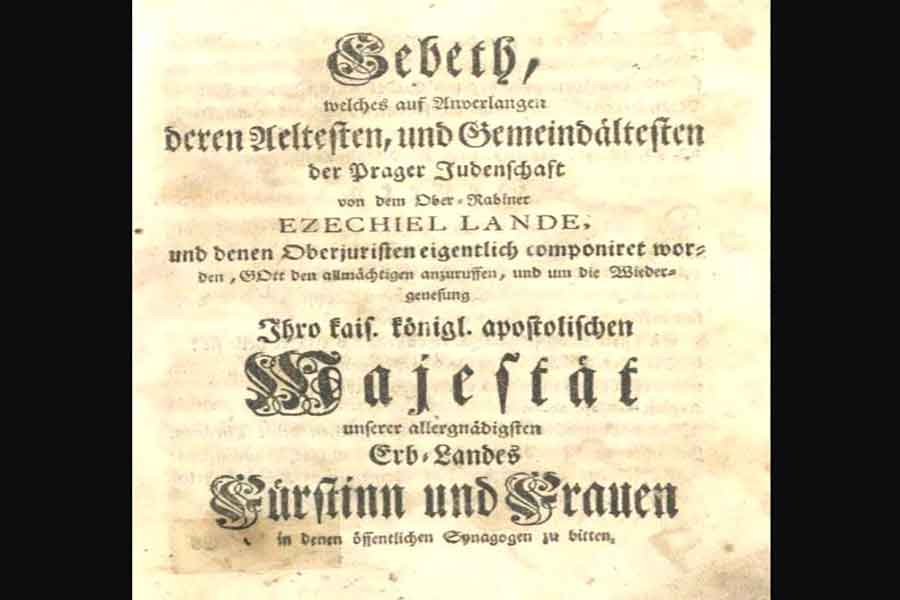
What is unusual in this order of prayer is that the Empress Maria Theresa is recalled as one of the most antisemitic and hostile rulers in modern Jewish history.
During the initial year-and-a-half of its existence, the Vaad concentrated its efforts on assisting the over 2,600 Polish rabbis and yeshivah students who had escaped to Lithuania, and trying to arrange their emigration overseas.

This manuscript of approximately 450 pages is dated 1891. It contains 32 chapters, written under the pseudonym Yeshay Ben Amotz, perhaps a play on his last name Schaikewitz.
Deinard's antiquarian activities, which involved constant travel throughout Europe, the Orient and America, gave him a unique acquaintance with scholars, private collectors, fellow booksellers and libraries.


 October 9, 2026