יום שבת, כ״ט תשרי תשפ״זSaturday, October 10, 2026



Follow Us


Israel Mizrahi is the owner of Mizrahi Bookstore in Brooklyn, NY, and JudaicaUsed.com. He can be reached at JudaicaUsed@gmail.com.
Read More
The manuscript, written in the late 19th century, contains a varied collection of songs in Arabic but written in the Hebrew alphabet, using the cursive Solitreo script.
Jews were among the first Europeans to settle in Bulawayo; the first white child born there, in April, 1984, was Jewish.

When his grandfather passed away, Dov Yehuda Daina replaced him as judge and religious authority. He was raised in Slutsk during the first eleven years of his life and in fact began studying at the Slutsk yeshiva.
Per legend, the night following their refusing to give approbations for this work, the rabbis of Jerusalem were visited by R. Yaakov Abuhatzeira in a dream in which they were reprimanded for their refusal.

Much has been written about Rev. Mrs Citron and her devotion to publishing her father's writings.
When the book was first published, the author's contemporaries in Egypt upon reading the book found that the author used harsh language in many places against other rabbis and their opinions.
This volume, Land Israel, by a Jewish author, Ludwig Strauss, was published in Berlin in 1935, during the Nazi period.

For a time, cultural life at Theresienstadt was allowed to develop. Authors, scholars, musicians and Yiddish theatre actors gave performances.
The author printed this story that happened to him on the title page of every book he published after this event.
Over the generations, German Jewry had accumulated numerous different Selichot prayers, and the custom developed to rotate the selections for each year...
The mis-attribution is the result of a book titled Shnei Hame’orot published in Kishinev in 1896.
Da Bologna was not the most brilliant of censors, and the Jewish Encyclopedia mentions several instances of his ignorance...
The New York Times reported that the run was based on a false rumor spread by a small local merchant, a holder of stock in the bank, who claimed that the bank had refused to sell his stock.
The shtadlan served as an intercessor for the local European Jewish community in matters that related to the local government.
The community was unusual, though, in the large number of adults that grew up without a proper Jewish education, many of whom were unable read and recite the Hebrew prayers. The response was a flurry of printing in the Spanish and Portuguese languages, such as this prayerbook.
The map was created for an earlier edition of this Haggadah, first printed in 1695, a birth of a new trend of Haggadot publications, with illustrations and iconography.
One custom that gained popularity during this time was the practice of saying additional prayers and selihot in the early mornings.
One such volume I recently acquired is a very fine copy of the responsa of the Noda Beyehuda. The title page sports the signature of a noted Frankfurt rabbi and dayan, Rabbi Moshe Meintz (1805-1886).
In World War I, an estimated 100,000 German Jews served in the German Army of which over 12,000 were killed.
The volume, published in 1898, is a first edition of Hakrvay's Yiddish-English Dictionary, an indispensable aid for American Jewish Immigrants.
‘I read it and became anti-Semitic…. In the poverty-stricken and wretched Germany of the time, youth looked toward America, and it was Henry Ford who to us represented America.’
While today we hear of shomer Shabbat baseball players, senators and ambassadors, life for a shomer Shabbat Jew in the United States was often an uphill battle.
Following the Chmielnizki pogroms in 1648-49, the Vaad Arba Aratzot (Council of Four Lands) reinstated the 20th of Sivan as a fast day to commemorate the pogroms and suffering the Jewish community underwent during this period.
Rabbi Baruch Rabinowitz would later be deposed by his chassidim for Zionistic leanings.
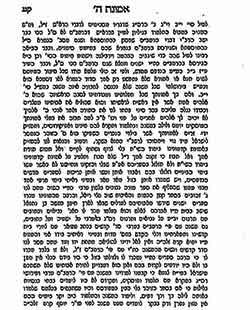
Both camps produced polemical works defending their positions, and one rare publication I acquired this week, titled Emunat Hashem, published anonymously, was a defense of the Kabbalah and an attempt to refute R. Yihya Qafih's writings in his Milhamot Hashem (1931 Jerusalem).
A handful of books, all exceedingly rare, were printed in the 16th century in Fez, Morocco, and possibly in Egypt by Jewish exiles from the Iberian Peninsula. Following that brief period, no Hebrew books were published until the Chok Leyisrael in 1740.
An 1828 edition of the Peri Megadim printed in Lemberg that I recently acquired contained a beautiful inscription on the free-end with the writer describing how this book was gifted to him by his beloved wife in honor of Rosh Hashanah 5631.
The first sefer to systematically list the halachic portions of the Zohar, Yesh Sachar was printed in 1609 in Prague, and authored by R. Yisochor Baer ben Petachiah Moshe of Kremnitz, Hungary (d. before 1648).
The new reality of Jews living in the land of their fathers led to the publication of his Pe'at Hashulchan, a work dealing with halachot of the Land of Israel, particularly shemittah...
The publisher, Rabbi Aron Hacohen Margolies (Perl), a resident of Debrecen, writes how the Rabbenu Bachya was nearly forgotten due to the unavailability of his writings...
As the war neared its end, the Vaad Hatzalah started focusing on assisting the Jews that survived the atrocities and were stuck in the Displaced Persons Camps in Germany.
A keen observer and master educator, the author describes the dire straits and danger in the future of Jewish education in the inter-war period in Eastern Europe...
In 1927, Rebbetzin Shterna Sarah Schneerson witnessed the arrest of her son by Stalin's henchmen, when he was taken away and sentenced to death for his efforts to keep Judaism alive throughout the Soviet empire.
By the end of the Civil War, Ahavath Chesed was ready to hire its first permanent rabbinic figure and, in 1866, Dr. Adloph Huebsch came from Hungary to assume the helm.
Jews in the United States were on both sides of the slavery debate in the decades before the Civil War.
It’s a sacred Jewish custom to study on the nights of Shavuot and Hoshana Rabba; to read from Torah, Nevi'im, Mishnah and Talmud, Aggadah and Kabbalistic books…
When Algeria declared its independence from France, the situation for Jews in the country became dangerous almost immediately.
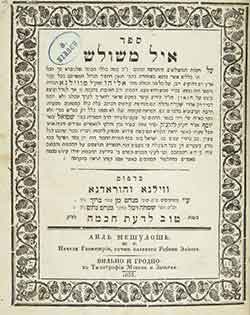
The Vilna Gaon is known to have valued all fields of knowledge and educated himself in them as tools to understand the Torah.
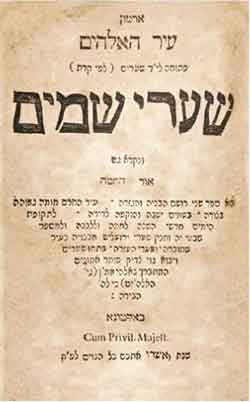
The Yaavetz was unusual for a man of his stature, not holding a rabbinical position but rather supporting himself by publishing books.
A widespread custom at the time among Syrian Jews was to have a pizmon written and composed in honor of major life-style occasions such as bar mitzvahs and wedding celebrations.
The author writes in his introduction that he believes Sephardic Jews need to view themselves as Levantines, no longer as Sephardim, and adapt and modernize themselves to continue to be competitive in business.
Remarkably, I just came across a fascinating remnant of the ghetto’s defiant Jewish spirit this week: a Russian-Yiddish Dictionary.
Shevile Olam Chadash gives us insight into the widespread longing for the New World felt by the oppressed Jews in Eastern Europe...
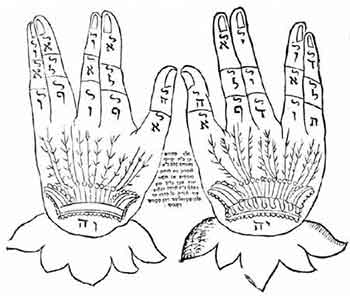
This printing is remarkable because of the many illustrations and diagrams depicting Kabbalistic ideas.
R. Bakst raised funds for the yeshiva in Cleveland, OH, and its environs, and this letter, requesting assistance, describes the sorry financial state of the yeshiva.
After his passing, the library changed hands a few times but was eventually cataloged in Koheleth David and subsequently purchased by the Bodleian Library in Oxford in 1829.
Orthodoxy in America at the time was in a dismal state, and R. Jacob Joseph's courageous attempts to raise the standards of the kosher meat industry faced fierce opposition.
A bookplate on the free-end of a copy I just acquired states that it was donated by the kollel to the Beit Medrash in the Windsheim, Germany, D.P. Camp.
The rest of his work remained in manuscript form, part of which is currently in the possession of the National Library of Israel.
As Persian Jews lacked much of a printing press of its own, Morocco became the only country that still had an active Hebrew press that was not under an Iranian trade embargo.
A traditional prayer used by many doctors and pharmacists to this day is attributed to the Rambam and attests to his devotion to his patients.
You should know, my beloved children, that our journey to the Holy City of Jerusalem was very difficult. It was a test like the binding of the Patriarch Isaac, as written in the Torah, ‘Go forth from your native land...
The response and impact on the general population and culture was swift and lasting, and within a few months’ time, publications came off the printer to commemorate the loss.
On both sides, Jews were accused of being traitors and, by the time the war ended, millions of Jews were displaced and impoverished while anti-Semitism flourished.
Eichler, seeing the approaching devastation, seems to have stamped his books with this message in the hopes of being able to reclaim them in better days.
Prenumeranten can often be a great source for finding inter-community relations and genealogy, allowing us to see who lived in what cities when, and what type of literature they supported.
His famous work by which he’s called today – Sdei Chemed – is a comprehensive rabbinic encyclopedia that contains correspondence with hundreds of the leading rabbis of his day.
He also discusses whether one may perform a bris on children whose father is Jewish but whose mother is not.

One of the Yemenite Jews’ first projects upon settling in Eretz Yisrael was printing the Taj (whose literal translation is “crown”).
In the New World – from the late 1800s through the 1950s – there were many attempts to create Jewish farming settlements as an alternative to the clusters of city tenements many immigrants found themselves in.
The lone surviving members of the entire family clan was one granddaughter of R. Menachem Mendel and her elderly grandfather, whom she cared for in hiding during the war.
This copy has a beautiful intriguing inscription by the author to Leo Herzberg-Fränkel, a famous Austrian/Galician writer and journalist of the period.
The edition I acquired was published alongside the first complete edition of the Talmud published by Daniel Bomberg, a landmark in Hebrew printing which standardized the layout of the Talmud daf.
Daily, he would lie in a coffin to remind himself of the day of death and dispel any thoughts of haughtiness.
This rare Yiddish edition was translated anonymously, and since a romantic view of the New World was common in prospective Jewish immigrants...
His general knowledge drew the ire of many chassidim, and one can find sharp attacks against him in chassidic writings of the day and equally vicious remarks of the Maharatz Chayes towards the chassidim of his era.
Over the course of the 18th century, the Ashkenazi population of The Hague grew to surpass that of the Portuguese, the latter being the earlier and more establishment community in the Netherlands.
We can see that the rabbis in the Talmud themselves understood and found error in the practices of those times.
Under his signature appears the address 50 West 120th St. in New York City – his address in Harlem when Jews were a dominant presence in the neighborhood.
Publishing a linear translation in early printing was a remarkable achievement considering the primitive printing process available at the time.
The letter is written on behalf of Chinuch Atzmai, the independent education system of the charedim in Israel which was led at the time by Rav Ahron Kotler.
In post-1917 Russia, Judaism and Zionism (and the Hebrew language) came under attack, so manuscripts such as this one often had to pass secretly from hand to hand.
Surviving the war with Rudolf Kasztner's assistance in Switzerland, R. Weissmandl made every effort to alert the world to the Nazi’s crimes, mostly to deaf ears.
Coffee wasn’t the only reason societies of the kind described above proliferated during this period.
This “Kehillot Moshe" edition contains an astounding 36 different commentaries on Tanach as well as the complete introductions of each of these commentaries, a feature often lacking in other Mikraot Gedolot editions.
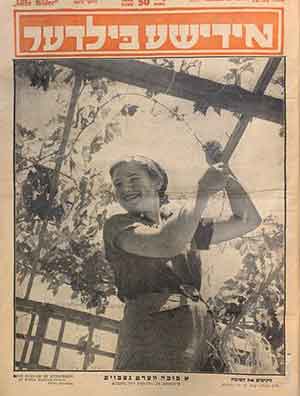
I just acquired a full run of the Yiddish periodical Iddishe Bilder, published in Riga, Latvia, between May 1937 and September 1939.
This week, I acquired a splendid copy of Synagoga Judaica, a Latin book published in 1680, authored by Johannes Buxtorf (1564-1629). This book scrupulously documents the customs and society of German Jewry in the early modern period. Synagoga Judaica is probably the most famous book from a long forgotten genre of books written by Christian Hebraists who had […]
It is always an emotional moment for me when I find a book whose owner was a Holocaust victim as it may serve as the only tangible memory of the deceased's existence.
Over the next few years, his interest and admiration for the Jewish people grew, and he published many publications in Japanese on Jews and Judaism.
Because of Hungary's relative safety in the first five years of the war, numerous sefarim were amazingly published there even as the Holocaust ravished Jewish life elsewhere.
While codifying and summarizing halachot for easy reference seems natural today, it was met with fierce criticism from some of the greatest gedolim centuries ago.
In it, the anonymous translator notes two objections voiced against publishing Jewish texts in Ladino...
He recorded the information he compiled regarding sefarim and their authors in Shem Hagedolim, which contains an alphabetical list of authors of sefarim followed by a list of known sefarim.
He started publishing a set of Yerushalmi with his commentary and others in 1899, but found himself lacking funds to print the final volume.
A keen and careful observer, he noted in detail Yemenite Jewish life, including its educational system, manner of dress, minhagim, and unique pronunciation of Hebrew.
In his introduction, the author writes that he had no intention to publish the work, thinking it unworthy of publication.
The psak concerned a very wealthy elderly Jew who passed away childless, leaving his wife in need of yibum or chalitzah.
This sefer is notable for being the first published Hebrew book to include a portrait of its author.
He was reputed to have had a photographic memory, with the contents of each sefer he handled committed to his memory.
This week I acquired a work titled Mesharet Moshe, published in 1858 in Koenigsberg, which today is known as Kaliningrad, Russia.
Involved in numerous controversies in the local Jewish community, he was a prolific author and active on behalf of the poor Jewish immigrants who were arriving in droves from Eastern Europe at the time.
Sephardic and Near-Eastern communities originally recited the entire 82 stanzas of the poem on Shabbat Zachor in the middle of the final beracha before Shemoneh Esrei.
Sam Hayim, based on the writings of R. Hayim Palagi (1788-1868), attempts to explain why the earthquake took place;
I recently acquired a fascinating work titled Et Ketz, which was printed in Amsterdam in 1710. Its author is R. Isaac Chayim Cantarini of Italy (1644- 1723), a rabbi, physician, and preacher whose sermons were said to have been attended by both Jews and Christians. His disciples included the Ramchal, who wrote a hesped for […]
The copy I acquired is notable because it is uncensored, which is rare for a Masechet Avodah Zarah from the first few centuries of printing.
It was produced for a special prayer service convened at the Spanish & Portuguese synagogue in Amsterdam on December 2 to pray for the success of the Dutch Kingdom in its war against the Belgians.

When the Rogatchover Gaon passed away in 1936, his daughter left the safety of her home in Israel to return to Dvinsk, Latvia, to assemble her father’s many unpublished manuscripts.
The letter describes the yeshiva’s dire situation, precluding it from spending money on books and forcing it to ask published authors to send copies of their books to the yeshiva as a donation.
The tribute Sam writes to his father in this book, though loving and respectful, sounds akin to what someone might write about viewing the pyramids from afar with a telescope.
Since this woman was not capable of receiving a get due to her mental state, her husband couldn’t marry another woman and was forced to raise his children alone.


 October 9, 2026