יום רביעי, י״ט תשרי תשפ״זWednesday, September 30, 2026



Follow Us


Rabbi Fuchs learned in Yeshivas Toras Moshe, where he became a close talmid of Rav Michel Shurkin, shlit”a. While he was there he received semicha from Rav Zalman Nechemia Goldberg, shlit”a. He then learned in Mirrer Yeshiva in Brooklyn, and became a close talmid of Rav Shmuel Berenbaum, zt”l. Rabbi Fuchs received semicha from the Mirrer Yeshiva as well. After Rav Shmuel’s petira Rabbi Fuchs learned in Bais Hatalmud Kollel for six years. He is currently a Shoel Umaishiv in Yeshivas Beis Meir in Lakewood, and a Torah editor and weekly columnist at The Jewish Press.
Read More

How can we be certain that any animal can be counted toward ma’asar beheimah when perhaps it is a treifah?
This separation between Kohanim, Levi’im and Yisraelim obligates us to honor kohanim.
The pasuk says that since the halacha concerning a Mechallel Shabbos was uncertain, the mekoshesh was placed in custody until the halacha was clarified.
The question still remains on how to reconcile all of the different drashos that are derived from this pasuk.
Generally there is an issur de’oraisa to erase Hashem’s name, but here the Torah explicitly permits it.
Only mitzvos that are clearly stated in the pasuk may be counted as one of the 613 mitzvos.
And yet, the Gemara in Megillah clearly states that the halacha about the tochacha only applies to the tochacha in Vayikra, not to the tochacha in Devarim.
The Minchas Chinuch first suggests that the obligation to be mafkir one’s produce may not be a time-sensitive mitzvah.
One difference between these two approaches is when one is aware that the fetus is a male, i.e. through ultra sound.
Is telling someone to transgress a rabbinic prohibition not considered bad advice?
According to the Rambam, the k’nas applies to any chametz on Pesach with which one could, in theory, transgress the aveirah – even if no transgression actually occurred.
One difference between Bnei Yisrael and Bnei Noach is that shiurim only apply to Bnei Yisrael.
The Gemara, in Kiddushin 57b, searches for a source to confirm that the bird that is to be set free is permitted to be eaten after the process is concluded.
The Gemara (Niddah 31b) states that Rabbi Shimon bar Yochai was asked why a woman who gives birth must bring a korban.
The Ritvah understands that the kosher signs are not just “signs” indicating that a fish is kosher; rather, they are what actually render the fish kosher. This may also be applied to the kosher signs of an animal, but the Ritvah does not indicate this.
If a korban chatas cannot be brought as a nedavah, how can one read the parshah of the korban chatas if he is not certain that he is obligated to bring one?
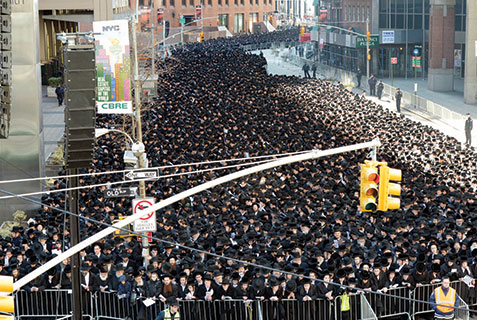
Following the Minchah (afternoon) service, led by the Vyelipoler Rebbe, Rabbi Yosef Frankel, rally participants recited several passages of Tehillim.
Rav Akiva Eiger questions why semicha is considered a mitzvas assei she’hazman gramma. While it is true that it must be performed during the daytime, this is not because the semicha per se cannot be performed by night.
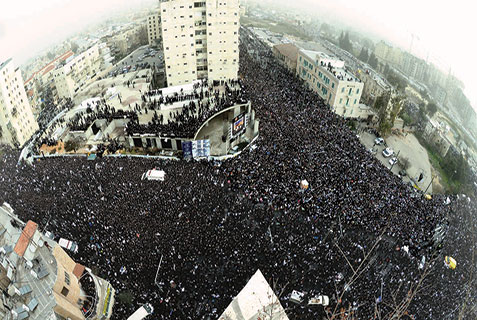
An anti-draft rally in Jerusalem this past Sunday, called for by the country’s leading haredi rabbis and billed a Million Man Atzeres (assembly), drew hundreds of thousands of demonstrators.
The Panim Yafos asks: since invariably one of the seven days of miluim must have been Shabbos, how was Moshe able to erect the Mishkan on Shabbos?
Rabbeinu Bachya points out that of all the materials that were donated to the building of the Mishkan, we do not find the inclusion of meshi (silk).
There are various requirements as to who can perform the shechitah. Optimally one should know the halachos involved and be a male over 13 years of age. If an individual is unfamiliar with the halachos of shechitah he should not shecht, as many problematic issues that he is unaware of can arise. He is also required to be an observant Jew.
When the Rambam wished to give an example of how a non-kohen could light the menorah, why did he have to say that a kohen took the menorah outside of the Kodesh?
Although a mitzvah may not require kavanah, it may nevertheless require lishmah.
This week’s parshah contains the source for the halacha of following the rov (majority). The pasuk states: “acharei rabbim lehatos.” The Gemara in Chullin 11a says that this pasuk is referring to the Sanhedrin where the halacha follows the majority opinion of the judges.
The Ramban writes in Parshas Yisro that the luchos were divided into two categories: the first side was mitzvos bein adam lamakom, and the second side contained mitzvos bein adam lachaveiro. The Ramban adds that the mitzvah of kibud av v’eim is on the first side because it is indeed a mitzvah bein adam lamakom.
There is a machlokes Rishonim regarding the halacha that women are obligated in mitzvos that af ha’im hayu b’osah haneis.
There is a question as to whether darkness is its literal meaning, or if it is simply the absence of light. The fact that light overcomes darkness is not an indication that darkness is merely a lack of light.
In this week’s parshah (Shemos 6:6) Hashem tells Moshe to tell the Bnei Yisrael the four leshonos of geulah: v’hotzeisi, v’hitzalti, v’ga’alti, and v’lakachti. The Mishnah in Pesachim 99b says that a poor man should be given four cups of wine, even from money that is allotted for tzedakah. Rashi there quotes a Yerushalmi in Pesachim that cites Rabbi Yochanan’s opinion that the four cups of wine that we are commanded to drink at the Pesach Seder correspond to the four leshonos of geulah as mentioned above.
This week we begin reading sefer and parshas Shemos. The parshah begins with the words “v’eileh shemos bnei Yisrael habaim Mitzraimah.”
This week’s parshah begins with Yaakov Avinu on his deathbed. He called for and requested of Yosef not to bury him in Mitzrayim, but rather in Eretz Yisrael. Although Yosef agreed to fulfill this request, Yaakov asked him to swear that he would keep his word, which he did.
In this week’s parshah Yaakov Avinu takes his entire family down to Mitzrayim. The Torah lists the family members who made this journey. On the list is Shimon’s son, Shaul. The pasuk refers to him as Shaul ben haCanaanis – the son of the Canaanis.
In this week’s parshah, Yosef is the ruler of Mitzrayim and his brothers come to purchase food from him, not realizing with whom they were dealing.
"Toras Hashem temimah” – The Torah, in all aspects, is perfect and complete. It need not bend or comply with any other system. In fact, since the Torah is the blueprint according to which the universe was created, other systems should be judged by their agreement with the Torah.
Toward the end of the parshah, we read that Yosef was incarcerated. While there, the sar hamashkim and the sar ha’ofim were imprisoned as well. Both men had dreams one night, which disturbed them the next day. Rashi tells us that they each dreamed the interpretation of the other’s dream.
At the beginning of this week’s parshah we learn that Eisav was coming with 400 men to attack Yaakov and his family. We are told of the many preparations that Yaakov took before this encounter. The pasuk says that Yaakov was very afraid, for as it is written: “vayira Yaakov me’od, vayeitzer lo” (Bereishis 32:8). Rashi tells us that this fear was not for his own life; rather this fear was that he might have to take other people’s lives. In Rashi’s words: “shema yehareg es acheirim.”
The Magen Avraham, in siman 42:3, says that one should not reverse the straps from his tefillin (shel yad and shel rosh), making the part that was originally tied as either a “yud” or a “daled” into the opposite end – which is either wrapped around the fingers, or just left hanging down. The reason for this is because the part of the strap that was tied as a “yud” had more kedushah.
Last week, Israel’s Habayit Hayehudi Party spearheaded a new nationwide marriage registration bill into law. The bill, the Tzohar Law, was passed in a 54-17 vote.
After Yaakov received the berachos from his father and was leaving the room, the pasuk says, “Vayeitzei Yaakov mei’eis penei aviv, Yitzchak – And Yaakov left the face of his father, Yitzchak.” Rav Meir Simcha of Davinsk wrote in his sefer on Chumash, Meshech Chachmah, that the reason why the pasuk used a strange wording – leaving his face – is because the Gemara in Yuma 53b says that when a talmid leaves the presence of a rebbe he should not turn his face to leave; rather, his face should remain in the direction of the rebbe. Rav Meir Simcha continues by citing the Gemara: Rava acted in this manner when leaving his rebbe, Rav Yosef. Therefore the pasuk is teaching us that Yaakov followed this same process.
Rabi Yosi ben Rabi Chanina says that the avos where misaken the tefillos. The Gemara quotes a braisa that supports this view and cites pesukim from which we derive that Avraham was mesaken Shacharis, Yitzchak was mesaken Minchah, and Yaakov was mesaken Ma’ariv. Rabi Yehoshua ben Levi disagrees, saying that tefillah was instituted to correspond to the korbanos.
The Gemara in Kiddushin 29a derives from a pasuk in this week’s parshah that women are exempt from performing a bris milah on their sons. The pasuk says: “ka’asher tzivah oso Elokim” (Bereishis 21:4). The Gemara takes from the word “oso” (him) that women are exempt. The Rishonim there are disturbed by the following question: why is it necessary for this pasuk to be written in the Torah when it is a mitzvas assei she’hazman gramma (time-sensitive mitzvah), which women are exempt from performing?
In this week’s parshah, Hashem commands Avraham in the mitzvah of bris milah. The pasuk says that if one does not perform a bris he will be chayav kares. The Rambam writes in Hilchos Milah (1:2) that one who did not have a bris milah performed when he was a child must do so when he is an adult. He is mevatel a mitzvas assei every day that he delays doing so.
The Rambam writes in Hilchos Melachim 9:1 that Adam HaRishon was commanded in six mitzvos, and Noach was commanded in a seventh. Adam was commanded to not do the following: worship avodah zarah, curse Hashem, kill, gilui arayos, and steal. He was also commanded to set up a court system. In addition to those commands, Noach was commanded not to eat from ever min hachai (a limb detached from a live animal).
The Mishnah in Sukkah 34b says that an esrog of urla (fruit from the first three years after the tree was planted) and that of terumah temeiah are unfit for use in fulfilling the mitzvah. The Gemara (35a) explains that this is because one of the requirements of the mitzvah is that one must be able to eat the esrog. Since one may not eat urla or terumah temeiah they are unfit for the mitzvah.
There is a mitzvah to eat on Erev Yom Kippur. The pasuk says that we should do ennui to our soul on the ninth day of Tishrei. The Gemara, in Yuma 81b, explains that the pasuk cannot be referring to the ninth day because we know from other pesukim that the ennui is on the tenth of the month. Therefore the Gemara explains that the pasuk is teaching us that whoever eats on the ninth day is considered to have fasted on the ninth and tenth days.
Many of the speakers described the vast chesed that Reb Shlomo performed on a daily basis.
The Mishnah in Rosh Hashanah 16a says that on the first day of the year (Rosh Hashanah), every human being passes in front of Hashem and is judged. The Gemara there (16b) says in the name of Rabbi Kruspadai that there are three sefarim opened on Rosh Hashanah – one for tzaddikim, one for reshaim, and one for beinonim. The tzaddikim are inscribed for life, the reshaim are written for death, and the beinonim must wait until Yom Kippur to see what the judgment on them will be. If they are “zocheh,” they will be inscribed for life; if not, they will be marked for death.
There is a famous pasuk in one of this week’s parshiyos, Parshas Nitzavim, which carries strong halachic ramifications.
At the beginning of this week’s parshah the Torah discusses the halachos of bikkurim. When one sees the first fruit blossoming, he is to tie a red string on that fruit, bring them to the Beis HaMikdash, and give them to a kohen. While there, he must read a passage from the Torah found in the beginning of this week’s parshah.
In this week’s parshah the Torah discusses the halachos of hashavas aveidah (returning a lost object). The Gemara in Baba Metzia 27b derives from the pasuk in this week’s parshah, which says that one who finds a lost object should hold it until he is derosh acheichah, that the finder must investigate whether the man who claims that the lost object is his is being truthful. The Torah accepts simanim (signs) that one can provide as proof that the object is indeed his.
The Rambam is of the opinion that a safek is permitted min haTorah. The rabbanan forbade one to take a chance and do something that is a safek issur. Many Rishonim disagree with this ruling and say that a safek is forbidden min haTorah. The Rishonim ask on the Rambam’s opinion from many places in Shas.
In this week’s parshah the Torah writes about the mitzvah to destroy avodah zarah. At the same time, the Torah says not to do avodah zarah to Hashem your God. As the pasuk says: “va’avaditam es shemam min hamakom hahu, lo sa’asun kein la’Hashem Elokeichem.”
In this week’s parshah we derive the mitzvah of birchas hamazon from the pasuk of “v’achalta v’savata u’veirachta” (Devarim 8:10). This mitzvah is to recite three berachos mi’de’oraisa and one mi’de’rabbanan after one eats bread made from the five grains (wheat, spelt, oats, rye, and barley).
In this week’s parshah and in Parshas Re’eh the Torah commands us not to add to the mitzvos or lessen them (bal tosif and bal tigra). For example, the Gemara in Sanhedrin 88b says that one may not have five parshios in his tefillin or five different species together with his lulav. The Ramban in Parshas Re’eh says that the pasuk in this week’s parshah is the main prohibition and the pasuk in Re’eh is referring to the korbanos.
This week we begin reading Sefer Devarim. The Gemara in Baba Basra 13b says that four blank lines must be scratched onto the parchment between each of the sefarim of a Sefer Torah (i.e. between Sefer Bereishis and Sefer Shemos).
In parshas Masei the Torah discusses the halachos regarding when one person accidentally kills another. The Torah says that a relative of the victim (goel hadam) may avenge the death of his relative by killing the murderer who acted accidentally. According to the Torah, the perpetrator must go to one of the arei miklat (city of refuge). While in the ir miklat the goel hadam may not kill the murderer who acted accidentally. If he does kill him while he was in the ir miklat, he will be liable for murder.
In this week’s parshah the Torah lists the different korbanos that we are to bring on the various different days of the year. In perek 28, pasuk 11 the Torah commands us as to which korbanos we must bring on Rosh Chodesh. In the times of the Beis HaMikdash, Rosh Chodesh was determined by the actual birth of the moon. Witnesses would testify before beis din that they saw the rebirth of the new moon, and beis din would pronounce that that day was Rosh Chodesh.
In this week’s parshah Bilam decides to approach Balak with the intention of cursing the Bnei Yisrael. En route his donkey refused to continue on the path, continuing to veer to the side of the road. At one point the donkey smashed Bilam’s leg into the wall. Bilam hit his donkey three different times. The reason that his donkey would not proceed is because it saw that there was a malach standing in the road with his sword drawn.
In this week’s parshah the Torah discusses many halachos of tumah. One halacha is that a person who is tamei may not enter the Mikdash. Doing so makes him liable for kareis.
In this week’s parshah the Torah tells us that Hashem told Aharon to redeem every firstborn child. This is known as pidyon haben. The Rema, in Yoreh De’ah 305:10, rules in the name of the Rivash that one may not appoint a shaliach to perform pidyon haben. Many Acharonim argue with this ruling and posit that one can appoint a shaliach to perform pidyon haben.
In this week’s parshah we read about the episode of the meraglim. The meraglim were sent to spy on Eretz Canaan to see if it was militarily feasible for the Bnei Yisrael to conquer the land by defeating the nations that were living there.
In this week’s parshah we read about the individuals who were tamei and thus could not bring the korban Pesach. They approached Moshe Rabbeinu and asked him whether there was anything they could do to bring the korban. Ultimately, Hashem told Moshe that they should bring a korban a month after Pesach, on the 14th of Iyar.
In this week’s parshah the Torah discusses the halachos of when one steals from another and when confronted in beis din, the thief swears falsely with his denial that he stole. This parshah was already taught in parshas Vayikra; however, there are two halachos that the Torah adds in this parshah to this topic.
In this week’s parshah the Torah tells us that the bechorim were replaced by the levi’im to serve in the Mikdash. The Torah says that there were 273 more bechorim than levi’im. Those bechorim could not simply be replaced, and had to be redeemed. Hashem told Moshe that each bechor should give five shekalim to Moshe, who, in turn, should give them to Aharon and his sons. With that, they would be redeemed.
In parshas Behar the Torah reiterates some of the halachos of ribbis, and teaches several new halachos as well. The pasuk says that one should not take ribbis from his fellow, he should fear God, “v’chei achicha imach – and your brother shall live with you.” The Gemara derives from the end of this pasuk that if one does charge ribbis and collects it, it must be returned.
This week I will be addressing a question from a previous column – with a new answer. The pasuk in this week’s parshah (Vayikra 23:14) says, “V’lechem v’kali v’karmel lo sochlu ad etzem hayom hazeh ad haviachem es korban elokeichem – And you shall not eat bread [etc.] on this very day until you bring the offering of your God.” This pasuk teaches us that all of the five grains (wheat, spelt, rye, oats, and barley) are forbidden from the time they are harvested until after the korban omer is brought.
Both of this week’s parshiyos discuss the various arayos – forbidden relationships. The Gemara in Kiddushin 67b states that if one attempts to perform kiddushin on one of the arayos, the kiddushin is invalid.
The Rambam writes the halachos of Sefiras Ha’Omer in Hilchos Temidim U’musafin (7:22-25). He says that there is a mitzvas assei to count seven complete weeks from the day that the korban omer was brought. The mitzvah is to count the days and the weeks. We count at night because the mitzvah requires that we count at the beginning of the day, which is at night. If one forgot to count at night he may count by day.
In this week’s parshah the Torah teaches us which animals are kosher and which are not. There is a machlokes Rishonim whether one may eat human meat. The Rambam derives from a pasuk in this week’s parshah that says that from any animal that has split hooves and chews its cud, “osah tocheilu – that one you may eat” – that it is forbidden to eat human meat.
There is a mitzvah to remove and destroy the chametz from one’s possession before Pesach. This is derived from the pasuk in Parshas Bo, “tashbisu se’or mibateichem” (Shemos 12:15). There are also two lavim associated with owning chametz on Pesach: bal yiraeh and bal yimatzei.
The Gemara in Pesachim 58b derives from the pasuk in this week’s parshah, “V’arach aleha ha’olah” that the tamid must precede all other korbanos. The drasha is from the letter “hei” that signifies the known one – in this scenario, the korban that is known to be the first korban.
In this week’s parshah the Torah discusses many different halachos that pertain to korbanos. Regarding the korban olah, the pasuk tells us that the entire animal must be brought on the mizbeach and is burned.
The Gemara in Shabbos 49b discusses different options regarding what the 39 melachos correspond to. One opinion in the Gemara holds that they correspond to the 39 times that the Torah uses the word “melachah.”
The Gemara says that anything made forbidden by a court must have an explicit permission put forth by another court in order for the prohibition to be removed.
This column is dedicated to the refuah sheleimah of Shlomo Eliezer ben Chaya Sarah Elka. This week we read parshas Zachor (Devarim 25:17), which details the attack of Amalek and the commandment for us to destroy any remembrance of them. There is a mitzvah to remember what Amalek did to us on the way when […]
If one holds the object of a mitzvah upside down he has not fulfilled the mitzvah.
One of the many halachos written in this week’s parshah is the prohibition for a judge to accept a bribe. The Torah testifies that bribery works and can blind the eyes of the righteous; thus it is forbidden to accept any form of bribery – even for one to judge correctly.
At the beginning of this week’s parshah the Torah says that when Yisro, Moshe Rabbeinu’s father-in-law, joined Bnei Yisrael in the desert, one “ish” (man) bowed to the other and kissed him.
In this week’s parshah the Torah informs us that after Bnei Yisrael miraculously crossed the yam suf, they traveled in the desert without water for three days. The Gemara in Baba Kama 82a expounds on this pasuk and explains that the word “water” is a reference to Torah. So the pasuk is actually telling us that Bnei Yisrael went three days without Torah – and they wilted.
There is a contradiction in the pesukim as to when makkas bechoros occurred. The pasuk in this week’s parshah says, “vayehi bachatzos halailah, v’Hashem hikah kol bechor b’eretz Mitzrayim… – and at chatzos of the night, Hashem hit every firstborn in the land of Mitzrayim…” (Shemos 12:29). This pasuk states that makkas bechoros occurred by night. The implication from the pasuk in Bamidbar 8:17 is that makkas bechoros occurred by day, for the pasuk says: “b’yom hakosi kol bechor… -- on the day that I hit all of the firstborn…”


 September 25, 2026