 September 25, 2026
 Catch-up Time & Far-Reaching Consequences


Parshat Chukat-Balak & Shiv’a Asar B’Tamuz
Israel and Chutz LaAretz went out-of-sync for Parshat HaShavua on the Shabbat that was the second day of the two-day chag of Shavuot in Chutz LaAretz. In Israel, on that Shabbat – the day after our Shavuot – we read Parshat Naso, while outside of Israel, Jews were hearing the Torah reading for the second day of Shavuot.
This coming Shabbat, we in Israel will read Parshat Balak, and in Chutz LaAretz, both Chukat and Balak will be read. The Shabbat after next, we all will be reading Parshat Pinchas. Back in sync!
Question: Is it Chutz LaAretz that combines Chukat and Balak to catch up to Israel, or do we in Israel split Chukat-Balak to slow down and get into sync?
Another question: Does it make a difference?
Answers: The one-year cycle of Torah reading and the rules for when some sedras are combined and when they are read separately is a system developed in Chutz LaAretz (in Babylonia) for Chutz LaAretz in the 2nd-3rd centuries of the Common Era. From around the same time, Eretz Yisrael had a three-and-a-half-year cycle. Israel adopted the annual cycle sometime between the 7th and 10th centuries C.E.
Therefore, the accurate statement of facts is that we in Israel split Chukat and Balak so that we can get back in sync. This difference is important for historic accuracy.
* * * * *
Before moving on, let me summarize the out-of-sync sedra situation (again). Out of the seven pairs of sedras that are sometimes read separately and sometimes combined, three of the pairs serve to bring Israel and Chutz LaAretz back into sync.
Chukat-Balak are combined only when Shavuot is Friday-Shabbat. This occurs in 28.57% of years. In those years, they are read separately in Israel. Chukat and Balak are never combined in Israel.
The other two situations happen when the first day of Pesach is Shabbat. In a shana p’shuta (a plain year of 12 months, one Adar), this occurs 18.05% of the time. When it happens, we go out-of-sync because we in Israel read Parshat Sh’mini, and in Chutz LaAretz the reading is for Sh’mini shel Pesach. (Sh’mini-Sh’mini – nice touch!) We in Israel will separate the double-sedra B’har-B’chukotai to get back into sync.
In a shana m’uberet (13 months, two Adars), it happens 9.98% of the time. In these years, the first available double for us to split is Matot-Mas’ei, creating the longest out-of-sync situation.
For B’har-B’chukotai and Matot-Mas’ei, there are other years when they are combined, just like they are in Chutz LaAretz.
One further comment in the FYI category: According to the Avudraham (a 14th-century Rishon from Spain and author of Seder Ha-Ibur), the original double-sedra was Sh’lach-Korach. At some point later, it was changed to Chukat-Balak.
That’s enough for now. (Maybe more than enough, but I get carried away with topics related to the calendar…)
* * * * *
Chukat has 87 p’sukim; Balak has 104. Combined, they have 191 p’sukim. That’s more than the longest single sedra (Naso, with 176), but second place to Matot-Mas’ei (244). The aliyot for Chukat-Balak are neatly divided, with each aliya being two aliyot of the sedras separately.
Chukat is a small sedra – the smallest in Bamidbar and ranked 43rd among the Torah’s 54 sedras. Balak is middle-sized, a bit below average (ranked 34th), the average per sedra for the Torah being 108.26 p’sukim.
Chukat has three mitzvot (as do two other sedras); Balak has none (as do 16 other sedras).
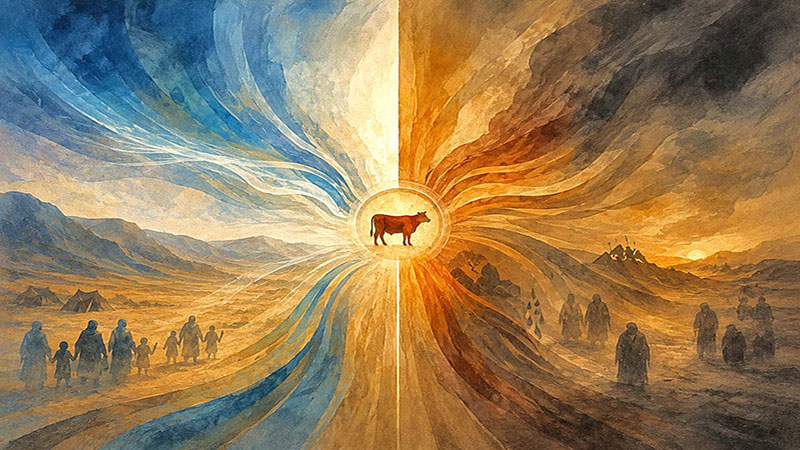
Let’s look at the sedras separately. Chukat begins with the topic of the Para Adumah, the red heifer whose ashes were mixed with mayim chayim (living waters) to produce a potion that was used – and will be used – as part of the purification process for someone who became t’mei meit, ritually impure from contact with a dead body. The mitzvah of preparing the Para Adumah potion (let’s call it PAP) is introduced by the famous phrase “Zot chukat haTorah,” this is the quintessential chok of the Torah. A chok (plural, chukim) is a mitzvah that is not easily understood and which we would not discover on our own with logic or common sense.
It’s harder to define than I thought… How about this: A chok is a Divine decree whose ultimate purpose exceeds human understanding, even though it may contain many layers of meaning.
Rashi quotes the Midrash Tanchuma as saying: “Because the Satan and the nations of the world (and, sadly, many Jews, as well) scoff at Israel saying, ‘What is this mitzvah and what reason does it have?’ – therefore it [here, the Para Adumah] is called a chok, [and we say] it is a decree [from G-d] to me, and we do not question it.”
As it turns out, our Sages throughout the generations have tried to explain even the most enigmatic of chukim, sometimes giving us a handle towards understanding the mitzvah, but there will usually be details of the mitzvah whose understanding still eludes us.
Another point to consider is that Rashi’s quoted statement of our commitment to heed G-d’s commands just because they are His commands can and should apply as the first aspect of Torah observance, not just with regard to chukim.
The opposite of a chok is a mishpat. Mishpatim are mitzvot that good people would come up with on their own, even if not commanded to do them. Pay for damages you caused – that is a reasonable rule to follow. It is a Torah mitzvah that society would probably develop on its own. Why would one pay for damages he caused? Because it is the right thing to do? Yes. But our approach even to mishpatim is first that it is a mitzvah. It is G-d’s command and I will do it just because of that. Then, I will do it because it is the right thing to do. Because I would want someone who causes me damage to pay for it. Because it is good for society. And so on and so on.
* * * * *
Look back to the two previous sedras. Sh’lach with the whole Meraglim fiasco and Korach with its namesake’s rebellion. When did those events occur? Shortly after leaving Egypt, during the early part of our sojourn through the Midbar. And when were we commanded to do the Para Adumah? Sources tell us that it probably predated Matan Torah at Sinai.
Now look at what follows the Para Adumah section of Chukat: the death of Miriam, the striking of the rock instead of speaking to it, Aharon’s death, further battles in the Midbar, and more... When did those take place? At the end of the 40 years. It is as if the Para Adumah mitzvot form a divider between two parts of the Midbar experience.
* * * * *
Parshat Balak is a different story. Literally and figuratively. It is made up of only two parshiyot. The first is a very long, 95-pasuk portion that is the story of Balak and Bil’am attempting to weaken the Israelites via the power of a curse, from the master of curses, Bil’am – 95 p’sukim describing their repeated attempts and failures to “bless” us.
There is something unique about this parsha (referring to the 95 p’sukim, not the whole sedra – as you will see later). Every event that we find in the Torah from the beginning of Sh’mot through to the end of the Torah was witnessed by millions of men, women, and children. From the enslavement and oppression in Egypt to the miraculous plagues to our first Korban Pesach to the Exodus to the crossing of the sea to the Revelation at Sinai to all that happened during the 40-year sojourn through the Wilderness – all of it was witnessed by the People of Israel. With the singular exception of the Bil’am-Balak episode.
Balak being afraid of the Israelites, sending messengers to solicit Bil’am to curse the people, sending a more prestigious delegation when Bil’am refused to come to him, the episode of the talking donkey, Bil’am and Balak on hilltops overlooking the multitude of Am Yisrael, building altars, sacrificing animals, Bil’am’s failed attempts to curse the People – to all of that, we were totally oblivious. We went about our daily lives in the Midbar, unaware that powerful people were attempting to destroy us. And unaware that Hashem had taken it upon Himself, so to speak, to protect us without our participation or even just our observation. When Par’o and his army pursued the People boxed in by the sea and mountains, we saw what G-d did. When Amalek attacked, we fought side-by-side with G-d. This time, He took care of things by Himself.
We only know this story because G-d included it in the Torah, the Torah which was written in full only at the very end of the time in the Midbar.
What comes to mind as I write (type) these words is an episode that happened a couple of months ago and was reported only last week. A deadly enemy explosive drone was entangled in an eiruv wire of an army camp and exploded without causing injury or worse. G-d is there and here, fighting with us and for us. Sometimes we see and feel it; sometimes we don’t.
* * * * *
And then comes the second parsha of Balak, the small nine-pasuk portion that describes the devastating results of Israelite men being seduced by Moavite women to the perverted, orgiastic worship of Baal Pe’or – G-d’s anger manifest in a plague that claimed 24,000 lives which was stopped only by the zealous action of Pinchas. (Stay tuned, next week – same time, same channel...)
After 95 p’sukim of almost laughable failure, Bil’am and Balak prevailed with the plan to get G-d angry with us, and do what they couldn’t do on their own. We shot ourselves in the foot, as the expression goes, or more seriously put, we are sometimes our worst enemy.
* * * * *
Let me end this week’s column with what is coming up next week on Thursday – namely, Shiv’a Asar b’Tamuz, the fast of the 17th of Tamuz.
The Mishna in Taanit states that five calamities occurred on the 17th of Tamuz and five on the 9th of Av. On the 17th of Tamuz, Moshe smashed the first Luchot; the Korban Tamid ceased; the city of Jerusalem was breached (referring to what preceded the destruction of the second Beit HaMikdash; the breach by the Babylonians occurred on 9 Tamuz – no separate fast was declared for that); Apostimus burned a Sefer Torah; and an idol was erected in the Beit HaMikdash.
Without further details and without listing the five events for Tish’a b’Av, let me make an observation. Both the 17th of Tamuz and the 9th of Av mark events that happened as part of the Churban, the destruction of the Temples. However, each list of five events begins with something that happened much, much earlier, back in the infancy of the Jewish People. The Luchot were broken as a consequence of the sin of the Golden Calf. The decree against the adult male population that they would die out during the wandering in the Midbar, was, of course, a consequence of the Sin of the Spies. I might suggest that both these sins resulted in a lack of faith, confidence, and trust in G-d. (This might be said of all sin, both communal and individual.) And that idea gives us an important starting point for our own introspections and reflections as the Three Weeks (Bein Hameitzarim) approach.
For Ashkenazim, there are mournful practices and restrictions during the Three Weeks, with a significant increase during the Nine Days. S’faradim (Eidot Mizrach) generally focus the mournful restrictions for the week in which Tish’a b’Av falls (Shavua she-chal bo), and some begin the mournful practices from (or right after) Rosh Chodesh Av.
One thing we must remember and include in our thoughts: We have been promised by G-d, via the navi Zechariya, that the four fasts related to the Churban will not only cease in the time of the Geula Sh’leima, but they will become Yamim Tovim – festive days. Our mourning during the upcoming period should not be viewed only as mourning for what happened a long time ago, but it should also challenge us to do our share to break the cycle and move forward toward the bright future promised and guaranteed. May we see it and rejoice, speedily, in our time.
Shabbat Shalom.