 October 9, 2026
 Categories: In Print / Featured / Parsha
Confession


The Talmud in Chullin (105a) quotes Mar Ukva who said, “I am like vinegar, the son of wine, relative to my father.” He was referring to his father’s practice of not eating cheese for 24 hours following a meal of meat, whereas he merely waited until the next meal before eating cheese. Incidentally, this is the source for waiting six hours between eating meat and dairy.
The question is: Did Mar Ukva crave the cheese so much that he couldn’t wait until the next day? On the other hand, there is no obligation to wait 24 hours before eating dairy. Why did Mar Ukva compare himself to vinegar, i.e. wine that has spoiled and has lost its value?
The Kochav M’Yaakov (the Dubno Maggid) suggests the following analogy. A down-and-out pauper in tattered clothes went from door to door collecting alms. At the end of the day, he barely had enough money to buy a piece of bread. One day he met a fellow beggar, who was also collecting. However, his friend was dressed nicely and carried an ample assortment of food in his bundle.
“What is the secret of your success?” asked the pauper.
The well-dressed beggar explained that, unlike his friend who knocked on the doors of people who were not much better off than he and could only give him pennies, he personally knocked only on the doors of wealthy people who were much more generous.
“How do you know where the rich people live?” asked the pauper.
“You can tell by the mezuzah on the door. The poor people have simple cases of wood or clay for their mezuzah. The rich people have mezuzah cases made of silver or gold.”
The pauper was amazed and thanked his friend for his wonderful advice. He borrowed money from everyone he knew, and bought himself a beautiful mezuzah case of pure silver. He then proudly showed it to his friend.
“What are you going to do with this?” asked his friend.
“I am going to put this mezuzah on the doorway of my house and poverty will no longer exist within my home. You told me that this is the mezuzah of the wealthy.”
“Fool!” exclaimed his friend. “The mezuzah case is not the reason why the people are rich. It only indicates that they are rich. If you don’t have food or clothing, the mezuzah case of silver is like a gold ring in a pig’s snout.”
In truth, one doesn’t have to wait 24 hours after eating meat to partake of dairy. However, Mar Ukva’s father was of the pious men who, as it says in Duties of the Heart (Sha’ar HaTeshuvah, Chapter 5), “separated from the 70 kinds of permitted things out of fear of taking one that was forbidden.”
Mar Ukva considered himself far removed from such a degree of fear of sin. He therefore branded himself as vinegar compared to his father who was wine.
R’ Yaakov Galinsky notes that Mar Ukva did not do anything that was prohibited. He didn’t commit an aveirah. Why did he compare himself to wine that had become sour, rather than just a lesser quality wine?
R’ Galinsky cites the Talmud (Shabbos 56a) which expounds on the pasuk (Shmuel 1, 8:3), “And [Shmuel’s] sons did not walk in his ways.” Our Sages tell us that they did not conduct themselves as their father did, but they did not sin. Shmuel, in his piety, would travel throughout Eretz Yisrael, and sit in judgment in their towns. His sons, Yoel and Aviyah, however, established their headquarters in Be’er Sheva.
The Meiri asks: All the judges and prophets sat in judgment in their own towns. Shmuel was exceedingly devout and went the extra mile. Why is there a complaint against the children for not emulating his behavior?
There is a fundamental concept to be learned here, explains R’ Galinsky. If one’s father assumes a pious manner of conducting himself, the children are obligated to follow suit. Otherwise, they are held accountable.
R’ Yisroel of Shklov, the author of Pe’as HaShulchan (1770-1839) was a disciple of the Vilna Gaon. About 200 years ago, R’ Yisroel along with a group of students and followers of the Gaon, and their families, set sail to Eretz Yisrael in the month of Elul.
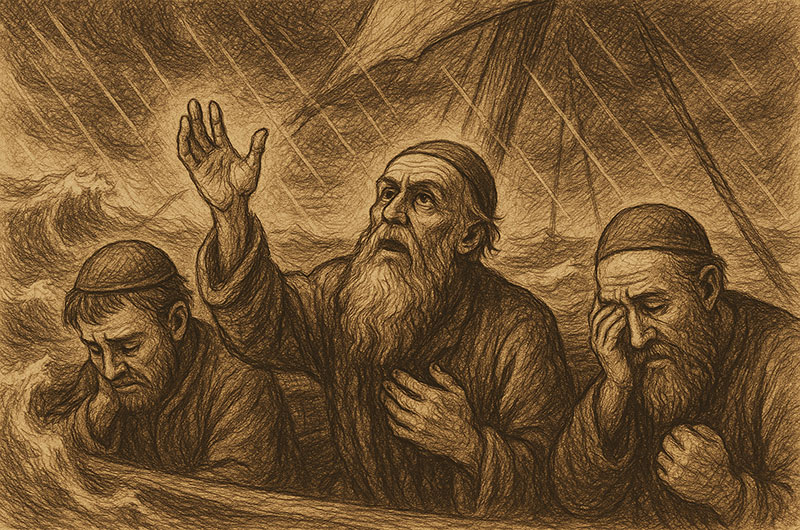
On the first day of Selichos strong waves began to toss the ship in the waters. The captain assembled all the passengers and informed them that their situation was dire. A strong storm was brewing in the sea, and he was afraid – barring a miracle – that the ship would sink.
When R’ Yisroel of Shklov heard this, he turned to the people on the ship and spoke to them. He expounded on the Talmud (Brachos 10a), “Even if a sharp sword rests upon a person’s neck, he should not refrain from praying for mercy,” and reminded the passengers that storms don’t just happen. “We have to turn to the One Who conducts the entire world and do teshuvah. Hashem will have mercy and save us in a supernatural way.
Everyone on board accepted the instructions of the Rav, and R’ Yisroel requested one of the young men to be the first to follow the steps of repentance, beginning with acknowledging his transgression.
“Over the years I lied to my father and mother,” said the bachur, beginning to cry uncontrollably. “Let me explain my lie.”
He revealed that his father worked very hard trying to provide for his family, with not much success. There was very little food in the house, and his father would try to get some scraps from the local bakery at the end of the day for the family to eat.
“When I saw this,” said the young man, “I decided that I would not take my portion, so that my father and the others could have it. Therefore, I lied. I told my parents that I had already had more than enough to eat in yeshiva. That was not true because every student had to bring his own food, and I had nothing to bring or to eat. But I said this in order that my father should have my portion.
“I confess my wrongdoing, and I resolve to find a different, honest, way of achieving the desired results.”
Everyone present began to cry, overwhelmed by the type of transgression this young man was confessing.
R’ Yisroel of Shklov listened to each word and then lifted his eyes up to Heaven and cried out: “Ribono Shel Olam, if these are the transgressions of Your nation, we want You to analyze them carefully as they are surely so sweet and beloved by You.”
When the tzaddik finished speaking, the seas immediately stopped raging. The waves subsided, and everyone was safe again.
The people on the ship were shocked to see how Hashem listened and paid attention to their repentance, their confessions, and their regret.
Every year before Yom Tov, I personally reach out to all of our loyal readers and friends of the Jewish Press with a humble request – to assist me in helping others in the community who are in dire financial straits. There are families, individuals, and children who need our encouragement, our support, and our monetary assistance so that they can rejoice during the Yomim Tovim along with the rest of Klal Yisrael. Please join me in this great mitzvah.
I personally administer and distribute the monies from the special Yom Tov Fund I have established directly into the hands of those who are most in need.
Please send your contribution to Khal Bnei Yitzchok Yom Tov Fund, c/o Rabbi Dovid Goldwasser, 1336 E. 21 Street, Brooklyn, NY 11210. Donations can also be Zelled to 718-954-4343.
In the zechus of your contribution may you merit blessing and success, good health, nachas, happiness and prosperity. You may also include the names of anyone in particular who is in need of shalom bayis, shidduchim, refuah, parnassah, etc. and I will say special prayers on their behalf. May we be worthy, with all of our tefillos, to celebrate a good, healthy and joyous New Year. May we see an immediate resolution to the current situation that plagues the world, and blessing and peace for Klal Yisrael. Amen.