October 2, 2026
 Categories: Featured / Parsha / Torah
Divine Writing Engraved on the Luchot


The Torah teaches that when Moshe descended from Har Sinai carrying the Luchot, they were engraved with “Divine writing” upon both side (Shemot 32:15-16). In a well-known Gemara (from Shabbat 104a), we learn that the middles of the letters were suspended miraculously and that according to Rav Chisda, the text could literally be read from either side – in both directions. The Gemara uses some very specific language to develop these ideas, which on the surface don’t seem so difficult to grasp, but many of the commentators have delved into its nuances. Taken in that light, the Gemara is actually fairly complex and comprises multiple layers of meaning.
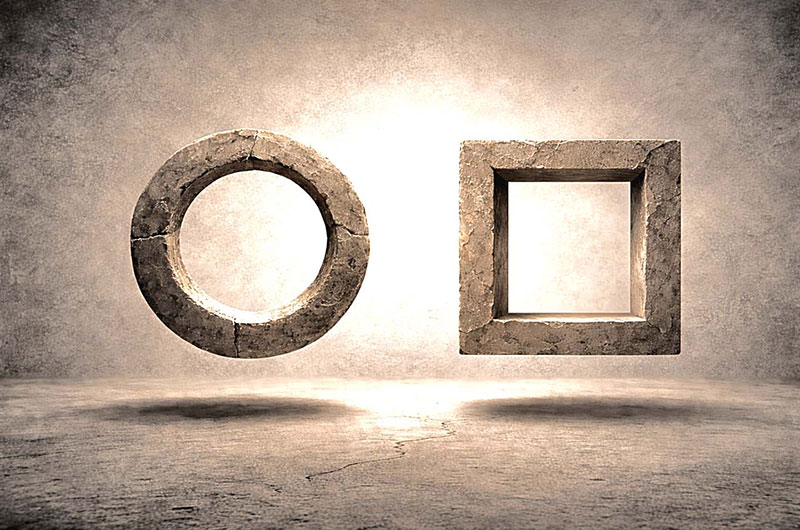
Rav Kook, in Ein Aya, examines the letters in miraculous suspension; the examples of these are Samech and final Mem. Each of these fully encloses an interior space which, according to the Gemara, was suspended miraculously in spite of being carved all around. Rav Kook teaches that this is the very foundation for the suspension of existence itself on the face of the void – it is the illustration of the Creation of the universe and Hashem’s ongoing intervention in it. Everything that exists only exists because He willed it into being and nothing necessarily follows of its own accord; in fact, without His ongoing sustenance, everything should have collapsed long ago into entropy.
The form of the world we know, like the forms of the letters engraved upon the Luchot, is that which was decreed on High when Hashem decided to create our universe. The Luchot allude to this, but also the specific letters that are used as examples exemplify this principle. The Mem signifies water, the primordial material from which the rest of physicality was extruded. And we learn from the opening verses of Bereishit that the Ruach Elokim hovered upon the face of the water. This Divine Presence is the foundation, or yesod, of all Creation; it is also the siba, that is, the cause, of everything. Both of these words are derived from the letter Samech. Thus, with Mem and Samech upon the Luchot, we learn that indeed not only the letters but all of physical reality is suspended miraculously.
Similarly, regarding the reading of the text in both directions, Rav Kook sees allegory in this as well. Everything that exists has its superficial appearance and its inner essence. These are integrally related and you can always learn one from the other if you examine them closely. When the intention is tied into the manifestation and the manifestation properly expresses the intention, then there is true understanding and the Will of the Creator is done. This was the case with the writing on the Luchot – it could be read from any angle and in any direction, and it always expressed the intention of its Divine Author.
Rav Chisda in the Gemara brings some examples of these sorts of palindromes but, as Tosafot point out, none of the examples in the Gemara actually appear in the text that was written on the Luchot! It is therefore difficult to understand what Rav Chisda was trying to express with these examples that seem to not be examples of anything familiar to us at all. Rav Kook analyses each as an allegory, further developing the above theme. According to his reading, Rav Chisda is elaborating on the philosophical content of the Luchot to further develop the notion that we are to learn from the text itself, and from the script, the secrets of the universe. This is also consistent with the Mishna in Avot that teaches of the things created at twilight on the sixth day among which are listed the “writing, the script, and the Luchot” (Avot 5:6). The Ishbitzer Rebbe in Mei HaShiloach reads this passage in a similar way, teaching in a manner that anticipates Rav Kook of the power of Torah to transform human consciousness. Rav Kook extrapolates from this to the nature of physical reality itself, but each of them finds allusions to the efficacy of Torah as represented by the Luchot to shape our experience of reality.
Interestingly, the Ben Ish Chai suggests that the specific words chosen by Rav Chisda are mnemonic devices or possibly even incantations, whereby an initiate to the secrets of the Torah would elicit successions of words and phrases with the power to alter consciousness or even the fabric of reality itself. However, if this tradition existed in the time of the Gemara, it has seemingly been lost in our time, or at least was not known to the Ben Ish Chai.