 October 9, 2026
 Categories: Torah
From Festival to Fast & Our All-Important Impact


Parshat Vayigash & The First Third of Tevet
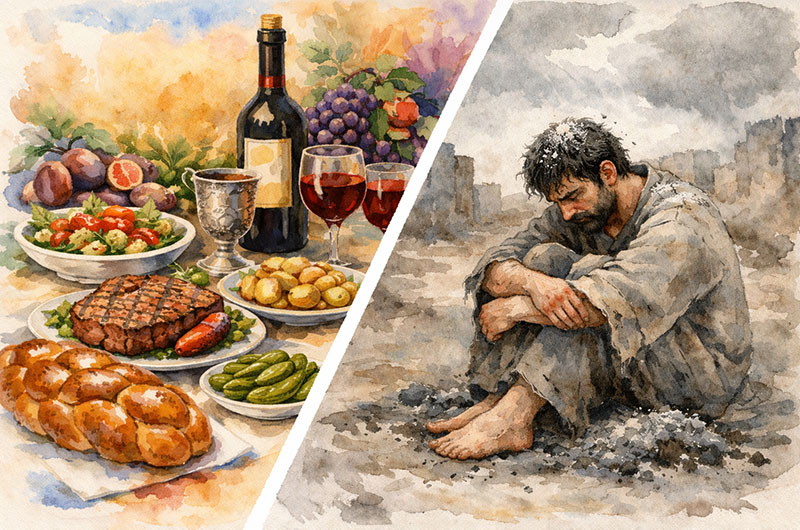
Even though the title of this column is “Torah by the Numbers,” we’re starting this week with a look at the end of Chanukah and the three tragedies commemorated on the 8th, 9th, and 10th of this month.
I tried to connect these events with the Torah. I searched the Chumash for “Chodesh haAsiri,” and I found it in Parshat Noach, within the chronology of the Flood. That’s the only occurrence of “the Tenth Month” in the Torah. Only one tiny weeny problem with that: It is most likely that the tenth month referred to in Noach was Tammuz, since Nissan’s being considered the first month only began in Egypt, hundreds of years after the Flood.
So, I’m going to talk about numbers in the month of Tevet – specifically, the first, second, and third, and the eighth, ninth, and tenth of the month.
This year, the first of Tevet is the second day of Rosh Chodesh and the seventh day of Chanukah. And it follows that the second of Tevet is the eighth day of Chanuka. In some years, the first of Tevet is the one and only day of Rosh Chodesh and the sixth day of Chanukah. In those years, the second and third days of Tevet are the seventh and eighth day of Chanukah.
These are happy days of Hallel and joy.
Which brings us to the other notable dates in Tevet – the eighth, ninth, and tenth.
* * * * *
The 8th of Tevet marks the tragedy of the Torah’s being translated into Greek, and thereafter into any language you’ve ever heard of – and some you probably haven’t.The 9th of Tevet is associated with the deaths of Ezra and Nechemia, the two great men responsible for the return of the exiles (unfortunately, only a small fraction of them) and the restoration of Torah learning, understanding, and practice. It is a sad day whenever great leaders are taken from us.
The 10th of Tevet marks the beginning of the destruction of the First Beit HaMikdash, with the siege around Jerusalem by Nevuchadnetzar, king of Bavel.
Chronologically, the Chanukah story is the last of the above-mentioned events. But from our perspective, we see these events in the order in which they occur in the calendar.
So, when we ponder the busy first third of the current month, we start with Chanukah. We start with the bright spot and hope-filled events that occurred approximately mid-way through the tenure of the Second Beit HaMikdash.
Things were very bad before Chanukah “happened”; Chanukah is a joyous celebration, but only a few days afterward, we are plunged into commemorating a series of tragic events that call upon us not just to remember, not just to mourn, but to develop an agenda and work on it.
We would like to be able to say, “We’ll keep Chanukah, but we need to get rid of the echoes of the bad dates, and we need to do our share in the realization of the prophecy that the fasts for the Churban will become Yamim Tovim.”
What are we supposed to do? What should our agenda be?
Easier said than done, but here’s what I would suggest.
The translation of the Torah into other languages is not per se bad. But when it results in separating the Written Word from the Oral Law and Tradition, it is disastrous. We then must practice and teach Torah Judaism with a total commitment to the whole package of the Torah: The Written Word, the Oral Law, Rabbinic Law (which is backed by the Torah), Minhagim, and Masoret.
Ezra and Nechemia started an important job and we owe them much.
But we must continue their work by fostering a love and commitment to Torah – within ourselves, our families, our fellow Jews. We must encourage aliyah and help build the State of Israel the way it should be, to hasten the Geulah Sheleima. We must reverse the trends within the Jewish world that led to this churban or that.
It’s a tough job – which is not up to us to complete, but we are never free to slacken off from these challenges.
On the technical side, Chazal made a decision to combine the 8th, 9th, and 10th tragedies into the one fast of Asara b’Tevet. Our Sages tried to minimize the number of fast days throughout the year. Asara b’Tevet this year is on Tuesday, December 30.
It is one of the four fast days referred to by the Navi Zecharia as “the fast of the Fourth” (month, i.e., Tammuz, the 17th thereof), “the fast of the Fifth” (month, i.e., Av, the 9th thereof), “the fast of the Seventh” (month, i.e., Tzom Gedalia on the 3rd of Tishrei), and “the fast of the Tenth” (month, i.e., Asara b’Tevet).
The fast begins at dawn – Alot HaShachar. You might see different times on different calendars. This is due to two main opinions as to when dawn occurs. Dawn is sometimes calculated as 90 minutes before sunrise and sometimes as 72 minutes before sunrise.
“Stars-out” also has different definitions depending upon to what it is applied. For example, Shabbat-out uses a later timing than would apply to the end of a Rabbinic fast.
* * * * *
And now to Vayigash. Actually, I first want to share an observation from Parshat Mikeitz first. The word “amtachat,” referring to the sacks of the brothers that contained grain and money, occurs 15 times in the sedra, with different grammatical forms:Amtachat, amt’chot, amtachto (meaning “his amtachat” – appears five times), amt’choteinu (“our amtachats”), amt’choteichem (“your amtachats” – appears twice), b’amt’choti (“in my amtachat”), b’amt’choteinu (“in our amtachats” – appears three times), and b’amt’chot (“in the amtachot of”).
That’s a lot. But most remarkable is the fact that aside from these 15 occurrences of the word, it is found nowhere else in all of Tanach.
So, what’s with the word amtachat? I have no idea. Any suggestions?
* * * * *
Okay, Vayigash, for real.Since Mikeitz is Shabbat Chanukah 90% of the time, Vayigash is the Shabbat right after Chanukah 90% of the time. But, since we read the first aliyah of Vayigash at Mincha on the Shabbat when we read Mikeitz, that means that the first part of Vayigash is actually read on Chanukah 90% of the time.
Side point: The regular haftarah of Mikeitz is read only in the 10% of years when Chanukah runs from Friday to Friday. The next time that is scheduled to occur is in the year 5801 – 15 years from now.
A little hint to the connection between Parshat Vayigash and Chanukah is the word Goshna, meaning “to Goshen.” Yosef sends Yehuda to Goshen to prepare things there for the rest of the family who will be living there. Goshna is spelled Gimel-Shin-Nun-Hei – the letters of the dreidel (the non-Israeli dreidel, that is).
The closest we get to a sedra-Chanuka-dreidel connection in Israel is the word gefen, which appears twice in Parshat Vayeishev (in the Wine Steward’s dream) – Vayeishev being the other Chanukah sedra, together with Mikeitz and Vayigash. But that gives us only the Gimel, Pei, and Nun of the dreidel – or should we say, s’vivon, with the Hei gone missing.
(We in Israel get the whole dreidel letter-set every time we make a beracha on wine: HaGaFeN.)
* * * * *
Vayigash is the 11th of the Torah’s 54 sedras, the 11th of 12 in Bereishit.It is written on 178.07 lines in a Sefer Torah (ranking 34th).
Vayigash is composed of three parshiyot, all closed, one very closed. Actually, Vayigash has only 2.89 parshiot – it ends after 34 pesukim of a 38-pasuk parsha. Vayigash is the only sedra that does not end with a parsha break. This shows up in a printed Chumash by there being no Pei-Pei-Pei or Samach-Samach-Samach between Vayigash and Vaychi. In a Sefer Torah, Vayigash’s final word, which is “M’od,” is followed by Vaychi’s first word, which is “Vaychi,” with nothing between them but a regular space between words.
Nostalgic story (if you are familiar with what I’m about to mention, let me know):
When I was a kid back in Crown Heights, many of us would play Chumash sometime during shul. (Maybe I shouldn’t admit to doing anything but davening and listening to Torah-reading, but...)
On your turn, you’d open a Chumash to a random page. If there was a Pei-Pei-Pei on one of those two pages, you’d get 25 points and go again. Samach-Samach-Samach was 50 points. And Chazak was 100 points.
If there was nothing to score on the page, you said a number and turned that many pages in either direction. If you scored, fine. If not, the next player would take his turn. The highest scoring finds were 500 points for the backwards Nuns in B’ha-alo-t’cha and 1,000 points for the end of Vayigash.
Those were the days…
Continuing with our sedra, Vayigash has 106 pesukim; it ranks 28th, tied with To-l’dot and Bo. That’s just below average for the Torah – 5,846 pesukim in 54 sedras gives an average of 108.26 pesukim per sedra.
It is a much smaller sedra than Bo, a bit larger than To-l’dot. It has 1,480 words (30th), 5,680 letters (29th), and ranks 9th (of 12 sedras) in the Book of Bereishit in all three categories.
None of the Torah’s 613 mitzvot are found in Vayigash.
* * * * *
At the end of the Book of Bereishit (the end of Parshat Vaychi), it is recorded that Yosef died at the age of 110. Commentaries point out that this was ten years short of the traditional full lifespan of 120. They explain that Yosef lost ten years because he heard his father Yaakov being called Avd’cha – Your servant – ten times, and he didn’t object or reveal himself to prevent his father’s denigration.In fact, the term “Avd’cha Avi” – Your slave, my father – was said by Yehuda three times at the beginning of Vayigash, and once he said “Avd’cha Avinu” – Your slave, our father. Back in Mikeitz, the brothers answered Yosef (as yet, his identity unknown) about how their father was doing by saying “Shalom l’Avd’cha l’avinu, odenu chai” – Your slave, our father is at peace’; he is still alive.
That’s only five times. Why ten years? The answer is that Yosef heard it once from the brothers (and Yehuda) and again from the mouth of the interpreter: ten times, all counted.
* * * * *
Let me finish with an important point to take away from Parshat Vayigash. Yosef’s brothers are consumed with regret for having treated Yosef as they did. Perhaps it is sincere remorse; perhaps it is fear of retribution from Yosef. Yosef, on the other hand, tells his brothers not to “beat themselves up” concerning what they did to him, because it was G-d’s Plan.I think it is important to separate human Free Will from G-d’s plans.
What the brothers did to Yosef was terrible. Whatever G-d had in mind, the brothers’ actions brought great pain to their father Yaakov and caused our descent into Egypt.
In the words of Midrash P’li’a, “HaKadosh Baruch Hu said: You sold Yosef! By your lives, you will be saying every single year, ‘Avadim Hayinu…We were slaves to Pharaoh in Egypt.’”
And let’s not forget the Asara Harugei Malchut – the horrible deaths of ten Torah scholars by order of the Roman emperor inflicted as delayed justice for the sale of Yosef by his ten brothers.
Whatever Hashem has in mind for us, however we see G-d’s plans being realized in what happens – we are responsible for our actions.
Had the brothers not done what they did, G-d’s prophecy to Avraham of our being strangers in a strange land and oppressed there would have happened some other way.
Our actions have gotten us into trouble repeatedly throughout Jewish history. But our actions can also hasten the Geulah and turn the four fasts into Yamim Tovim for us – may we see it soon, in our time.
Shabbat Shalom.