 October 9, 2026
 Categories: Headline / Parsha / Torah
Getting to 100 (Shofar Blasts, That Is) & the Shabbat-Rosh HaShana Matrix
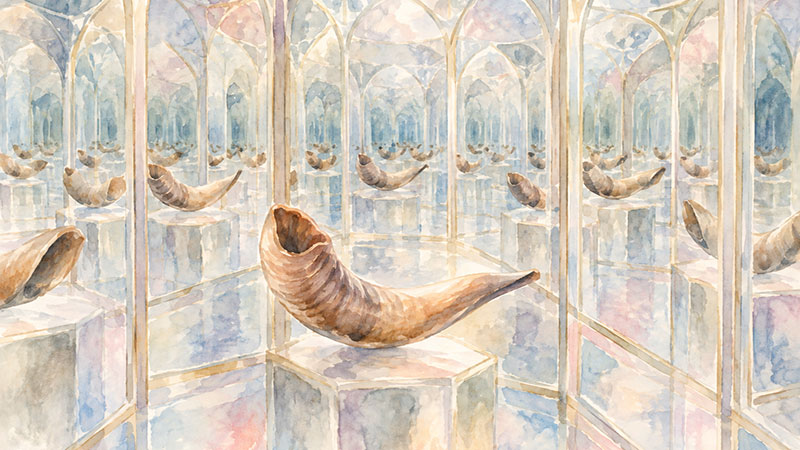


Rosh HaShana
I hope no one will be surprised if I tell you that this coming Shabbat and Sunday are Rosh HaShana. But I have some points to share with you that I hope add something new.
First, how often does Rosh HaShana fall on Shabbat (and Sunday)?
Based on the rule of our fixed calendar (in use when we do not have a Sanhedrin) of LO ADU ROSH – that Rosh HaShana may not begin on a Sunday, Wednesday, or Friday – it follows that it can be on Monday-Tuesday, Tuesday-Wednesday, Thursday-Friday, or Shabbat-Sunday (as it is this year).
I have mentioned a number of times in previous columns (and on my website PhiloTorah.co and in various shiurim) that there are 385 possible dates on our calendar. This coming year of 5787 has 385 days and consequently contains all the possible dates. Of those 385 dates, 295 follow the LO ADU ROSH rule. Rosh HaShana is obviously one (or rather, two) of those 295 dates, because the rule starts with ROSH, i.e., Rosh HaShana.
It turns out that three of the four possible days of the week that LO ADU “permits” are close in frequency of occurrence, and the fourth situation is rarer – as you will see with the following numbers:
Rosh HaShana on Monday-Tuesday occurs in 28.03% of years.
Rosh HaShana on Tuesday-Wednesday occurs in 11.51% of years.
Rosh HaShana on Thursday-Friday occurs in 31.89% of years.
Rosh HaShana on Shabbat-Sunday occurs in 28.57% of years.
Year-types are not evenly distributed. The last Shabbat-Sunday Rosh HaShana was three years ago. Before that, it was another three years earlier. And before that, 11 years earlier.
Next year (5788), we are scheduled for another Shabbat-Sunday Rosh HaShana.
You might remember back at the turn of the century and millennium (remember the computer fears of Y2K?) that we had four Shabbat-Sunday Rosh HaShanas in a five-year period (1999-2003)!
Rosh HaShana on Shabbat-Sunday is different from the weekday pairs in a number of ways. The most obvious is no shofar on Shabbat.
* * * * *
The Torah commands that we hear the shofar on the first day of the seventh month, Tishrei. The Torah makes no distinction between weekdays and Shabbat. However, Chazal, our Sages, enacted a decree banning shofar on Shabbat. So too for the Four Species, the Arba Minim, a.k.a. lulav and etrog – not on Shabbat. Even though the Torah says to take the Four Species on the 15th day of Tishrei, Chazal say not in that case. And the same goes for Megillat Esther when Purim falls on Shabbat. This cannot happen in our LO ADU ROSH calendar, but it does happen in Yerushalayim, where Purim is observed on the 15th of Adar.
We need to understand why Chazal made this g’zeira (decree) and how they are allowed to ban shofar and lulav on the days that the Torah says to do those mitzvot.
Their official reason, which parallels that for lulav and megila, is this: They feared that a person who lives in an area without an eiruv, in which carrying is not permitted (outside a private domain), andwho has a shofar but doesn't know how to blow it, would carry it in the street on Shabbat-Rosh HaShana to a neighbor who does know how to blow shofar but has none, thinking that the mitzva to hear shofar overrides the prohibition of carrying on Shabbat.
What about people who live in a location with an eiruv? What about someone who knows that you are not allowed to carry with no eiruv? What about a person who has a shofar and knows how to blow it? What about a person who goes to shul to hear shofar? Why can’t any of them (or any of us) do the mitzva?
It seems a stretch to think that there is a Jew without an eiruv, with a shofar, who doesn’t know how to blow it and doesn’t know that he or she can’t carry it to a neighbor. What are the odds for such a person even existing? Very slim, at best. So why did Chazal make this g’zeira?
First of all, it is the Torah that gives our Sages the authority to legislate in general (from the beginning of Parshat Sho-f’tim), and that includes being able to decree that we “sit on our hands” in certain circumstances which they describe. They cannot legislate that we actively do something that is prohibited by the Torah, but they can tell us not to do something the Torah requires, as they did in the case of shofar on Shabbat-Rosh HaShana.
Furthermore, they would never have decreed not to blow shofar if we did not have a second day on which to blow. Similarly, because we take the Four Species on Sukkot for six of the seven days of Sukkot, they could ban their use on Shabbat, even when it is the first day – as it is this year.
We still have to try to understand the decree concerning shofar, as far-fetched as their stated concern might be. And this next point is why I think they did what they did.
What is Rosh HaShana without shofar? The answer is… Rosh HaShana. As important as shofar is, its absence from the first day does not diminish Rosh HaShana. It might actually enhance it by giving us a certain perspective on both Rosh HaShana and Shabbat.
Shabbat is not just a coincidence of the calendar, not just a small matter we have to be concerned with. Shabbat is more than that. Hence, Kabbalat Shabbat in the machzor, albeit in condensed form; no Avinu Malkeinu; references to Shabbat inserted into our davening; and seven people called to the Torah rather than five for a weekday Yom Tov.
Shabbat is pro-active in proclaiming G-d as the Creator, the Master of the Universe, the King of kings. If once a year, Rosh HaShana marks G-d’s being the “Melech al kol haAretz,” Shabbat does that every week. The message of the ban of shofar on Shabbat is that Rosh HaShana is not just Yom T’ru’a, but also Yom Zichron T’ru’a – a day to remember the sound of the shofar.
Shabbat completes a significant message of Rosh HaShana. On Rosh HaShana, we have sophisticated prayers – specifically, the three middle b’rachot of the Amida of Musaf: Malchiyot (G-d’s Kingship), Zichronot (Remembrances), and Shofarot. These are accompanied by the primitive elemental sound of the shofar. And when Rosh HaShana is on Shabbat, silence completes the whole picture.
I am convinced that the g’zeira against shofar on Shabbat is not just to protect Shabbat from inadvertent, misguided violation. It is to benefit the rest of us by our not taking shofar for granted and not taking Shabbat for granted.
* * * * *
The tradition is that we hear 100 kolot (sounds) from the shofar, but that number is arrived at slowly, slowly.
Let’s start with the Torah in Parshat Pinchas, where we find the mitzva of shofar. The Torah says something a bit enigmatic. It says that on the first day of the seventh month, “Yom T’ru’a yihyeh lachem” – you shall have a “T’ru’a Day.” The Oral Law explains what Yom T’ru’a means. It means that we shall hear the sound of the shofar called a t’ru’a.
What is a t’ru’a (not to be confused with the sound we call a T’ru’a, composed of a minimum of nine very short sounds)? A t’ru’a is a broken sound that mimics sighing, moaning, groaning, and crying. There are different opinions as to what that sound is. These include what we call a Sh’varim (three short sounds, but not as short as the T’ru’a sounds described above), what we call a T’ru’a, or a combination of the two. So we make all three of those sounds – Sh’varim-T’ru’a, Sh’varim, and T’ru’a.
So why not just use the Sh’varim-T’ru’a, which is the combination as well as each of its two components? The answer is the next part of the story: the fact that before a T’ru’a is sounded, we need to sound a P’shuta (that is, T’ki’a) first, and then another P’shuta after it. This results in three sequences being the required way to sound the Torah’s T’ru’a: T’ki’a Sh’varim-T’ru’a T’ki’a, T’ki’a Sh’varim T’ki’a, and T’ki'a T’ru’a T’ki’a.
Then comes the rule that each T’ru’a (flanked by T’ki’a) be sounded three times. This results in three repetitions each of T’ki’a Sh’varim-T’ru’a T’ki’a, T’ki’a Sh’varim T’ki’a, and T’ki'a T’ru’a T’ki’a. These are called the 30 kolot – 30 blasts of the shofar.
Still more to go. Technically, hearing the 30 blasts fulfills the mitzva of hearing the shofar on Rosh HaShana. But another question pops up. Do we sound all 30 in one “sitting”? Or do we sound 10 each together with the three central b’rachot of the Musaf Amida? Interweaving shofar with t’fila seems to be the better way to go. On the other hand, blowing a full set of 30 kolot is also a good idea because following the b’rachot for the mitzva with its full performance is a good idea.
So, what do we do? If a person is hearing the shofar not in the context of davening in shul, then b’rachot followed by all 30 blasts is the way to go. Mitzva done! But in a shul, we do both suggestions... and more.
We blow 30 kolot right after the b’rachot, and then another set of 10 and 10 and 10 with the three special b’rachot in the Amida of Musaf. Which Musaf – the silent Amida or the repetition? Nusach Ashkenaz blows 10+10+10 in the repetition only. Nusach S’fard blows in the silent Amida as well. Eidot Mizrach (i.e., S’faradim) also blow in the silent Amida and in the repetition. (Note that there can be some crossing of the lines with this issue – some Nusach Ashkenaz congregations might blow in the silent Amida and some Nusach S’fard ones might not.)
One more step to go. The tradition calls for blowing more sounds to bring the number to 100 blasts. This is done by either blowing 10 more blasts after the Amida for those who blow in the silent Amida and the repetition, or a total of 40 more for those who only blow during the repetition.
The reason given for 100 kolot total has to do with the mother of Sisra, who cried for her son when he failed to return home after Yael had killed him. Her lament, called a y’vava (another term for the t’ru’a sound of the shofar) consists of 101 letters. Chazal wanted to counter those letters of a cruel woman with 100 shofar sounds, but chose to let one sound (corresponding to one letter) survive because of her genuine feelings of motherhood toward her son.
We can also suggest that 100 is not just a number; it represents a full set of sounds from the shofar.
* * * * *
As is typical, I have run out of space to cover other points, so I trust that you will review YaKNeHaZ from other columns or books, as well as details of the Seder of Leil Rosh HaShana. And of Tashlich being on day two this year for Ashkenazim. And the issue of Shehecheyanu on the second night. And the symbolism of the shofar (G-d’s coronation as King, a call to t’shuva, Akeidat Yitzchak, Matan Torah... and more).
But for this column, let me wish you and your families and all of K’lal Yisrael a K’tiva vachatima tova and a Shana tova umtuka as well as a Shabbat Shalom.