 October 16, 2026
 Categories: In Print / Headline / Parsha
Getting Too Comfortable


Parshas Ki Savo
The word “Vehaya” contains the letters of G-d’s name. It is also an expression of joy. Bikkurim are brought only after Eretz Yisrael has been conquered and the Children of Israel are permanently settled in their allotted portions of land. Only then is the final phase of redemption of “Vehevesi” realized.
The Children of Israel’s right to Eretz Yisrael is not a yerusha. It is a morasha. It is dependent on their performing the mitzvot of the Torah and passing this legacy on to their children after them.
For forty years, plus the time it took to conquer the land, G-d had to stall on his promise to Avraham that the fourth generation would return to Israel (Bereishis 15:16). But now that it has finally come to pass, G-d rejoices.
By bringing the Bikkurim, we acknowledge that we are just sharecroppers in His land and that everything belongs to Him. What better time to admit that it is not the work of our hands that has brought us success but the help of G-d, than the time when we reap the reward of success by bringing in our harvest. That is the meaning of “Ve’anisa,” which comes from the word “ani,” which means a poor person. One has to realize, when thanking G-d for one’s success, that without His help, we are poor.
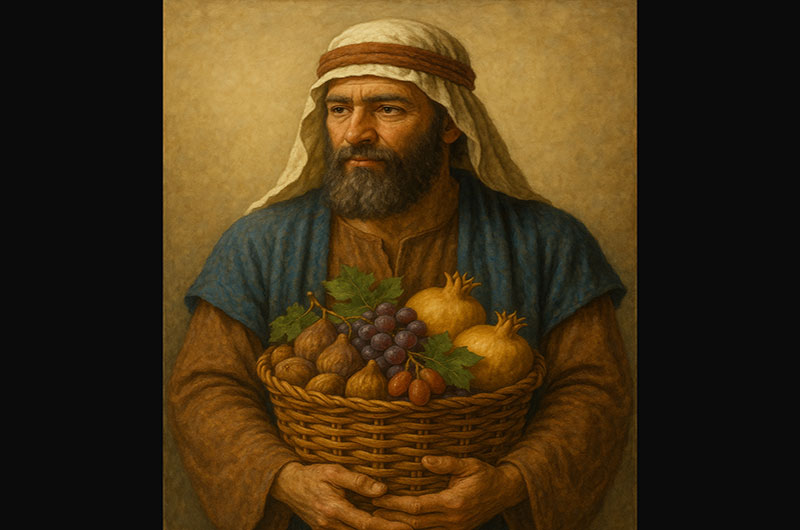
The gift of Bikkurim has to be wrapped in a way that is fit for a King. It must be offered in a beautiful basket. The Biblical source of the importance of offering a gift in beautiful packaging can be traced to the story of the brothers of Joseph who, when journeying to Egypt in search of food, were asked by their father to bring him gifts of the best fruits of the land. When they arrived in Egypt, they spent all morning preparing the gifts in beautiful wrappings.
The kohen takes the basket of Bikkurim, “ve’hinicho” and lays it down before G-d. Chazal tell us that the word “ve’hinicho” means to wave. The kohen and the owner wave these symbols of prosperity in the direction of the four corners of the earth, as with the lulav, to acknowledge that He who controls beneficial and destructive winds also controls our fate. Once we demonstrate this recognition through the waving, G-d is ready to keep the harmful forces that destroy our crops at bay and bless us with prosperity.
In proclaiming his thanks to G-d, the person bringing the Bikkurim says that Yaakov and his family went down to Egypt “vayagar sham,” and lived there. The Ba’al Haggadah interprets the word ”vayagar” as reflecting that Yaakov and his relatives who came to Egypt never really settled down there, but always considered themselves to be “geirim” strangers in Egypt. Indeed, in reciting the descent of Yaakov and his family to Egypt as an historical fact, the Torah tells at the beginning of Shemos, “These are the names of the Children of Israel who are coming, “ha’baim,” to Egypt.” Yaakov and his family were coming, not that they came to Egypt. They saw themselves as only temporary residents there. They always remembered where they came from and forever yearned to return to Eretz Yisrael. They remained few in number and lived apart from the Egyptians in the land of Goshen. The Egyptians had no problem with that.
It was only when they multiplied, became powerful and moved into the major cities of Egypt that the Egyptians rose up against them. The words “Vatimaleh ha’aretz otam,” generally understood to mean that the Israelites filled the land, can also be understood to mean that the land filled them, to the point of infatuation. True, they remained unique there in that they kept their Hebrew names, wore different clothes, spoke Hebrew and did not intermarry. However, in all other respects, they conducted themselves like Egyptians. History repeats itself. Whenever the Jews assimilate and forget their identity, their host countries rise up against them.