 October 16, 2026
 Categories: Headline / Parsha / Torah
Granting G-d Credit


Noach
The Torah begins the story of Noach with the words “Eleh toldos Noach – These are the generations of Noach” (6:9), not Ve’eleh toldos – and these are the generations of Noach. This is because this new world that began with Noach had no connection with the old world that began with Adam. That world was destroyed. Noach did not carry with him into the ark and into the new world the genes of idolatry and licentiousness.
In the old world the people of Noach’s generation wanted more. They were never satisfied. If they were given a million dollars they wanted two million. But Noach was different. He was tamim. He was happy with his lot and never asked for more.
Yet, Noach expected justice. He walked in tandem with a G-d of justice, Et haElokim. If he obeyed G-d’s command not to steal, he expected to be rewarded with food to eat. That’s justice. If that bargain was broken, he felt he would be justified in stealing.
He was unlike Avraham who was promised the entire land of Israel, yet had to pay Efron for a tiny plot in which to bury his wife. Avraham did not hold G-d to quid pro quo justice. He understood that G-d is eternal. That G-d’s ineffable name spans past, present and future. As such, G-d’s promise was fulfilled to Avraham’s descendants after his own lifetime, and that was as valuable as immediate gratification. That was the difference between Noach and Avraham. About Avraham we are told “hishalech lefonei ve’heyeh tamim” (17:1). Avraham walked before G-d. He gave G-d credit. He performed his part of the bargain before he received payment. That is what tamim really means.
“And the earth was corrupt before G-d and filled with crime” (6:11). The word “Vatishaches,” the Hebrew word for corrupt, refers to idolatry and sexual immorality. The word “chamas,” the Hebrew word for crime, refers to theft and lawlessness. Idolatry and sexual immorality, when indulged in consensually, are ostensibly only offences “lifnei Elokim,” against G-d, not against society. But G-d foresees that they lead to crime. Stealing the heart of someone else’s wife is a short step from stealing someone else’s property or even murdering anyone who gets in the way of one’s rampant desires. It is what Avraham explained to Elimelech when asked why he had lied about Sarah being his sister and not his wife. “I realized,” answered Avraham, “that the one thing missing here is the fear of G-d and they will kill me to take my wife” (20:11).
One hundred and twenty years before the flood, G-d instructed Noach to build the ark (Rashi 6:14) and seven days before the flood, He instructed him to enter it (7:1). But Noach only entered it when he saw the waters rising threateningly high (Rashi 7:7). According to Rashi, Noach was a person of limited faith. He did not fully believe what G-d had foretold him, that there would be a flood. So he did not enter the ark before the rising tide forced him in. Perhaps Noach did believe that there would be a flood and that is precisely why he entered the ark. The problem was that he entered the ark because he feared the flood not because he feared G-d. He should have entered the ark because G-d said so, regardless of whether there would or would not be a flood, like Moshe who sprang up the mountain of Nevo because G-d told him to, regardless of the fact that he was jumping to his death.
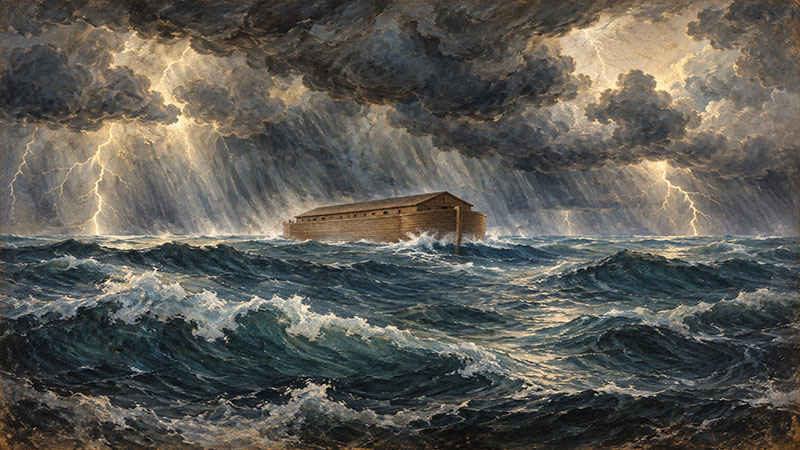
Once he finally entered, we are told that G-d sealed the ark for Noah’s protection (7:16). Notwithstanding all of the safeguards that the Torah describes that went into making the ark seaworthy and waterproof, including tarring it from within and without, at the end of the day there was only one reason why the vessel did not sink. It was because G-d Himself sealed it. Indeed, the hot sulfur that caused the surrounding sea to boil would, if left to the forces of nature, have melted the tar and invaded the ark. But G-d wrought a miracle and the waters surrounding the ark remained cool even as those further away boiled and bubbled (Rashi 6:14, Zevachim 113b).
The waters began to recede on Rosh Chodesh Sivan (Rashi 8:3). That was the same day that the Jews later on would arrive at Mount Sinai and encamp around it as one man with one heart. The world stands on three pillars: justice, truth and peace. Without peace the world self-destructs. And so on that day, Rosh Chodesh Sivan, when G-d foresaw that the Jews would come together in peace to accept the Torah, whose pathways are peaceful, he decided to save the world and give it another chance. G-d made a wind blow on the earth and the waters began to subside. Since when does wind make waters subside? Doesn’t it make waves churn? But this was a special wind. It was the same wind of G-d that we met at creation, “and a wind from G-d moved over the surface of the water.” These were winds of creation, not winds of destruction; they were winds of peace.
Once the waters had receded low enough for the tops of the mountains to be visible, Noach sent out the dove to test the dry land. It came back the second time holding an olive branch in its beak which it had plucked off a tree. Rashi explains that the word “taraf” is the same as chataf, which means that the olive branch was grabbed on the fly. The dove told Noach that it preferred the taste of food that it had sought out itself with G-d’s help, even though it tasted bitter, to the food provided by Noach in the ark, even though it tasted sweet. To be as free as a bird, dependent on G-d, is sweeter than to be fed as a servant dependent on man. That is why the word taraf is used. Ultimately, we are no different from the animal that finds its food in the wild, as Mishlei tells us (30:8), “Hatrifeini lechem chuki – Seize for me my daily bread.”