 October 16, 2026
 Categories: Headline / Business/Finance
How Much Is Too Much To Pay For Knicks Tickets
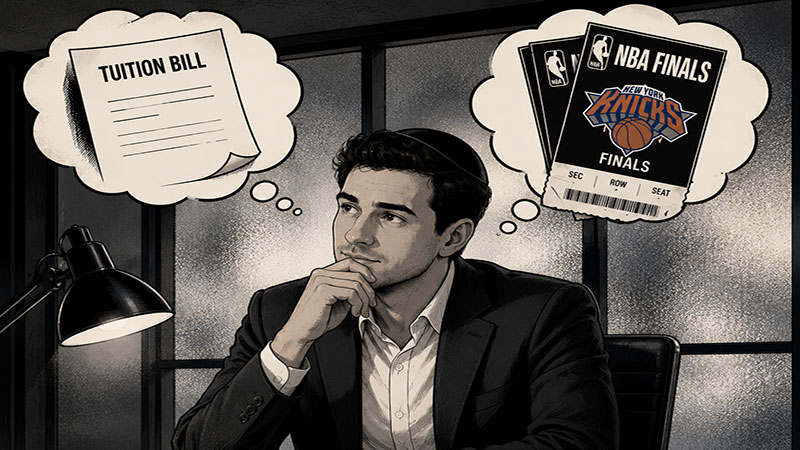


I paid tens of thousands of dollars for tickets to the NBA Finals at Madison Square Garden. I will not get into the exact amount, but I spent roughly the equivalent of one year of one child's yeshiva tuition to enjoy the experience.
I am not rich, but I pay my bills comfortably, have no debt other than a modest mortgage, save regularly for retirement, and give tzedakah. The purchase temporarily reduced my emergency fund, but I expect to replenish it within about a month. Some people whose opinions I respect told me this was a waste of money and that the funds could have been used for more productive purposes, including supporting Yiddishkeit and communal institutions. Was this a poor financial decision?
This is a question to which many New Yorkers can relate. As an avid Knicks fan myself, I was curious about Finals ticket prices when the team made its historic run. By the time I looked, the least expensive seats I could find, located high in the upper level, were selling for around $6,000 per ticket. While attending the game would certainly have been exciting, watching from my couch suddenly seemed like the more rational option.
That said, I am glad you went. Hopefully, it was Game 4, a contest that Knicks fans will likely talk about for generations.
As for whether this was a financial mistake, the information you provided allows me to answer with a fair degree of confidence. More importantly, your question highlights several broader financial planning lessons that can benefit many frum families.
You Are Spending Within Your Means: When evaluating a purchase, the dollar amount is often less important than whether your financial situation can comfortably support the expense. People frequently experience sticker shock when they hear the price of a luxury item, special event, or once-in-a-lifetime experience. However, a purchase is not inherently irresponsible simply because it is expensive. The real question is whether it fits within your overall financial picture.
Based on the facts you shared, you appear to be financially disciplined. You pay your bills, save for the future, contribute to charitable causes, and carry very little debt. While drawing from your emergency fund for discretionary expenses is generally not ideal, the concern is significantly reduced when you have a realistic and near-term plan to replenish those funds.
Financial planning is not solely about maximizing every dollar. It is also about using money as a tool to enhance your life. If your obligations are being met, and your long-term goals remain on track, there is nothing wrong with spending money on an experience that brings you genuine enjoyment. Viewed through that lens, purchasing Knicks Finals tickets was not a poor financial decision.
A One-Time Expense Is Different from a Lifestyle: Large expenditures become problematic when they evolve into recurring behavior that your income and savings cannot sustain. The Knicks do not play in the NBA Finals every year. Even if you purchased tickets for multiple games, this was a unique event rather than an ongoing lifestyle expense.
Over the years, many clients have called me seeking reassurance before making a large one-time purchase. Sometimes it is a lavish anniversary celebration. Other times it is a dream vacation after retirement, a milestone family simcha, or a substantial donation to an institution that has played an important role in their lives. These expenditures are fundamentally different from recurring expenses. They do not permanently alter a family's financial structure. They are isolated events tied to meaningful moments.
Attending the NBA Finals to watch your hometown team compete falls squarely into that category. It is not a monthly budget item. It is a rare opportunity that may not come around again soon.
Do Not Let Other People's Priorities Dictate Yours: One of the most common financial mistakes people make is allowing the opinions and behaviors of others to influence their own decisions.
Sometimes families overspend because they are trying to keep up with friends or neighbors. Other times they pursue investment strategies that are inappropriate for their circumstances simply because someone else is doing it. The same principle applies here.
The people who criticized your decision are not necessarily wrong. They simply have different priorities. Perhaps they would derive little enjoyment from attending a basketball game. Maybe they would rather spend the money on travel, philanthropy, education, or collecting rare books. That is perfectly reasonable. What is equally reasonable is recognizing that your priorities may be different.
One phrase I often repeat to clients is, "You do you." Your financial decisions should reflect your values, goals, interests, and circumstances. The fact that someone else would have spent the money differently does not automatically make your decision wrong. As long as your spending aligns with your financial reality and personal priorities, the opinions of others should carry limited weight.
Experiences Often Deliver Greater Value Than Things: Several years ago, I wrote about the difference between spending money on possessions versus spending money on experiences. Material purchases can certainly bring enjoyment, but their novelty often fades over time. Experiences tend to be different since they become part of our personal story and help shape our identity. We are not defined by the things we own nearly as much as we are defined by the things we have done, the people with whom we have shared experiences, and the moments we remember.
Attending the NBA Finals to watch your favorite team compete on the biggest stage is an extraordinary experience. If it was Game 4, it may very well be something you discuss for the rest of your life. Long after the ticket stubs are gone and the money has been forgotten, the memories will remain.
This lesson is particularly relevant during the summer months. As business activity slows and families spend more time together, there is value in creating meaningful shared experiences. That might involve travel, a concert, a sporting event, a family outing, or another memorable activity. When done within your means, spending money on experiences can be one of the best investments you ever make.
Could the Money Have Been Better Spent Elsewhere? The most important question is not whether there were other worthwhile uses for the money. There almost always are. Rather, the question is whether this purchase came at the expense of something your family would have valued more. If buying these tickets meant canceling a long-planned summer vacation that would have brought greater happiness to your spouse and children, then the decision becomes more difficult.
There is no universally correct answer. In every family, priorities must be balanced, and not everyone gets an equal vote. If that were the case, my children would outvote me and my wife, and we would be having ice cream for dinner every night. Perhaps you and your spouse decided together that attending the NBA Finals was worth scaling back other discretionary spending. If so, that is a perfectly reasonable choice.
What leads me to believe this was money well spent, despite the potential financial tradeoffs involved, is the unique nature of the experience. The Knicks had not reached the NBA Finals in 27 years, and they had not won a championship in more than five decades. Opportunities to witness a truly historic moment are rare. Sometimes it makes sense to pass on ordinary experiences in order to participate in an extraordinary one.
You May Be Richer Than You Think: You began your question by saying that you are not rich. That depends on how we define the word. Pirkei Avot famously asks, "Who is rich?" Ben Zoma answers, "One who is happy with his lot."
Whether you feel content with your financial situation is something only you can answer. However, from a practical financial planning perspective, you possess many of the characteristics that people spend decades trying to achieve.
You can pay your bills without constant stress. You are saving for retirement. You support charitable causes. You are educating your children. You carry minimal debt. Most importantly, you were able to purchase tickets to one of the greatest events in New York sports history without jeopardizing your financial future or resorting to credit card debt. That is a form of wealth.
Being rich is not simply about reaching an arbitrary net worth figure. It is about having enough financial security to meet your obligations, prepare for the future, and occasionally enjoy the fruits of your labor.
Money should not exist solely to accumulate in an account. It should also be used to create meaningful experiences and lasting memories. Based on everything you described, you made a conscious decision, stayed within your means, and purchased an experience that brought you tremendous joy.
That does not sound like a financial mistake to me. It sounds like a life well lived.