 October 16, 2026
 Categories: Featured / Parsha / Torah
Manifesting the Priestly Blessing


In three years of Divrei Torah recorded in the Warsaw Ghetto that have come down to us, the Piaseczna Rebbe, known as the Aish Kodesh, did not once speak on Parshat Naso. In 5690, he made the following remarks about Birkat Kohanim that become so much more poignant when we consider how he was moser nefesh al Kiddush Hashem.
Hashem commands the Kohanim, “Ko tevarchu” – thus shall you bless them – and later concludes “they will put my Name upon them and I will bless them” (Bamidbar 6:22-27). So who, the Rebbe asks, is doing the blessing? Is it the Kohanim, or is it Hashem?
In Midrash Tanchuma (Vayakhel 5), we learn, “The Holy One Blessed is He said: ‘In this world My spirit imbued you with wisdom, but in the future, I will give you wisdom and also bring you life.’” This midrash contains an apparent contradiction that resembles our pasuk. In the beginning Hashem’s spirit gives us wisdom, but later He gives wisdom and life? What changes and how is that experienced differently by us?
The Aish Kodesh explains that in this world, a Jew can be identified by virtue of his rootedness in the supernal wisdom, but all the wisdom that reaches his consciousness comes through an extension of the Divine spirit into this material world. If a person trusts his own intellect, then not only will his higher self, embodying Divine wisdom, not ever be revealed, but he will never even find himself as he is meant to be in this world. In other words, the Jew exists as a construct in the “mind” of Hashem, connected to His wisdom but also tied to this world; only by keeping that connection intact can he function as a Jew.
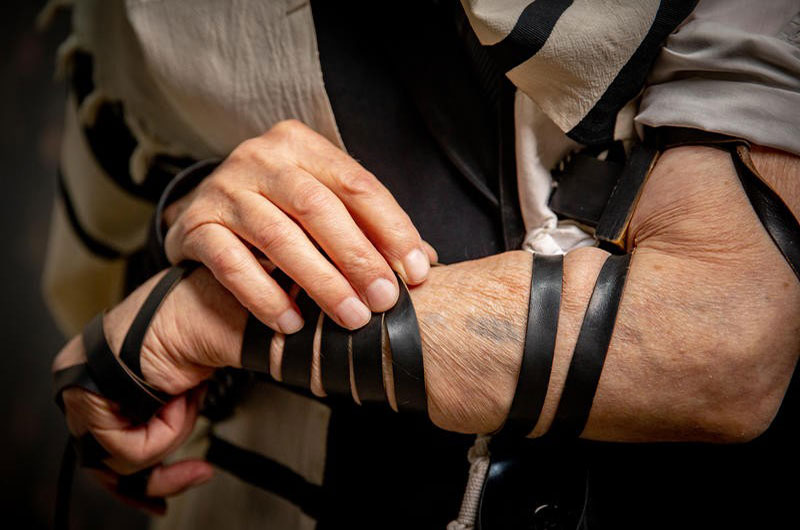
In other words, when we exist in this world of history and struggle, we embody both a “higher self” that encompasses Divine wisdom and a “lower self” that walks the earth and interacts with it. As we have seen, our intellect is insufficient to bridge the gap between these worlds. That distance can only be spanned by pure faith, which alone transcends the human capacity for knowledge. But faith in the mind is of no use in this world of events – the faith must be made manifest in some way. Thus, for example, a Jewish man wears tefillin to demonstrate his faith and his love of Hashem.
Ultimately the greatest demonstration of faith a person can make to bridge the gap between the higher and lower selves is the sacrifice of all matter in this world to a higher purpose. In this way, the lower becomes an aspect of the higher, and the supernal wisdom permeates everything. In this world, Hashem’s spirit imbues us with wisdom, but in the future, when we have succeeded in merging the two worlds, the spirit will also bring us life.
This is why, when the Kohanim bless Israel, they do not specify particular blessings such as wealth, health, and peace. Rather, the blessings they give are that Hashem should turn His countenance upon us, guard us, and so on. In this way, they connect Hashem to His people and the people to Hashem. They link the higher self with the lower self; they put His Name upon us; and then we are blessed by Hashem.