 October 23, 2026
 Categories: Features / Headline
Norman Ciment, America's First Shomer Shabbos Mayor Turns 90
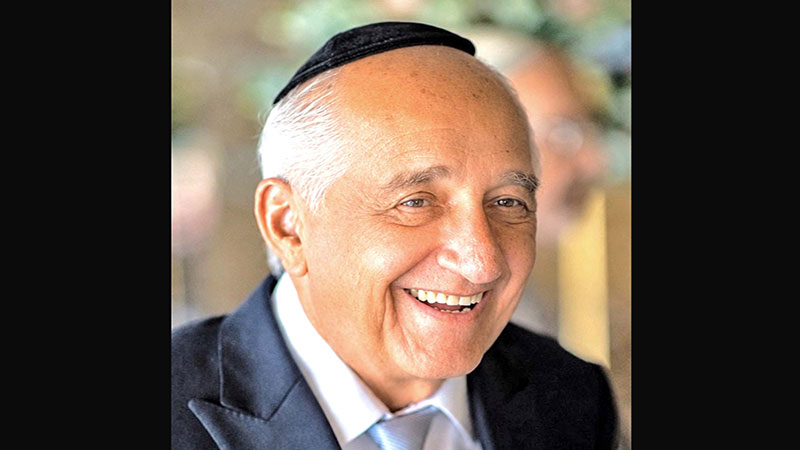


The year was 1936. Franklin Delano Roosevelt was the President and WWII had not yet begun. Shirley Temple and Clark Gable were the number one box stars in the world while names such as Sullivan, Carson, Sinatra, the Beatles and Elvis were still unknown, yet on New York's Lower East Side, America’s first Shomer Shabbos mayor was born.
In 1967 at the ripe old age of 31, he was elected city councilman in Miami Beach, later becoming a Circuit Court Judge, president of ORT, president of Hebrew Academy of Greater Miami, and eventually becoming the first shomer Shabbos mayor in America. Having reached this milestone, I had the privilege to reflect with this legend of a man – who also just happens to be my dad.
Avi Ciment: Did you ever experience the crossroads between religion and politics?
Norman Ciment: A few come to mind. I had the great zechus of meeting the Satmar Rebbe, Rav Yoel, z”l, in the 1950s and then when I became commissioner in 1967, he sent me a telegram congratulating me. Fourteen years later when I became the Mayor of Miami Beach, I remember when our community rav, Rabbi Mordechai Shapiro, z”l, warned me that my position carried great responsibility and that I should remind myself that I represent the Jewish people.
When I was mayor, the honorable Rabbi Tibor Stern, z”l, put a mezuzah on the mayor's office, and then suggested I build an eruv for the community. The story is well documented in my book, Destiny, as well as in the Jewish Museum in Miami Beach, and suffice to say, B”H we got it done.
The second time was when I was invited to be a guest by the president of Santa Marta, Colombia. Saturday morning there’s a knock at my door and I am told there are 2,000 people, including decorated generals, not to mention the president of the country waiting downstairs for me to escort a beauty contest. Naturally, I had no idea of this and B”H was able to walk the entire parade (in a suit and dress shoes no less) and then take a cab home after Shabbos. It certainly wasn’t ideal but I kept my values, just as I refused to take a test on Shabbos in law school (while I was on and off probation.) Thank G-d it all worked out. The berachas all come from Shabbos.
In the early 70s, you became president of the Hebrew Academy. How did that happen?
Well, it was 11 o’clock at night and there was a knock at my door. Rabbi Alexander Gross, z”l, asked if I wouldn’t mind running for president of the Hebrew Academy? I asked why, and he explained to me that most of the old guard was dying out and we needed new blood who were Sabbath observant. And with that I took the lead.
You met some pretty amazing people in your career. From Jackie Gleason, Frank Sinatra, Ed Koch, Simon Wiesenthal, Yitzchak Rabin, Shamir, Ariel Sharon, Menachem Begin, Bibi and Bill Clinton. Who impressed you the most?
Menachem Begin without a doubt. He was a short man, but so powerful. So gentle and eloquent with a twinkle in his eye, yet you knew that somewhere beneath that facade lay a powerful warrior. In fact, the day we met, he was as cool as a cucumber, smiling and laughing, and only 24 hours later he invaded Lebanon.
But I must say that Simon Wiesenthal was also a giant. We sat for two hours in Austria at my hotel where I then invited him to be my guest for the premiere of his latest film, Genocide, in the Lincoln Theatre in South Beach. What a night!
Do you think politics is a good idea for a nice Jewish boy?
It has its challenges and you have to have a strong inner core.
What projects are you working on now?
After visiting Hadassah Hospital in Israel after October 7, I was overwhelmed by the victims of terror and decided to start an educational program for wounded warriors in Israel. Bar Ilan and Tel Aviv University both took the initiative and the response has been overwhelming and met with great success. We are educating wounded soldiers to learn professions that can be adapted to their specific injuries, enabling them to become productive members of society. The classes were overbooked when we initially started and we were forced to add more classes.
Urim Publications recently published your autobiography, Destiny: From Shoeshine Boy to Mayor. The takeaway is how your journey is laced with hashgacha pratis, Divine intervention. Did you realize it at that time?
I’d like to say that I did, but to be truthful, I was “in the race” and didn’t realize it at the time. Hindsight is 20/20. I look back and I realize that Hashem had brought me to several different situations that were unbelievable, but I didn't always recognize it at that time.
I think you did pretty good.
Thank G-d. Like my zaydie always taught me, “Ich bin suffreiden.” (I am satisfied.)