 September 18, 2026
 Ottoman-Era Document Reveals a Battle for the Rabbinate
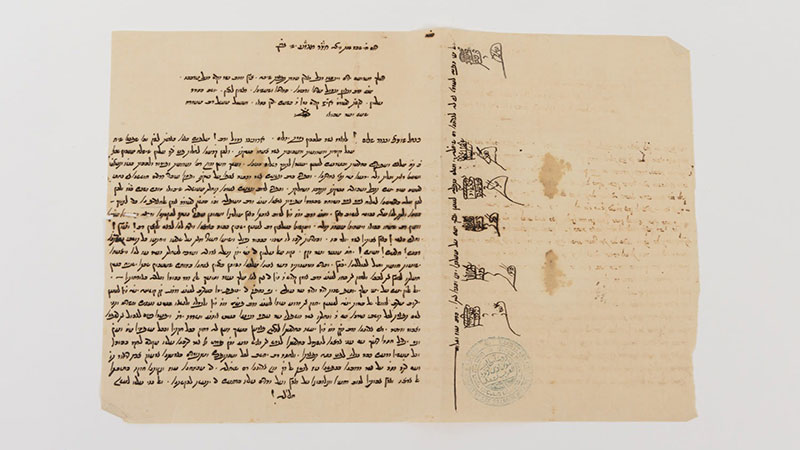


An interesting document I acquired this week was an eye-opener into a world long forgotten: the fraught state of legal rights for Jews in the Ottoman Empire and the complicated layers of influence that controlled lay and rabbinic leadership across the vast realm. Historically, community leaders and rabbis were appointed locally through an elective process or, quite often, inherited roles. In the Ottoman Empire, however, rabbinic appointments were managed via Istanbul and required the approval of the imperial government. This frequently involved direct communication and negotiation with the chief rabbi of Istanbul, the Hakham Bashi.
Inevitably, this bureaucratic structure led to a disconnect between the central leadership in Istanbul and the distant communities themselves, from places as far-flung as Baghdad, Yemen, Algeria, and Aleppo. While highly qualified candidates were often available locally, the ability to communicate with the government in Turkish or the political acumen required to deal with imperial authorities was a scarce commodity among the local rabbinate, who were largely untrained in and unfamiliar with the nuances of Ottoman politics. Consequently, many rabbinical positions were filled by appointees dispatched by the Istanbul Rabbinate and sourced from different corners of the vast empire. It was not unusual for the same rabbi to be shuffled from one community to another as positions opened up. While many such appointees were well-loved by their host communities, there were numerous instances of intense strife arising from the conflicting worldviews and objectives of the transient chief rabbis and their local congregations.
Baghdad, Aleppo, Damascus, and Alexandria are prime examples of cities that witnessed dozens of rabbis and candidates cycle through leadership in the final decades of the empire, with some appointments lasting only a few days or weeks. Rabbinic responsa from this era are rife with fierce debates regarding the advantages of one rabbinic candidate over another.
In this newly acquired document, penned by several prominent rabbis of Tiberias in 1897 and addressed to the chief rabbi of Jerusalem, the great Rishon LeZion, Rabbi Yaakov Shaul Elyashar, one such debate unfolds. At the time, Tiberias had ground to a standstill over who would serve as their official, state-recognized rabbi. For centuries, the old, established Sephardic families had held an absolute monopoly over the rabbinate. However, the city's demographics were shifting rapidly, and by 1897, the majority of Jews in Tiberias were North African immigrants. Despite this population shift, the community was still financially sustained by the Haluka, the distribution of charitable funds sent from the Diaspora, an apparatus tightly controlled by the official chief rabbi.
The North African faction fiercely supported Rabbi Aharon Bachar Alhadif, while the old guard preferred Rabbi Shlomo Rahamim Abulafia, the son of the town's former chief rabbi. This bitter dispute severely disrupted the distribution of the Haluka, leading to a critical shortage of funding and the imminent collapse of the community's finances.
In this urgent letter, the local rabbis of Tiberias beseech chief rabbi Elyashar to dispatch two talmidei chachamim (Torah scholars) from Jerusalem to mediate the crisis and calm the rival camps. Furthermore, they request his political assistance in writing to Istanbul to officially confirm their consensus candidate, Rabbi Alhadif, as the recognized chief rabbi of Tiberias.