 October 9, 2026
 Categories: Headline / Book Reviews / Arts
Peeling Back the Layers: Rabbi Fohrman’s Parsha Companion
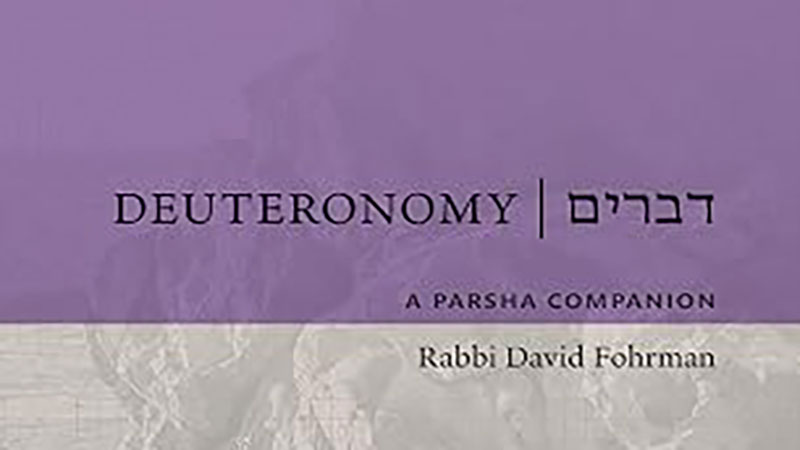


Title: Deuteronomy: A Parsha Companion
Author: Rabbi David Fohrman
Koren Publishers/Maggid
Some answer your questions. Rabbi David Fohrman first teaches you to notice questions you never realized were there. That talent is on full display in Deuteronomy: A Parsha Companion, the fifth and final volume in his Parsha Companion series, published by Koren and Maggid Books in partnership with Aleph Beta. Readers who know Rabbi Fohrman from his acclaimed books – including The Queen You Thought You Knew, The Exodus You Almost Passed Over, and The Beast That Crouches at the Door – will immediately recognize his distinctive style. Koren was fortunate to find an author like Rabbi Fohrman for this project, and Rabbi Fohrman was equally fortunate to have Koren as the publisher of this attractive high-quality volume. The collaboration with Aleph Beta, whose visually engaging Torah videos have introduced thousands to his approach, feels like a natural fit.
My wife recently described Rabbi Fohrman's method better than I ever could. After reading his treatment of the Aseres HaDibros in the recent Parshas VaEschanan, she remarked that reading one of his essays is like peeling an onion and then somehow putting it back together again. He peels away layer after layer of a familiar section, asking why a word appears here instead of there, why a phrase sounds oddly familiar, or why two seemingly unrelated sections stand side by side. By the end, all the pieces fit together again, but the reader is left seeing the Torah in an entirely new way.
At first glance, this week’s Parshas Re'eh seems like a challenging one to present to the modern lay reader, consisting largely of sometimes abstruse laws and detailed regulations. Yet Rabbi Fohrman somehow makes it feel surprisingly contemporary. His very relevant chapter on Re’eh discusses cheeseburgers, speeding tickets, a broken taillight, and his cross-country family road trip. These are not gimmicks but rather serve as bridges into serious Torah ideas. In fact, that is perhaps what Rabbi Fohrman does best. He begins with something completely ordinary and ends somewhere you never expected to go. A discussion about cheeseburgers becomes an exposition on why the Torah requires detailed laws instead of asking us simply to love G-d. A traffic story develops into a discussion of the relationship between the Written Torah and the Oral Torah. Along the way, he raises subjects that are not always given much attention in Torah literature, including vegetarianism and the Torah's concern for the welfare of animals.
His trademark method of reading Tanach also appears throughout the volume. His discussion of our parsha, for example, unexpectedly leads back to Adam and Chava in Gan Eden and then to Noach after the Flood. Rabbi Fohrman has an uncanny ability to recognize recurring words and themes throughout Tanach and use them to illuminate the local topic. What may initially seem like a surprising comparison gradually becomes persuasive as he patiently walks the reader through the evidence.
Just as memorable as his textual insights are his parables. A very illustrative one in this week’s parsha imagines a man meditating for hours, sitting on a stone floor, complete with closed eyes and burning incense, as he contemplates his wife’s greatness and his undying love for her. Eventually, however, his wife interrupts his session with a simple request: perhaps he could help in the kitchen or change a diaper. The point is both humorous and profound. Love that never finds expression in ordinary actions eventually withers. As Rabbi Fohrman writes, "If you truly love me, that feeling should translate into actions. Regular, mundane actions. Those actions make it real." It is a perfect example of how he uses an engaging story to illuminate a fundamental Torah principle, leaving the reader with a vital new insight as to why the Torah seems so focused on its mandates and laws.
The same chapter includes a delightful observation quoted in the name of Rabbi Berel Wein: "Life is like chewing gum: First you get a little flavor, and then it's all chew, chew, chew." Rabbi Fohrman uses the line not merely because it is funny, but because it captures a profound truth. Inspiration is wonderful, but both lasting relationships and lasting religious commitment are built through the routine actions that follow long after the excitement has faded.
One of the great strengths of this series is that it succeeds with very different audiences. A reader with relatively little Torah background will find Rabbi Fohrman's conversational and entertaining style inviting and accessible. At the same time, the seasoned student will discover fresh perspectives on familiar texts. Rabbi Fohrman also knows when to point readers beyond his own essays, directing them to more extensive works, such as Rabbi Yehuda Copperman's Peshuto Shel Mikra, for those who wish to explore particular topics in greater depth.
Commentaries on Chumash are hardly in short supply. Yet Rabbi Fohrman has carved out a niche that feels uniquely his own. He has the rare ability to combine close textual reading, broad Tanach connections, modern examples, psychology, humor, and compelling storytelling without ever losing sight of the Torah text itself. By the time one finishes an essay, the Torah has not changed – but somehow the reader has. That is no small accomplishment, and it is what makes Deuteronomy: A Parsha Companion such a rewarding conclusion to an outstanding series.