 September 4, 2026
 Categories: Headline / Perspectives / Op-Eds
‘Rescuing Publishing’ from Israel’s Enemies


When New York Times columnist Bret Stephens told a 92nd Street Y audience that fighting antisemitism is “mostly a wasted effort” and urged that related financial resources be reallocated for Jewish education, his remarks sparked a long-overdue discussion about priorities and strategy.
The debate that followed has mostly been productive. It forced a needed question: where should communal energy be directed to secure a vibrant Jewish future?
I don’t pretend to have all the answers. I’m inclined to think education must be central, while defense agencies have a vital role to play – provided they focus on defending Jews and the Jewish State.
But I do know this: one line in Stephens’s speech received far less attention than it warranted.
He observed that Zionism has become a “dirty word” in the publishing industry, adding that we must “rescue publishing.”
That remark should not be dismissed as an aside. It speaks to something larger. In significant sectors of today’s cultural world, support for Israel is treated as a professional risk and the Zionist movement is grotesquely maligned as reactionary and even racist rather than recognized for what it is – the national liberation movement of the Jewish people.
This matters because stories shape how people understand events. Most people don’t form their views from policy papers or academic debates. They absorb narratives – about what is just, legitimate, heroic, or shameful.
Novels, films, biographies, and documentaries of the mid-20th century were instrumental in building backing for Israel. They gave audiences a way to see the struggle for Jewish statehood as a cause that was rooted in history and plainly just.
Stories influence policy as well. Elected officials operate within a cultural climate shaped by the narratives circulating among voters, journalists, and opinion leaders. When Israel is viewed as the outcome of national liberation and survival after catastrophe, support feels natural. When Israel is cast primarily as an aggressor or colonial anomaly, support must be defended constantly.
The effect inside the Jewish community is significant. Most American Jews lack strong foundations in Jewish education. When pro-Israel stories circulate widely, Jewish identity is reinforced. When delegitimizing narratives dominate, doubts grow.
For much of the 20th century, mainstream culture supplied important positive narratives. Commercial fiction and major studio-financed films played a central role in shaping Jewish pride and Zionist literacy.
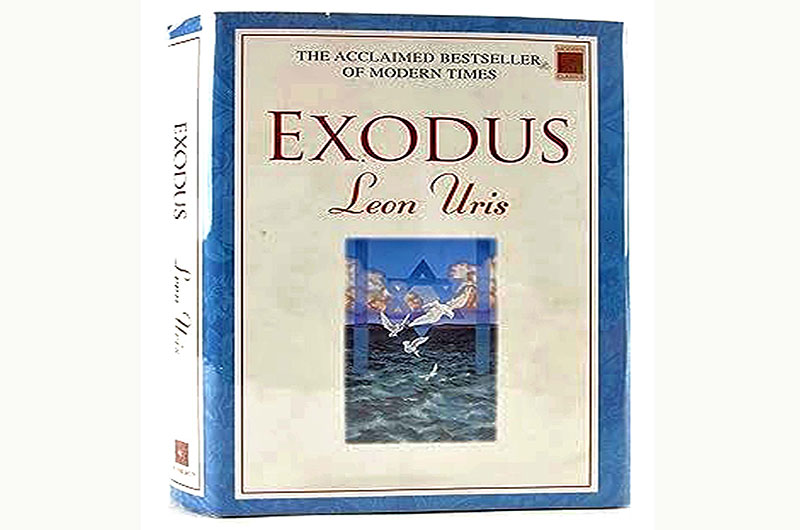
Leon Uris’s Exodus turned the story of Israel’s birth into a compelling epic of Jewish heroism and national renewal, with measurable impact on Jewish morale and Israel’s image. The novel sold millions of copies and became a hugely successful Hollywood film. It fused Holocaust memory, underground resistance, immigration, diplomacy, and a war for independence into a narrative readers absorbed as moral history. Israel’s founding was rightfully depicted as the remarkable result of organization, sacrifice, and political will.
Uris’s later novel Mila 18, about the Warsaw Ghetto uprising, likewise presented Jews as fighters and agents of their own destiny rather than passive victims.
Those works helped form a generation for whom Israel was a source of pride, and for whom Jewish resistance and rebellion was central to identity.
Exodus wasn’t the only work of its kind. Meyer Levin’s novels The Settlers and The Harvest, along with numerous other works of fiction set in Mandate-era Palestine and the early years of the state, contributed to a broader cultural atmosphere in which Zionism was portrayed as one of history’s most heroic and inspiring movements. These books may not have matched the scale of Exodus, but they helped readers grasp the realities of establishing and defending a nation against overwhelming odds.
Espionage fiction placed Israel within Cold War narratives familiar to American readers. Israeli intelligence and military struggles were woven into the larger contest between democracy and totalitarianism, reinforcing the perception of Israel as aligned with the West and embedded in global strategic realities.
Alongside novels and films stood a substantial body of nonfiction.
Histories of the Yishuv and the early state, biographies of Zionist and Israeli leaders, and memoirs of diplomats and soldiers created continuity between exile, political mobilization, underground struggle, and sovereignty. Autobiographies and firsthand accounts reinforced that sense of agency.
For decades, such books were readily available in general bookstores and university libraries. They helped shape Americans’ understanding of Israel and Jewish peoplehood.
Film reinforced that picture.
Cast a Giant Shadow portrayed American volunteers fighting in Israel’s War of Independence and linked Israel’s struggle to familiar American themes of courage and alliance.
Hill 24 Doesn’t Answer, one of Israel’s earliest feature films, depicted the War of Independence as a shared national effort across political lines.
The Israeli comedy Sallah Shabati dealt with immigrant absorption in a pioneering society, presenting Israel as a living country rather than a distant dream.
Israeli films like Hill 24 Doesn’t Answer and Sallah Shabati could still be made today. The difficulty lies in distribution. Securing broad international release through major studios, streaming platforms, or leading festival circuits would be far more difficult in the current climate. Even if distributed, such films would likely face organized boycotts and disruptive protests.
In today’s cultural climate, a new Exodus or Mila 18 would struggle mightily to find a major publisher, let alone a studio adaptation. Books and films condemning Israel – far less so.
In fact, anti-Israel books have become a genre. Editors and studio development executives are under intense ideological and institutional pressures, from internal staff activism to external campaigns, to avoid or neutralize narratives that foreground Jewish heroism and the justice of Jewish sovereignty in the Land of Israel.
That reality shapes what gets written, acquired, promoted, and taught.
The situation is so bad that in some sectors of today’s literary world, one of the most reliable ways for a Jewish writer to secure attention and institutional approval is to attack Israel – precisely “as a Jew” – even to the point of questioning its legitimacy.
The cultural climate is thus reshaped over time. Public opinion shifts, and Jewish confidence shifts with it.
There are, in effect, only two ways to rescue publishing and media in an environment where the word Zionist has perversely been turned into a slur and support for Israel is treated as a professional liability.
One way might be called the CBS News model. A mega-rich benefactor acquires a major legacy platform and uses ownership power to disrupt its culture, dismantle its bias-enforcing hierarchies, and install editors who are unapologetically committed to intellectual pluralism and to normalizing Zionism as a respectable point of view.
The recent elevation of Bari Weiss – who cheerfully calls herself a “Zionist fanatic” – to run CBS News illustrates how a single acquisition, backed by a billionaire prepared to endure elite outrage, can pry open a seemingly sealed institution and create room for stories, voices, and arguments that would otherwise never have cleared the internal censors.
But this route is by definition rare and precarious. It depends on staggering amounts of capital, on the quirks and courage of a tiny number of moguls, and on their willingness to keep resisting pressure from advertisers, activist stockholders and employees, and social networks that will relentlessly try to pull any heretical outlet back into the left/liberal consensus.
To construct a strategy for Jewish self‑respect and the defense of the Jewish State on the hope that a few white knights will periodically buy a network or newspaper is to confuse a possible tactical windfall with a viable strategic plan.
The other way forward is to build independent platforms and outlets to tell Israel’s story.
There are contemporary examples. When Bari Weiss left The New York Times, she demonstrated the necessity of independent media spaces. Instead of pleading for inclusion within narrowing institutions, she launched a Substack newsletter titled Common Sense. The name was later changed to The Free Press – which Weiss built into a media company before selling it to Paramount Skydance for a whopping $150 million.
In a plot twist itself worthy of a Hollywood film or streaming series, the conglomerate’s Chairman and CEO, David Ellison, installed her as head of CBS News.
History offers other examples – less spectacular but still relevant.
In 1948, Meyer Levin produced The Illegals, a riveting low-budget docudrama about Holocaust survivors attempting to reach Palestine despite British restrictions. The film, which blended real characters and events – and inspired Uris to write Exodus – relied on alternative distribution channels rather than the major studio system.
Two years earlier, Ben Hecht staged A Flag Is Born to raise funds for Zionist political activity. The production featured a young Marlon Brando, then an acclaimed young stage actor rather than the global movie star he would later become. Brando also appeared at fundraising events connected to the play.
Hecht and the American League for a Free Palestine also produced Last Night We Attacked (1947), a short, documentary-style advocacy film about the Irgun, which was screened through independent circuits and used to raise funds for the underground organization.
After the Six-Day War, when segments of the New Left turned sharply against Israel, an indigenous Jewish student press emerged. With support from foundations such as the American Zionist Youth Foundation, pro-Israel publications flourished across America’s college campuses.
Today’s tools make it easier than ever to produce and distribute content. Print-on-demand publishing, digital distribution, podcasts, and social media make it possible for content creators to reach and influence global audiences without passing through gatekeepers.
Following Bret Stephens’s call to action, imagine redirecting even a fraction of “fighting antisemitism” budgets toward building a new media ecosystem – in the Jewish national interest – producing broadly appealing novels, nonfiction books, graphic narratives, documentaries and docudramas, and even feature films.
There’s a rich history to be mined – for the first time, in many cases. A professionally produced graphic history of the rise of Jewish self-defense organizations against pogroms in Tsarist Russia, for example, or the formation and exploits of the Hashomer – the pioneering Jewish defense organization that laid the foundations for the Haganah, later the nucleus of the Israel Defense Forces – could accomplish more than a hundred academic seminars.
The stakes could not be higher. Continued American support for Israel may largely depend on our ability to effectively tell its story to Jewish and non-Jewish audiences.
In other words, it isn’t publishing that most urgently needs rescuing. It’s Zionism – the increasingly endangered cause that is central to our security and survival as a people.