 October 16, 2026
 Categories: In Print / Headline / Torah
Scheduling Selichot & Atoning for the Spies


Parshat Ki Tavo
This Shabbat, we read Parshat Ki Tavo, and Ashkenazim begin saying Selichot this Motza’ei Shabbat (or early Sunday morning). Sephardim (Eidot Mizrach) have been saying Selichot since Tuesday, the 2nd of Elul.
Here’s the story...
While Sephardim (Eidot Mizrach) say Selichot throughout the month of Elul, Ashkenazim say Selichot for a minimum of four days before Rosh Hashana. And Ashkenazim always start Selichot on a Motza’ei Shabbat (or early Sunday morning).
Parshat Nitzavim is always read on the last Shabbat of the year – the Shabbat right before Rosh Hashana. Sometimes, Nitzavim is read then on its own; sometimes it is combined with Vayeilech. This means that Ki Tavo is always the penultimate Shabbat of the year. Nitzavim is the buffer between Ki Tavo, with its harsh, depressing tochacha – and the Yamim Norai’m, since our parsha would not be a good choice to bring us into Rosh Hashana. Nitzavim has a much more uplifting and encouraging tone. It takes us into Rosh Hashana nicely.
Because of the rule known as “Lo A-D-U Rosh” (not on alef, dalet, or vav), there are three days of the week that Rosh Hashana’s first day cannot fall on – Sunday, Wednesday, and Friday – and thus four days of the week that it can: Monday, Tuesday, Thursday, and Shabbat.
When Rosh Hashana is Thursday-Friday (31.89% of years), then the previous Shabbat is Nitzavim-Vayeilech combined, and Selichot begins on Motza’ei Shabbat (Motza”Sh) of Nitzavim-Vayeilech, giving us four days of Selichot (which is three days plus erev Rosh Hashana, on which we say a much longer set of Selichot).
When Rosh Hashana is Shabbat-Sunday (28.57% of years), then the previous Shabbat is likewise Nitzavim-Vayeilech combined, and Selichot begins on that Motza”Sh, giving us six days of Selichot (five days plus erev Rosh HaShana).
When Rosh Hashana is Monday-Tuesday (28.03% of years), then the previous Shabbat is Nitzavim on its own – but if Selichot were to begin on that Motza”Sh, there would only be one day of Selichot. So, Selichot begins on Motza’ei Shabbat one Shabbat earlier – Motza”Sh of Ki Tavo – giving us seven days of Selichot (six plus erev Rosh Hashana).
Finally, when Rosh Hashana is Tuesday-Wednesday (as it is this year, an 11.51% occurrence), then the previous Shabbat is Nitzavim on its own – but if Selichot were to begin on that Motza”Sh, there would only be two days of Selichot. So here too, Selichot begins on Motza’ei Shabbat one Shabbat earlier – Motza”Sh of Ki Tavo, giving us eight days of Selichot (seven plus erev Rosh Hashana).
Nitzavim and Vayeilech are combined 60.46% of years. The following Shabbat is Shabbat Shuva of the new year, and we read Ha’azinu.
Nitzavim and Vayeilech are read separately 39.54% of years. The following Shabbat is Shabbat Shuva of the new year, and we read Vayeilech. Ha’azinu is then read on the Shabbat between Yom Kippur and Sukkot.
In all years, the calendar is ready (so to speak) for Ve’zot HaBeracha on Simchat Torah.
Now here’s Ki Tavo by the numbers (and more) ...
Ki Tavo is the 50th of the 54 sedras in the Torah. That means there are only four more sedras to read before we complete the current round of reading the entire Torah: Nitzavim (40 pesukim) next Shabbat, the last Shabbat of 5785; Vayeilech (30 pesukim) on Shabbat Shuva of the new year 5786 (HA”L – Habaa Aleinu L’Tova); Ha’azinu (52 pesukim) on the Shabbat between Yom Kippur and Sukkot; and Ve’zot HaBeracha (41 pesukim) which we will read on Simchat Torah (Tuesday, October 14 in Israel; Wednesday, October 15 in Chutz LaAretz).
Interestingly, Nitzavim, Vayeilech, and Ha’azinu total 122 pesukim – the same as Ki Tavo. Add Ve’zot HaBeracha, and the four last sedras of the Torah have 163 pesukim among them, fewer pesukim than either Naso or Pinchas, the two longest sedras.
Ki Tavo has 21 parshiyot (5 open and 16 closed). Not the most, but significantly above average (which is about 12.5 parshiyot per sedra). This means that there are blank spaces which result in Ki Tavo’s 233 lines in a Sefer Torah ranking it 13th, compared with its 122 pesukim which earn it 17th place pesukim-wise, tied with Vayakhel and Va’etchanan.
Ki Tavo’s pesukim are longer than average, but short for the Book of Devarim.
Speaking of pesukim, the distribution of pesukim among the seven aliyot is remarkable. The seven aliyot have 11, 4, 4, 10, 22, 63, and 8 pesukim, respectively. Shishi contains the tochacha – the harsh rebuke and warning against abandoning Torah and mitzvot. The practice is to contain the rebuke (here in Ki Tavo as well as in Bechukotai) within a single aliyah. This results in the longest of the Torah’s 378 aliyot, with 63 pesukim (not counting R’vi’i of the combined Matot-Mas’ei, which has 72 pesukim).
Regarding mitzvot in our sedra, let’s put things into perspective. The previous three sedras were loaded with mitzvot. Shoftim had 41; R’ei, 55; and Ki Teitzei, 74 – for a total of 170 mitzvot. The following 18 sedras – four more in Devarim, all 12 in Bereishit, and the first two sedras of Shemot, have a total of 5 mitzvot!
And Ki Tavo’s six mitzvot (3 positive and 3 prohibitions) sound like a low number, but actually, there are 22 sedras with more mitzvot, Pinchas with 6 also, and 30 sedras with fewer mitzvot.
Note, too, that the six mitzvot in Ki Tavo are all in the first 19 pesukim of the sedra. That’s a little more than 15% of the sedra. In fact, in the Vilna Gaon’s analysis of the Book of Devarim, he presents Shoftim, R’ei, Ki Teitzei, and the first part of Ki Tavo as the middle of three sections in the Book.
Let’s look at the first of Ki Tavo’s mitzvot – Bikurim, Part Two.
Bikkurim, Part One – the mitzvah to bring the first fruits of the Seven Species to the Beit HaMikdash – is commanded in half a pasuk back in Parshat Mishpatim. The exact same pasuk is repeated in Parshat Ki Tisa. (The other half of the pasuk, each time, is “Do not cook a ‘g’di’ in the milk of its mother.”)
In this week’s sedra we find the mitzvah – counted separately among Taryag (the 613 mitzvot), commanding the bikkurim-bringer to recite the special bikkurim portion made famous by the Pesach Haggadah: “And you shall call out and say before the L-rd, your G-d, ‘An Aramean [sought to] destroy my forefather, and he went down to Egypt and sojourned there with a small number of people, and there he became a great, mighty, and numerous nation. And the Egyptians treated us cruelly and afflicted us, and they imposed hard labor upon us. So, we cried out to the L-rd, G-d of our fathers, and the L-rd heard our voice and saw our affliction, our toil, and our oppression. And the L-rd brought us out from Egypt with a strong hand and with an outstretched arm, with great awe, and with signs and wonders. And He brought us to this place, and He gave us this land, a land flowing with milk and honey.’”
It is said of bikkurim: “Do this mitzvah, for in its merit you will enter the Land.” The Ari HaKadosh singles out bikkurim as the mitzvah which is the tikkun (repair) for the Sin of the Spies. Bikkurim has a Torah-commanded, built-in recitation that helps us focus our thoughts in a particular direction. With this recitation, the Jew identifies himself with his Jewish heritage and announces to one and all the centrality of Eretz Yisrael in G-d’s plans for the People of Israel.
Bikkurim makes the statement that we are glad to be here. Being happy about being in Eretz Yisrael grants us the zechut to be here. Joyfully thanking G-d for our being here helps “repair” the opposite attitude as expressed by the 10 spies and echoed by the panicked multitude. The Sin of the Spies was committed by what the Meraglim said, and it was while they were displaying fruits of Eretz Yisrael, no less. Bikkurim is the mitzvah that is performed by what the bikkurim-bringer says (in addition to bringing the fruits), and while he displays fruits that he brought from the Land. A perfect match (in opposites)!
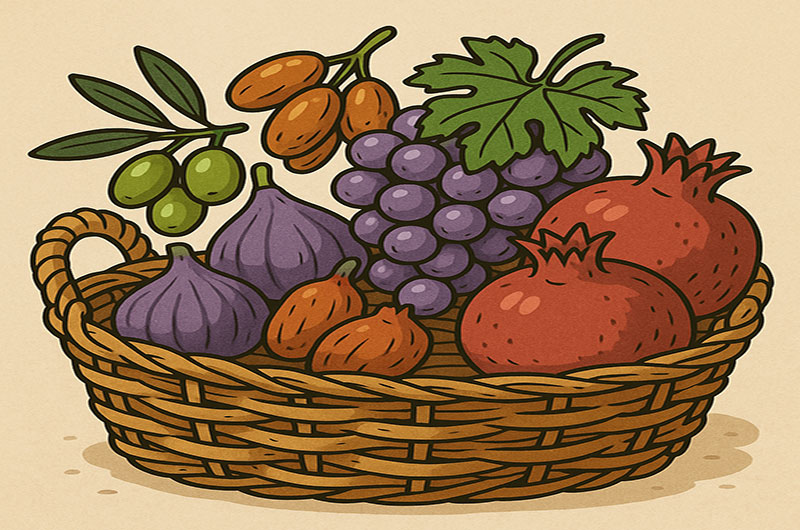
Rav Menachem Zemba, Hy”d, added a beautiful note to the above notion that bikkurim is the positive counterpart to Cheit HaMeraglim. Look in Mishna, Bikkurim 3:1: How does one designate his bikkurim? A person goes into his fields and sees a ripe fig, a ripe cluster of grapes, a ripe pomegranate... The Mishna uses as an example of bikkurim the very same three fruits that the Meraglim brought with them to show to the people. A perfect exclamation point to the statement of the Ari, z”l.
Bikkurim is a prime example of hakarat hatov, recognition and acknowledgement of the good that G-d does for us. We must apply this lesson to other areas of mitzvot and life in general. Do all mitzvot with the recognition that we are part of the Nation that Hashem chose as His. That simcha is – should be – part of every mitzvah we perform.
May we soon be privileged to bring bikkurim with all the joy and Jewish pride that signify that we are truly pleased to be chosen by G-d as His people and that we are genuinely thankful for this wonderful Land.
Shabbat Shalom and a meaningful Selichot period.