 October 16, 2026
 Categories: Book Reviews / Arts
Something New to Read Over Shabbos
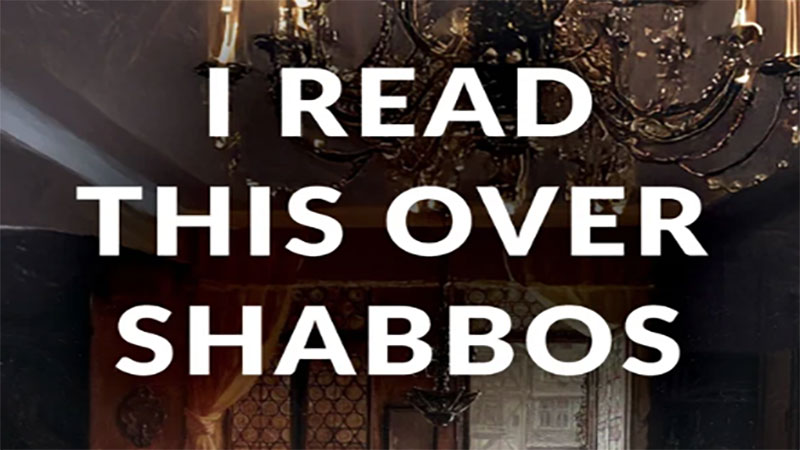


Title: I Read This Over Shabbos: Reading Jewish History in the Parasha
By: Rabbi David Bashevkin
Maggid Books
Many parsha books use the weekly parsha to illuminate Torah ideas. Rabbi David Bashevkin's I Read This Over Shabbos does something slightly different: it uses the parsha to illuminate Jewish history.
Readers familiar with Rabbi Bashevkin through his popular "18Forty" podcast will immediately recognize his voice. In fact, while reading the book, my wife, familiar with his podcast, remarked that she could practically hear him speaking as she read. The writing retains the curiosity, humor, and intellectual range that have made the podcast so successful.
Yet the book is far more than a collection of podcast summaries. Based on weekly shiurim Rabbi Bashevkin delivered in his Long Island and Teaneck communities, the volume explores personalities, movements, controversies, and ideas from across Jewish history through the lens of the weekly parsha. The result is a work that is both ambitious, but also surprisingly accessible.
The breadth of material is striking. In the chapter on Bereishis, Rabbi Bashevkin introduces readers to Sir Isaac Newton's fascination with religion, Jewish thought, and even Kabbalah. Translations of the Rambam’s Mishna Torah were found on his shelves. For this week’s Parshas Noach, Rabbi Bashevkin explains the significance of "1840," the year from which his podcast takes its name, and discusses the kabbalistic prediction that both secular and religious wisdom would burst forth into the world. By the time the reader reaches Lech Lecha, Rabbi Bashevkin is examining the life and thought of Rabbi Elmer Berger, a Reform rabbi famous for his fierce anti-Zionist views, while his footnotes direct readers to Rav Yitzchak Hutner's Pachad Yitzchak and its discussion of a tradition attributed to the Vilna Gaon concerning the redemption. Few authors move so comfortably between such disparate figures and ideas.
One of the book's strengths is that it rewards both longtime listeners and those entirely new to Rabbi Bashevkin's work. I was already familiar with the fascinating story of the Yabloner Rebbe, who left the religious world and returned near the end of his life, a narrative that appears in the Nitzavim-Vayeilech chapter. Nevertheless, reading the chapter added substantial detail and context and included photographs that enriched the story in ways that a podcast’s audio presentation could not.
The format is particularly well suited to Shabbos reading. Each chapter is concise enough to be read in a sitting, yet substantial enough to leave the reader with a meaningful idea or historical insight. Rabbi Bashevkin understands that not every reader is looking for a lengthy scholarly treatment on Shabbos afternoon. At the same time, those who wish to explore further will appreciate that each chapter concludes with references to the books and articles discussed, providing a roadmap for deeper study.
I found myself repeatedly impressed by the author's range and fascinated by his ability to make unfamiliar historical episodes feel relevant. I Read This Over Shabbos succeeds in what many books aspire to do but few accomplish, entertaining, educating, and inspiring all at once. Readers may come for the Parsha, but they are likely to leave with a much broader appreciation of the people, ideas, and stories that have shaped Jewish history.