 October 16, 2026
 Categories: Featured / Headline / Parsha / Holidays / Torah
Standing Still at Sinai: A Journey of Choice
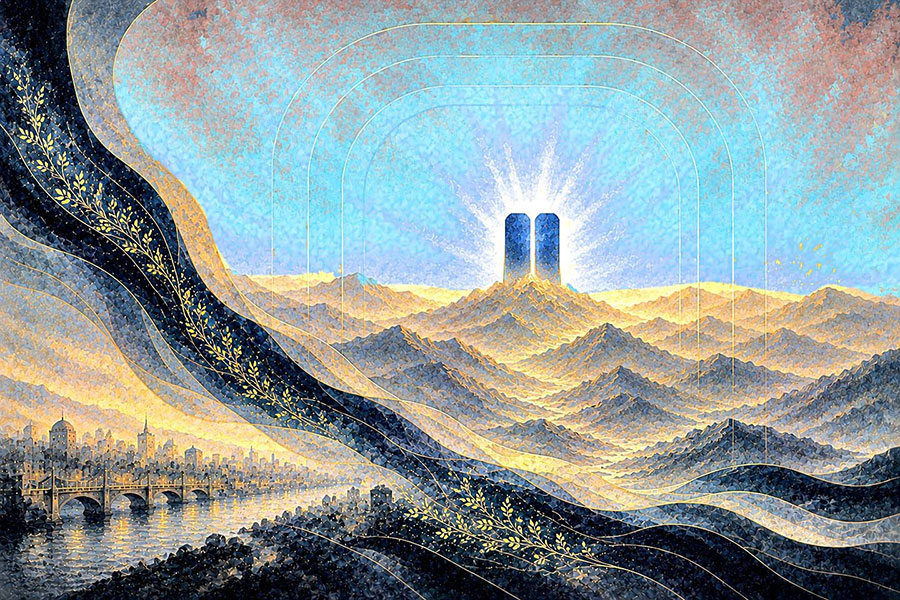


I did not know that my favorite Jewish holiday would be the one that found me in motion. Shavuos met me in more cities than I can count, in borrowed rooms and temporary spaces, in communities that held me for a moment and then released me to the next stage of becoming. But the Shavuos that shaped me most happened in Pittsburgh, in the last months before my geirus, when I was living with a family in Atlanta and waiting for the moment, I would finally be counted among Klal Yisrael.
Rabbi Ilan Feldman had not given me a date, only a patient “not yet” and the understanding that he would tell me when the beis din was ready to convene. I was almost a Jew, keeping everything except for one small act each Shabbos, a quiet reminder that it was not yet mine. And so I found myself in Pittsburgh, not because of a spiritual plan, but because the mother of the family I lived with had relatives there. It was my third Jewish community, and I was living a Jewish life while still halachically outside. Before the chag began, they handed me a book on Shavuos. I still have it, and I read it every year. The inscription is earnest and hopeful, written by people who saw something in me that I was still learning to see in myself. Whatever unfolded later, that book remains a marker of that moment – the last Shavuos I spent in the in-between, standing at the edge of Sinai but not yet inside.
Ruth and the Courage to Choose
Years later, I heard a rabbi say that Megillas Rus is not really about converts. At the time, I was sitting next to a dear friend who was also a ger, and we both reacted with the same startled look. It felt as if someone had taken away the one text that was supposed to be ours. But the more I live with the story, the more I realize that perhaps he was right in a way he did not intend. Ruth’s story is not about conversion as a moment. It is about covenant as a life. Her geirus is not described as a ceremony. It is described as a relationship. She chooses Naomi. She chooses the Jewish people. She chooses a life of chesed. She chooses a future she cannot yet see. She walks toward a people who have not yet claimed her, and she lives as if she belongs long before anyone formally recognizes it. Her declaration is not a request; it is a truth. It is the articulation of a loyalty that has already taken root. Ruth is not the story of a convert. Ruth is the story of a Jew. And that is the deeper truth of Shavuos. It is the holiday of people who step forward before they know what they are stepping into. It is the holiday of Naaseh v’nishma, the holiday of doing before understanding, the holiday of choosing before knowing the cost. Chazal describe Ruth as the mother of royalty – not because of her lineage, but because of her courage. Her story is the reminder that Jewish identity is not only inherited – it is also chosen. It is lived. It is enacted. It is renewed. Ruth teaches that belonging is not something granted from the outside. It is something that grows from within.What Shavuos Centers
Shavuos is the most understated of the Shalosh Regalim. There is no sukkah to build, no matzah to bake, no shofar to blow. There is only the act of receiving Torah, and the quiet courage that receiving requires. On the first day, we read the account of Matan Torah in Shemos. The Jewish people stand together “k’ish echad b’lev echad,” as one person with one heart. The Torah is given in the midbar, a place that belongs to no one, so that no tribe or lineage can claim ownership. Revelation happens in a place that is open, unclaimed, and free of hierarchy. The midbar is the great equalizer. It is the place where no one can say that Torah belongs to them more than to anyone else. We read the Merkavah in Yechezkel, a vision that insists that the presence of Hashem is not confined to geography. We read the laws of generosity and festivals in Devarim, which assume a society where everyone belongs and where holiness is enacted through daily life. We read the trembling prayer of Chavakuk, a prophet who finds faith in uncertainty. And we read Megillas Rus, the story of a woman whose courage becomes the foundation of Jewish royalty. We also recite Akdamus, the ancient Aramaic poem that precedes the Torah reading. It is a reminder that receiving Torah is not passive. It is an act of awe. It is an act of willingness. It is an act of stepping forward. Shavuos is the holiday where belonging is enacted, not inherited. It is the holiday where identity is chosen, not assumed. It is the holiday where the Jewish people become a people not by lineage, but by consent. It is the holiday that reminds us that Sinai was not a moment of ancestry. It was a moment of choice.A Jewish Life Formed in Motion
My Jewish life was shaped in motion. I did not inherit it. I built it, community by community. Atlanta was my first real home in Jewish life. I lived with one family who opened their doors to me while I prepared for geirus, and I spent time with many others who welcomed me into their homes with the same generosity. In those rooms and around those tables, I learned the rhythms of halacha by living inside them. Atlanta taught me that Jewish life is not an idea. It is a practice. It is a way of moving through the world. Pittsburgh was my last Shavuos before the mikvah. It was the place where I stood at the edge of Sinai and felt the ache of not yet belonging. It was the place where I received the book that still sits on my shelf, the book that reminds me of the year when I was almost inside. After that came the Catskills, where I spent part of the summer in a Chabad women’s learning program. It was the first time I lived in a community where Torah was the center of daily life. It was the first time I saw what it meant to live in a place where learning was not an activity, but an atmosphere. It was the first time I understood that Torah is not something we visit. It is something we inhabit. Crown Heights came next. I was in seminary, and it was intense and alive and overflowing with Jewish life. It was a place where I learned a great deal, but it was not yet my place. Then I returned to Atlanta, which had become my resting point, and I went back to college determined to live as a Jew in the wider world. Some of the moves that followed were quiet and practical, and some were dramatic, the kind that rearrange your life more than you expect. I almost moved to Houston, spent time in Borough Park, and eventually found myself back in Georgia again. Borough Park showed me what it means to live inside a fully Jewish world, a place where the rhythms of Torah shape every corner of daily life. Atlanta showed me how warmth and halacha can live side by side, how a community can hold both structure and gentleness. Through all of this, I was learning how to build a Jewish life even when the ground beneath me kept shifting. The movement itself became a kind of education. Each community revealed a different facet of Jewish life, and each one asked something different of me. Some places were immersive, others intense, others quiet, and others overflowing with energy. I was always grateful to be welcomed in, yet I always knew I was passing through. Those years taught me how to create belonging without permanence, how to root myself in practice even when I could not root myself in place. I learned how to carry Torah with me from one community to the next, trusting that the wandering was shaping me in ways I could not yet see, and that one day it would settle into something steady.Indianapolis as My Sinai
Indianapolis was the first place where I stood still long enough to become my own person inside Jewish life. For the first time, I found home where I began building a life on my own terms, and became part of a community in a way I had never been before. It gave me a stillness I had never known – the kind that lets you hear your own voice. Torah settled into my days quietly and steadily, through the consistency of living a Jewish life that was finally my own. Only after I left Indianapolis did the Shusterman family invite me back to speak at their “Ten Torah Talks Under the Tent,” an invitation that felt like a recognition of what had already begun to take shape during my years there. Indianapolis was the first place where I was not a visitor to Jewish life. It was the first place where I felt I belonged. If Pittsburgh was my last Shavuos on the outside, Indianapolis was my first Shavuos fully inside. It was my personal Maamad Har Sinai, not because of anything dramatic, but because it was the first time I experienced belonging as something lived rather than hoped for. It was the place where I learned that being part of a community is not only about being counted. It is also about being needed, in small and quiet ways.New Jersey as My Eretz Yisrael
After years of wandering through “out-of-town communities,” New Jersey became the first place I was not passing through. Teaneck and now Passaic are the first communities where my Jewish life feels rooted. No, not my Eretz Yisrael in geography, but my Eretz Yisrael in belonging. It is the place where I am not living in someone else’s Jewish life. It is the place where I am not in-between anymore. It is the place where my covenantal life finally took root. Every Jew has two Eretz Yisraels – the one on the map, and the one where their Jewish life becomes real. After all the places I passed through, this is where I chose and where I was chosen back.Shavuos as the Holiday of Choosing, and Being Chosen in Return
Shavuos is the holiday of becoming. It is the holiday of standing still after movement. It is the holiday of covenant by choice. Every year, when I hear the Aseres HaDibros, I remember Atlanta, Pittsburgh, Indianapolis, and Passaic. I remember the places where I stood at Sinai in different ways. I remember the places where I learned that belonging is not inherited. It is lived. It is chosen. It is renewed. Shavuos is not the holiday of where we come from. It is the holiday of what we choose. And after all the places I passed through, this is where I chose and where I was chosen back.Sinai: The Great Equalizer
I keep returning to that teaching about Ruth, the one that first showed me what Shavuos really holds. Ruth stands at Sinai with the same legitimacy as anyone born into the covenant. Her story teaches that what binds us is not ancestry but choice, not history but commitment. At the time, I understood it as a beautiful idea. Only later did I understand it as a description of what Sinai actually is. What I did not understand in those early years is that Sinai is the place where no one stands taller than anyone else, where the only lineage that matters is the one we choose with our lives. Rabbi Feldman’s words were not a barrier. They were a kind of preparation. When you finally stand at Sinai, you do not stand there as “almost” anything. You stand there as a Jew among Jews, equal in worth and equal in covenant. Sinai is the place where the only thing that matters is the willingness to say yes. Ruth said yes. Our ancestors said yes. Whether born into the covenant or choosing it later, we all stand at Sinai by the same act of assent. And in my own way, across all the places I passed through, I learned to say yes too. That is the secret of Shavuos. It gathers every wandering and every return. Ruth was not almost part of the Jewish people. She was fully part of it because she chose to be. That is the power of standing at Sinai. After all the years of movement and all the moments of “not yet,” this is where I stand. Fully inside. Fully counted. Fully equal. Chosen because I chose, and chosen back because Sinai makes no other distinction.