 October 9, 2026
 Categories: In Print / Features On The Jewish World
Star-Studded Early Printing of Moreh Nevuchim
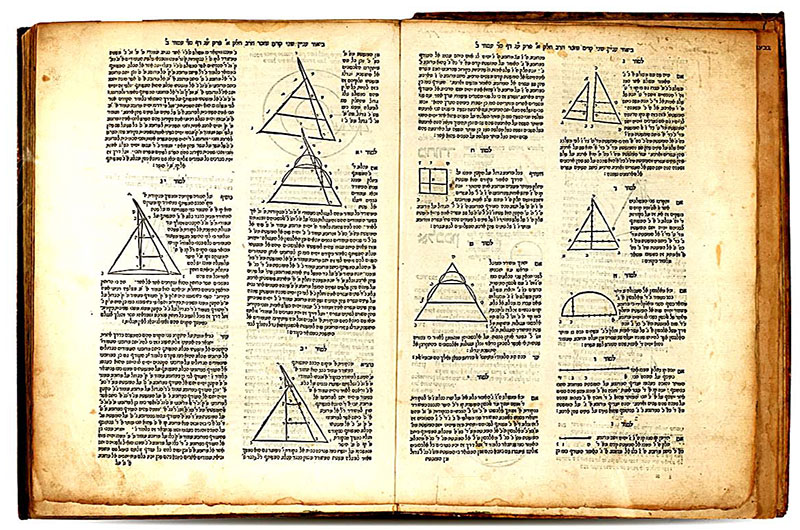


This week, I was privileged to acquire a remarkable and historically rich edition of Moreh Nevuchim (The Guide for the Perplexed) by the great Rambam, Rabbenu Moshe ben Maimon, printed in Sabbioneta, Italy, at the Foa press in the year 1553.
This edition, considered one of the earliest and most significant post-incunabula printings of the Moreh, stands out not only for its age but for its exceptional content. Included are the classic commentaries of Rabbi Shem Tov ben Yosef and Rabbi Yitzchak (Profiat) Duran – known as the Efodi. But what truly elevates this edition is the first-ever printing of the philosophical commentary by Rabbi Asher ibn Crescas, a rare and illuminating voice from 15th-century Provence.
Supplementing these are glosses by Rabbi Yehuda Alcharizi, known for his poetic gifts and translations, and a glossary compiled by Rabbi Shmuel ibn Tibbon, the famed translator of the Rambam's works from Arabic into Hebrew. Notably, the glossary here reflects a different manuscript tradition from what is found in the 1551 Venice edition, offering scholars a rare glimpse into alternate textual transmissions.
 What makes this edition even more significant is its place in the history of Hebrew printing. It was only the fourth book produced by the newly established Tobias Foa press in Sabbioneta, and the first to bear the name of Cornelius (Cornelio) Adelkind, a master printer who had previously worked on over 100 Hebrew titles in Venice – many under the legendary Daniel Bomberg. His sudden transition to Sabbioneta in 1553 is no accident. That year, by Papal decree, Hebrew printing was shuttered across much of Italy. Countless Hebrew books were burned in public squares – in Venice, Rome, Bologna, Ancona, and Padua. Amid this destruction, Sabbioneta and Ferrara emerged as rare sanctuaries. Under the patronage of Duke Vespasian Gonzaga, Sabbioneta offered a brief but vital window during which Torah continued to be printed, studied, and preserved.
The title page of this edition is a masterpiece in itself – an ornate architectural border adorned with classical motifs: vases brimming with fruit, symbolic figures, and the crest of the Foa family – a flowering tree guarded by lions and surmounted by a Magen David. The verse below it is telling: “The righteous shall flourish like a palm tree” (Tehillim 92:13) – a statement of quiet defiance during an era of censorship and fire.
Yet perhaps the rarest feature of all lies just past the title page: two additional leaves, bound only in a select few surviving copies. These contain eighteen geometrical diagrams and a deeply intellectual essay by Rabbi Moshe Provenzalo, Av Beit Din of Mantua and a contemporary of the Beit Yosef. His treatise – addressing the enigmatic "two lines" referenced on folio 64b of the Moreh – uses geometry to elucidate deep Kabbalistic and philosophical concepts. Printed separately with its own pagination, this slim pamphlet was never reissued and appears only in the rarest of copies.
It is difficult to overstate the centrality of Moreh Nevuchim in Jewish intellectual history. From its earliest printing – around 1470 in Rome – it has served as the bedrock of Jewish philosophical inquiry. Addressing subjects like the incorporeality of G-d, the nature of prophecy, and the mystical underpinnings of Ma’aseh Bereishit and Ma’aseh Merkavah, the Rambam's work has shaped Jewish thought for centuries. The Sabbioneta 1553 edition stands as a pivotal moment in that history – introducing, for the first time in print, voices like Rabbi Asher ibn Crescas and Rabbi Provenzalo that would otherwise have remained hidden in manuscript.
As for Cornelio Adelkind, his story remains tinged with mystery. Of German-Jewish origin, he had worked with nearly every major Hebrew press in Venice – Bomberg, Giustiniani, dei Farri – and was known for his editorial brilliance. Some accounts suggest that in later years he may have converted to Christianity, a tragic but not uncommon end in that era of persecution. Yet his contributions to Torah scholarship remain indelible, and his work in Sabbioneta is among his most lasting legacies.
Tobias Foa, too, deserves recognition. Between 1551 and 1559 – during a time when Jewish printing was under siege – he managed to publish 26 Hebrew works, a remarkable feat given the circumstances. His printing house would leave a lasting impact, with the Foa name continuing in Jewish printing until the early 19th century.
To hold this sefer is to hold not just a volume of Jewish philosophy, but a piece of our people's endurance – an artifact of faith, intellect, and resilience in the face of unimaginable pressure. In these fragile pages, one finds not only the questions of the perplexed – but the quiet, enduring answer of a nation that refused to be silenced.