October 2, 2026
 Categories: Collecting / Arts
The Jewish Art of Leonard Baskin
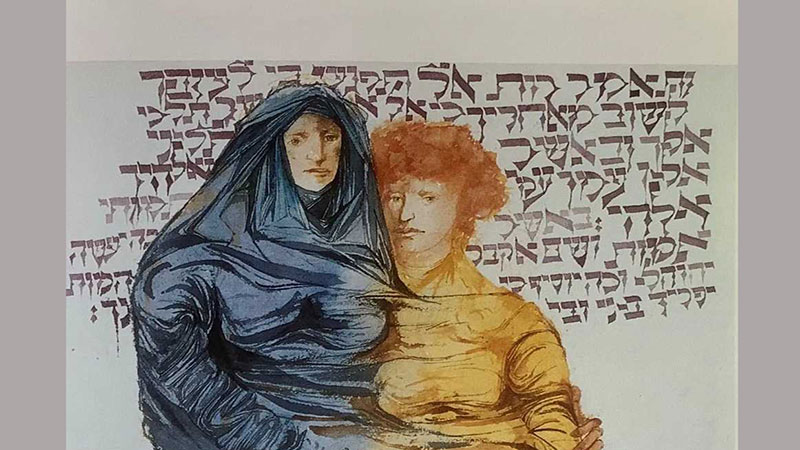


A true renaissance man, Leonard Baskin (1922-2000) was a writer who commented on important works and often-overlooked artists; the maker of books, whose Gehenna Press set the standard against which fine press books are measured; a Caldecott-honored book illustrator, whose works ranged from the bible to children's stories to natural history; and a watercolorist, whose explosion of color burst forth unexpectedly mid-career. He is best known, however, as a prolific master printmaker who reinvented the monumental woodcut and as one of the preeminent sculptors of the twentieth century. His public commissions include a thirty-foot long bas-relief for the FDR Memorial; a sculpture at the Woodrow Wilson Memorial in Washington, D.C.; and a Holocaust Memorial sculpture on the site of the first Jewish cemetery in Ann Arbor, Michigan.
Baskin occupies an unusual place in twentieth-century American art. He was at once a sculptor, draftsman, printmaker, illustrator, typographer, publisher, teacher, and public moralist, and he managed to be all these things without ever quite fitting comfortably into any dominant artistic movement of his time. Too figurative and too literary for the triumphantly abstract art world that emerged in the United States after World War II, too fiercely individual to become the spokesman of a school, and too deeply attached to moral seriousness to embrace irony or fashionable detachment, he nonetheless became one of the most respected American artists of his generation. His gaunt prophets, mourners, ravens, martyrs, dead animals, Holocaust figures, and monumental human heads seemed to arise from some older moral universe, one shaped as much by the Hebrew Bible and the Book of Job as by modern aesthetics. Baskin himself once remarked that “the essence of sculpture is for me the image of man,” and in his hands that image was rarely triumphant; rather, it was vulnerable, wounded, mortal, burdened by history, and perpetually shadowed by death.

That moral intensity cannot be understood apart from Baskin’s Jewish background and, although he was not conventionally observant in adulthood, Judaism marked his imagination permanently and profoundly. He was the son of a rabbi, educated in Jewish schools during childhood, immersed early in Hebrew language and biblical literature, and deeply conscious throughout his life of Jewish history and Jewish suffering. The Holocaust, which unfolded during his young adulthood, permanently affected his artistic worldview along with the long Jewish tradition of prophetic protest, mourning, ethical seriousness, and argument with G-d. However, his art was never merely “Jewish art” in a narrow ethnic sense, but Jewish themes, Jewish texts, Jewish memories, and Jewish ethical concerns recur throughout his career with extraordinary persistence. At a time when many American Jewish artists of the postwar period were cautious about ethnic labeling, fearing marginalization within elite art circles that still carried traces of antisemitic exclusion and suspicion of “ethnic” art, Baskin possessed no such hesitation.
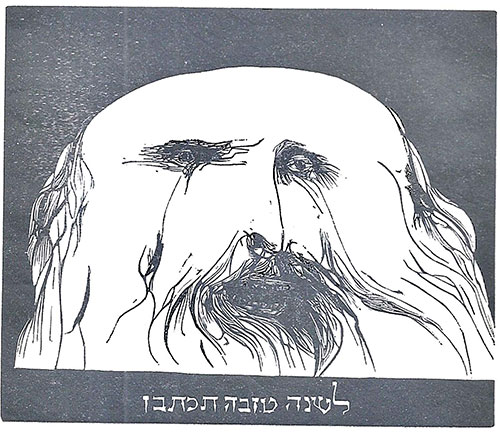
Born in New Brunswick, New Jersey, Leonard moved to Brooklyn with his family when his father, Rabbi Samuel Jacob Baskin, an Orthodox Rabbi, obtained a position as rav at Congregation B'nai Israel (1929). He attended what he would later characterize as a "dark, medieval" yeshiva in Brooklyn and worked in the synagogue to earn extra money. The Baskin household was intellectually serious and heavily shaped by Jewish learning, and Leonard later recalled the impact of Hebrew school and yeshiva education upon him, even when he rebelled against aspects of religious discipline. He developed an early fascination with biblical imagery, Hebrew letters, ritual forms, and prophetic language, and some art scholars have argued that even his mature visual vocabulary retained traces of the visual austerity and moral gravity associated with Eastern European Jewish religious culture.
The Baskin family’s Jewish roots lay in Eastern Europe, part of the great migration of Ashkenazic Jews to the United States in the late nineteenth and early twentieth centuries, and, like many American Jewish families of that era, they carried with them memories of poverty, insecurity, religious learning, and the pressures of antisemitism in Europe. Although Leonard did not make autobiographical ethnic identity the central subject of his public persona, he never concealed his Jewishness, and many contemporaries regarded him as one of the most unmistakably Jewish artistic personalities in postwar American culture.
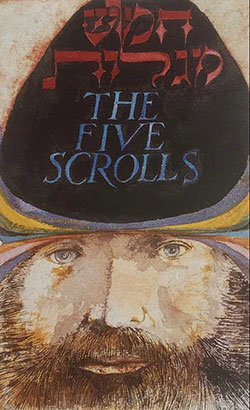

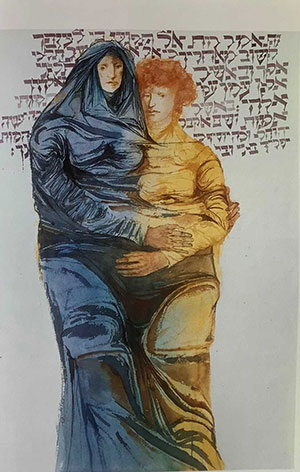
Baskin’s devotion to art began as a child. One famous anecdote, repeated in numerous accounts of his life, describes his visit as a teenager to the British Museum, where he encountered a cast of a sculpture by the German artist Ernst Barlach. Baskin later said that the experience convinced him to become a sculptor, and Barlach’s work, with its spiritual gravity, expressive distortion, and compassion for suffering humanity, became a lasting influence. Another important influence was the German artist Käthe Kollwitz, whose prints depicting grief, poverty, war, and mourning deeply affected him. Both Barlach and Kollwitz had themselves been marginalized or condemned by the Nazis, and Baskin’s admiration for them connected naturally with his growing awareness of the Shoah.
Baskin attended Yale University beginning in 1941 but did not complete his degree there at that time; instead, he founded the Gehenna Press, which would become one of the great fine presses of twentieth-century America. The very name “Gehenna” is especially revealing; derived from the Hebrew “Gehinnom,” associated in Jewish tradition with a place of punishment or purgation, the title reflected Baskin’s lifelong attraction to severe moral imagery and dark spiritual symbolism. Gehenna Press eventually became internationally celebrated for its beautifully printed editions of literary and religious texts, and Baskin collaborated with major writers, poets, and scholars, and his press embodied his conviction that words and images belonged together in a unified moral and artistic enterprise.
World War II profoundly shaped Baskin and, for an American Jew born in 1922, the Holocaust became an unavoidable moral fact. He was not himself a survivor, nor did he serve as a chronicler in the documentary sense, but the destruction of European Jewry entered his imagination with enormous force so that many of his works evoke mass death, vulnerability, exile, martyrdom, and collective mourning. Unlike some later artists who approached Holocaust themes through conceptual strategies or irony, he approached them with direct emotional seriousness, and his skeletal figures, tormented heads, and mournful processions often seem haunted by the destruction of European Jewish civilization.
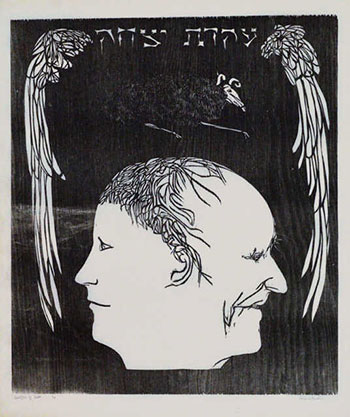
It is important, however, not to reduce Baskin entirely to Holocaust art because his imagination was far broader and older than that. Biblical subjects fascinated him throughout his life; he produced powerful depictions of prophets, angels, Job, Isaiah, Jeremiah, and other scriptural figures; and, in these works, the Hebrew Bible appears not as decorative religious material but as living moral drama. Baskin’s prophets are rarely serene; they are burdened, anguished, accusatory, exhausted by the knowledge they carry, and many critics have noted that Baskin seemed especially drawn to the prophetic tradition within Judaism: the insistence that moral truth matters more than power, wealth, or worldly success.
This prophetic impulse extended into Baskin’s broader humanistic concerns. He opposed cruelty, war, and dehumanization in many forms; during the Vietnam era, his work took on increasingly overt political resonance, but even when addressing universal themes, he often did so through imagery and sensibilities rooted in Jewish tradition. The Jewish historical experience of exile, persecution, survival, mourning, and ethical protest informed his moral imagination even when the immediate subject was not specifically Jewish.
Although Baskin came from a rabbinic home, his adult religious life was complicated. He was not known as a conventionally observant Jew in the Orthodox sense; there is little evidence that he maintained rigorous ritual observance throughout adulthood, and friends frequently described him as intellectually independent, skeptical, and resistant to dogma. Yet, it would be inaccurate to describe him simply as secular because religion permeated his language, imagery, reading, and moral outlook and he remained deeply engaged with biblical texts and Jewish concepts. Some observers described him as culturally Jewish; others regarded him as spiritually Jewish but religiously unorthodox. Perhaps the best way to describe his orientation is a combination of reverence for Jewish tradition with modern intellectual independence.
This tension appears in much of his work. Human beings in Baskin’s art are often presented as fallen creatures – mortal, vulnerable, physically awkward, spiritually burdened – yet there is usually also an implied dignity in their suffering, with some art historians connecting this quality to Jewish theological traditions emphasizing both the frailty and sacredness of human life. He repeatedly explored themes of mortality, burial, lamentation, and judgment; though death was perhaps the central subject of his art, it was not treated cynically or nihilistically but, rather, as a universal moral condition demanding seriousness and compassion.
Baskin’s Jewish identity also manifested itself in his fascination with Hebrew letters and sacred texts. Typography was enormously important to him and he produced at Gehenna Press exquisite editions of works by authors including William Blake, Ted Hughes, Anthony Hecht, and many others. The physical form of language mattered deeply to him, perhaps partly because of the traditional Jewish reverence for texts and letters, and his books often display an almost devotional attention to the relationship between script, page, image, and meaning.
Animals occupied a major place in Baskin’s art, as he created ravens, crows, hares, dogs, birds, and hybrid creatures of many kinds. Yet even these images often carried moral or biblical resonance; ravens and crows, for example, possess strong symbolic associations in both biblical and post-biblical literature. His creatures, which are rarely sentimental, confront the viewer with the raw realities of embodiment and mortality.
Perhaps the most directly Jewish body of Baskin’s work involved Holocaust-related imagery and memorial sculpture, and, over the decades he produced numerous works responding to Jewish catastrophe, including designing memorials, funeral monuments, and commemorative sculptures marked by emotional gravity. Unlike some monumental public memorials that emphasize abstraction, he usually retained recognizable human forms, reflecting his deep belief in the human body as the locus of suffering and moral meaning.
Baskin’s relationship with Zionism and Israel may perhaps best be described as muted. Available evidence suggests that he was conscious of the importance of Israel after the Holocaust, but he was not known primarily as a political Zionist activist; unlike some Jewish intellectuals and artists of his generation, he did not make public advocacy for Israel central to his career, nor is there much evidence that he devoted extensive artistic attention to Israeli state-building themes. His Jewish imagination remained more diasporic, prophetic, and universalist than nationalistic.
There are some references indicating that Baskin visited Israel, although detailed documentation of extended stays, official missions, or major political involvement there is sparse in standard biographies. Unlike figures whose Israel trips became central episodes in their public identity, his relationship to Israel seems to have remained comparatively private and secondary to his artistic life in the United States and England. What can be said with confidence is that Jewish historical experience, including the destruction that helped produce modern Israel, remained central to his consciousness.
Baskin’s work also reveals awareness of traditional Jewish attitudes toward images themselves. Judaism historically maintained ambivalence about representational art because of biblical prohibitions against graven images, and some scholars have suggested that Baskin’s distorted and anti-idealized figures partly reflect this tension. His sculptures rarely celebrate bodily perfection in the classical sense; instead, they expose fragility, awkwardness, age, deformity, and mortality and beauty in his work is often inseparable from suffering. At the same time, he possessed enormous technical skill and deep knowledge of European artistic traditions and he admired Renaissance art, German Expressionism, medieval imagery, and many other sources. As such, his Jewish identity did not isolate him from broader Western culture; rather, he entered Western artistic traditions while carrying distinctly Jewish historical and moral concerns.
His role as founder of Gehenna Press also had important Jewish resonances beyond the press’s name. The Jewish tradition has long revered scholarship, books, commentary, and textual transmission, and Baskin treated bookmaking as almost sacred labor. Fine paper, typography, illustration, and textual integrity mattered passionately to him, and the physical book became a moral object. In an increasingly commercial and technologically accelerated culture, Gehenna Press represented devotion to craftsmanship, memory, and intellectual seriousness.
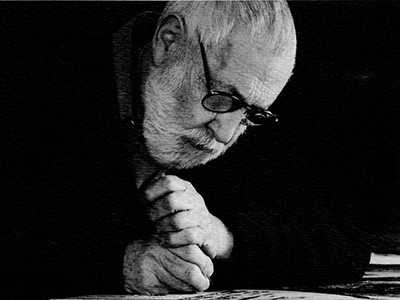
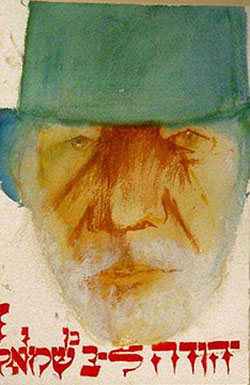
Baskin’s physical appearance contributed to his public image. Photographs often show him with a large beard and intense expression, resembling one of his own prophets or patriarchs; critics sometimes commented upon his “rabbinic” appearance; and his looks reinforced widespread perceptions of him as an artist deeply connected to Jewish intellectual and prophetic traditions.
Baskin’s illustrations for biblical texts deserve particular attention. He approached scripture not as decorative mythology but as existential drama, and his figures from the Hebrew Bible appear weathered, burdened, and psychologically intense. Art historians sense in these works an artist who knew biblical language intimately from childhood and continued wrestling with it throughout life. One sees this particularly clearly in his repeated engagement with the figure of Job which possessed particular force for post-Holocaust Jewish artists, as Job confronts innocent suffering, divine silence, bodily affliction, and the collapse of ordinary moral expectations. Baskin’s imagery repeatedly evokes Job-like humanity: wounded yet still demanding meaning.
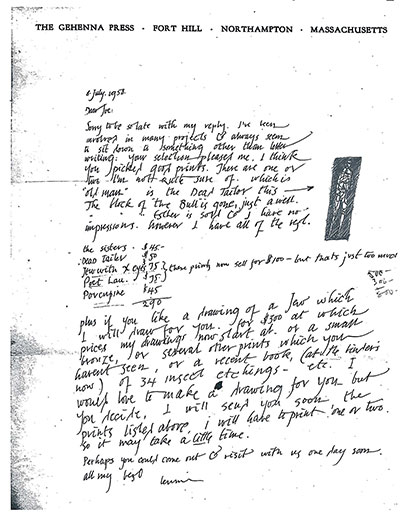
In the July 8, 1958 handwritten correspondence on his The Gehenna Press letterhead, Baskin writes to “Joe:”
Sorry to be so late with my reply. I’ve been involved in many projects & always seem to sit down to something other than letter writing. Your selection pleased me. I think you picked good prints. There are one or two I’m not quite sure of, which is “Old Man” is the Dead Tailor this.
Baskin draws an arrow over to a small ink sketch of the referenced “Dead Tailor,” then continues:
“The block of ‘the Bull’ is gone, just a well . . . Esther is sold & I have no impressions. However, I have all of the rest.” Baskin adds a list of prices for several prints: “The Sisters, $45,” “Dead Tailor, $50,” “Jew with X eyes, 75,” “Poet Lau., $75,” and “Porcupine, $45.” He writes: “Plus if you like a drawing of a Jew which I will draw for you, for $300 at which price my drawings now start at, of a small bronze, or several other prints which you haven’t seen, or a recent book (at the binders now) of 34 insect etchings. I would love to make a drawing for you, but you decide.”
This letter offers an unusually intimate glimpse into Baskin’s artistic world at a critical moment in his development; although seemingly brief and outwardly practical – a simple exchange concerning prints, prices, and availability – it is, in fact, a densely revealing document. In miniature, it contains many of the essential themes that would define his career: Jewish archetypes, mortality, postwar grief, artisanal craftsmanship, literary culture, bodily vulnerability, and the fusion of visual art with moral seriousness. Precisely because the letter is informal rather than theoretical, it may reveal more about Baskin’s deepest artistic instincts than many public interviews or critical essays.
The timing is important. In 1958, Baskin was thirty-five years old and entering the period in which his mature artistic identity had become unmistakable; he had already founded the Gehenna Press, established himself as a formidable printmaker and sculptor, and begun attracting serious literary and intellectual admirers. However, he was not yet the internationally honored elder statesman of American art he would later become, so our letter therefore comes from the period when his visual language was perhaps at its most concentrated and personal.
The tone of the letter is immediately recognizable as Baskin’s: apologetic, busy, immersed in work, and one senses not a polished businessman but a restless working artist operating within a highly personal artistic network. This was still an era when much of the fine-print world functioned through friendships, correspondence, collectors, poets, and intellectual circles rather than large corporate gallery structures, and Baskin’s world remained artisanal, intimate, and deeply literary.
The list of works mentioned in the letter is extraordinarily revealing because nearly every title points directly toward the Jewish and moral concerns that permeated Baskin’s art during the 1950s. Most striking of all is the reference to Old Man, which he clarifies is actually The Dead Tailor, adding a small ink sketch beside the words, a tiny moment that may be one of the most revealing details in the entire document. The recipient apparently remembered or identified the print incorrectly, and Baskin instinctively responds not merely with words but with a drawing, a reflex that itself says much about the artist: he thought visually so that even clarification became image.
The title The Dead Tailor is profoundly characteristic of Baskin’s imagination. The tailor occupied a central symbolic place in Eastern European Jewish and immigrant Jewish culture; tailors appear constantly in Yiddish literature, immigrant memoirs, and Jewish urban folklore, and they evoke labor, poverty, scholarship, stooped bodies, fragile masculinity, and the crowded world of Jewish immigrant life in New York and Eastern Europe. In the hands of another artist, a tailor might become a sentimental ethnic type, but in Baskin’s hands, the figure becomes elegiac and almost funereal. The addition of the word “Dead” changes everything and, while death was perhaps the single most persistent subject in Baskin’s art, his dead figures are rarely anonymous corpses but are culturally burdened human beings carrying memory and historical weight. In 1958, only thirteen years after the Holocaust, a work titled The Dead Tailor would almost inevitably have evoked the destruction of European Jewish civilization for many Jewish viewers, even if indirectly.
Baskin repeatedly transformed ordinary Jewish archetypes into memorial figures. His tailors, old men, prophets, and mourners often seem like survivors or ghosts wandering through the aftermath of catastrophe. Equally revealing is the astonishing title Jew with X Eyes; the title alone confirms how overtly Baskin was engaging Jewish identity in his work during the 1950s. The “X eyes” almost certainly refer to eyes marked as X’s, traditionally signifying death, blindness, annihilation, or dehumanization, reflecting the artist’s repeated return to damaged or hollowed eyes. A print titled Jew with X Eyes strongly suggests the convergence of several central Baskinian themes: Jewish identity, suffering, death, post-Holocaust consciousness, and moral witness.

Another title in the letter, Esther, reflects the influence of biblical Judaism on Baskin’s work. As discussed above, he was deeply drawn to biblical subjects throughout his life, particularly figures such as Queen Esther who are associated with moral burden, vulnerability, survival, and historical crisis. His statement in our correspondence that “Esther is sold & I have no impressions” also carries technical importance; in printmaking, “impressions” are the printed copies pulled from a plate or block, and Baskin is explaining that the edition has sold out, which tells us that there was sufficient demand for this particular work to exhaust the available prints.
Baskin’s statement that “The block of ‘the Bull’ is gone” adds another level of meaning. In relief printmaking, the block is the original carved surface used to create impressions; if the block is destroyed or lost, no further impressions can be produced, and collectors highly value such information greatly because scarcity becomes fixed. Yet, the symbolic dimensions matter as much as the technical ones because bulls and other animals occupied a major place in Baskin’s art, though never in a merely naturalistic sense. His creatures often possess mythic or sacrificial force, and bulls evoke ancient ritual, masculine power, violence, sacrifice, or even biblical undertones such as sacrificial animals or the Golden Calf.
Baskin’s reference to “34 insect etchings” is especially characteristic. Baskin was fascinated by insects throughout his career and insects allowed him to explore texture, mortality, grotesque beauty, and the uncanny structures of nature. His insects, which are rarely charming and feel ancient, hyper-detailed, almost apocalyptic, belong to the same moral universe as his human figures.
Particularly revealing is Baskin’s statement: “Plus if you like a drawing of a Jew which I will draw for you, for $300 at which price my drawings now start at.” This sentence is perhaps the single most important line in the entire letter because it demonstrates several things simultaneously. First, he evidently regarded “a Jew” as a coherent artistic category in itself, which is enormously significant. Jewish figures were not accidental or peripheral within his imagination; rather, they were central to the point that he could casually offer “a drawing of a Jew” as a meaningful and recognizable artistic proposition. Second, the phrase reveals the archetypal nature of Baskin’s Jewish imagery; he refers generically to “a Jew” rather than specifically referring to “rabbi,” “scholar,” “merchant,” or “old man.” He repeatedly created emblematic Jewish heads and figures – bearded patriarchs, mourners, prophets, tailors, old men, haunted faces – figures that were not mere caricatures; quite to the contrary, he approached Jewish physiognomy with tragic dignity and monumental gravity.
Third, the line reveals Baskin’s growing professional confidence, as “my drawings now start at” is the language of an artist consciously establishing his market value. In 1958, $300 represented a substantial amount of money; adjusted for inflation, it would amount to about $3500 today. Although he clearly understood that his reputation had risen, his tone remains remarkably personal and warm (“I would love to make a drawing for you.”) This is not cold gallery commerce but, rather, it is the voice of an artist speaking directly to a collector within an intimate intellectual network. That intimacy mattered greatly in the Gehenna Press world because Baskin’s artistic life revolved around relationships among writers, collectors, scholars, poets, and fellow artists.
The physicality of the letter itself also matters. Baskin discusses blocks, impressions, bindings, etchings, and drawings with tactile immediacy, reflecting another profoundly Jewish aspect of his worldview: reverence for craftsmanship and the physical transmission of culture. Jewish civilization has historically placed extraordinary emphasis upon books, texts, scribal labor, and material acts of preservation, and Baskin treated artistic production with almost devotional seriousness. Thus, our letter reads almost like a compressed manifesto of Baskin’s mature concerns, as one finds within it nearly every major element that would define his career: Jewish archetypes, death imagery, biblical resonance, artisanal print culture, literary seriousness, bodily vulnerability, moral gravity, and the organic place Jewish memory, Jewish physiognomy, and Jewish historical feeling occupied within his imagination in the late 1950s.
At the end of the day, if one seeks a single thread uniting Baskin’s Judaism, art, and worldview, it may be the ancient Jewish insistence upon memory. Jewish civilization is intensely memory-centered – memory of covenant, slavery, exile, destruction, persecution, learning, law, and survival – and his art is marked by memory: it remembers bodies, it remembers the dead, it remembers suffering, it remembers prophetic warning, and it remembers human fragility. For that reason, his work still possesses unusual power in an age often tempted toward distraction and amnesia: the human being, however broken, still bears moral significance; history matters, ethical seriousness matters, words matter, images matter, mourning matters and art, at its greatest, can become a form of testimony.