 October 9, 2026
 Categories: Headline / Perspectives
The Jewish National Anthem


I still remember my fury.
I was at the Nassau Coliseum on Long Island, N.Y., at the tenth Siyum HaShas. And I can still hear the master of ceremonies coming over the loudspeaker, asking everyone to rise as we sing the Jewish national anthem.
I stood with excitement. Hatikvah! This crowd, this room?!
Then the emcee began to sing Ani Maamin.
My jaw dropped. Who decided that Ani Maamin was the Jewish national anthem?!
And it got me thinking. What was the Jewish national anthem? I carried that question for years before an answer came, and when it came it was neither Hatikvah nor Ani Maamin.
I believe the Jewish national anthem is Shiras Ha'azinu. And I believe G-d said so explicitly, in this week's parsha.
What an anthem is for
An anthem is the distillation of a people's self-understanding into something a child can memorize and a crowd can sing. Look at what other nations chose.
France sings La Marseillaise, written in a single night in 1792 as war broke out. It opens Allons enfants de la Patrie, arise children of the fatherland, and drives to its refrain, Aux armes, citoyens, to arms, citizens. A nation born in revolution, defining itself by the willingness to fight for what it declared.
America sings The Star-Spangled Banner. Francis Scott Key watched the bombardment of Fort McHenry through the night of September 1814, the rockets and bursting shells "gave proof through the night that our flag was still there." A nation that defines itself by endurance.
Canada sings O Canada, and its posture is different again. No revolution, no siege. The line that recurs is We stand on guard for thee, and the prayer is that the land remain glorious and free. A nation whose self-understanding is guardianship, stewardship of something already possessed.
Israelis sing Hatikvah: Nefesh yehudi homiyah, the Jewish soul still yearns, and od lo avda tikvateinu, our hope is not yet lost. Two thousand years compressed into a refusal to stop hoping.
Four nations, four entirely different temperaments, and one thing in common. Every one of them reaches for its finest hour, or its highest hope, and sets that to music. None of them sings about its own failure. No nation on earth hands its children a song predicting the day the country will collapse and explaining that it will be their fault.
Except one.
This week's mitzvah, next week's song
The Shira itself is next week's parsha. What we read this Shabbos, at the close of Vayelech, is the commandment: v'atah kisvu lachem es haShira hazos v'lamdeha es Bnei Yisrael, simah b'fihem. Write this song, teach it to Bnei Yisrael, place it in their mouths.
Rashi and Ramban on the pasuk (Devarim 31:19) both understand “es haShira hazos” as Ha'azinu specifically, the shira that follows.
Moreover, in Hilchos Sefer Torah 7:1, the Rambam derives the obligation of every Jew to write a Sefer Torah from this very verse: “V'atah kisvu lachem es haShira hazos.” He explains that the verse means to write the Torah that contains this shira, because the Torah cannot be written parshiyos parshiyos, one section at a time. Such is the weight of this mitzvah.
This week we are given the obligation. Next week we are given the song.
A song that predicts our failure
What kind of song receives that standing?
Not a comforting one. Ha'azinu is tzur yeladcha teshi, you neglected the Rock who bore you. It is vayishman Yeshurun vayiv'at, Yeshurun grew fat and kicked. It is aster panai meihem, I will hide My face from them. The collapse, foretold in meter, handed to the people as their inheritance before they had even entered the land.
Every other nation sets its finest hour to music. We were given a song about our worst one, and told to make sure our children know it – simah b'fihem.
Picture a Jew standing in the ruins of Yerushalayim after the churban. He has three ways to interpret the events.
The first is as an atheist. To consider it happenstance. This is the ordinary churn of history. Nations rise and fall, and it was simply our turn to fall.
The second is as a Christian. To consider it abandonment. The covenant was a beautiful idea that did not hold, and the G-d of Israel has moved on. This is the reading much of the world has offered about us for two thousand years.
The third is as a Jew, remembering the song he learned as a child.
A Jew who knows Ha'azinu cannot read his suffering as randomness, because the script was published in advance. Nor can he read it as abandonment, because the very same song that predicts the destruction guarantees the ending: ki yadin Hashem amo, v'al avadav yisnecham, G-d will vindicate His people and have compassion on His servants (32:36).
The song does not spare him the grief. It denies him the two despairing explanations.
Consequence is the signature of attention
We instinctively hear the warnings in Ha'azinu as distance. Astira panai, the hiding of the face, sounds like absence, as though G-d has turned away and left us to history.
But consider what the alternative would actually mean. A G-d who does not respond to what we do is a G-d who is indifferent to what we do. Consequence is the signature of attention. The hiding of the face is not a withdrawal from history. It is a form of presence within it, painful precisely because it is personal.
That is why the song can hold a person steady. It insists that even in the darkest chapter, our story remains in G-d’s hands.
Known by heart
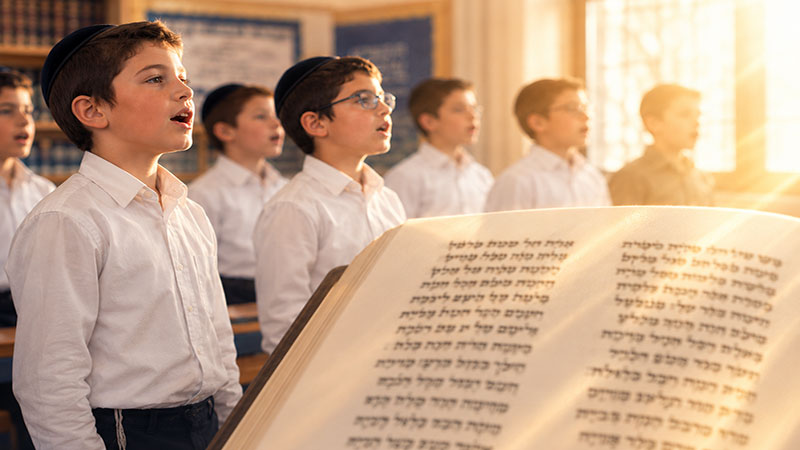
Ha’azinu was once taught the way anthems are taught. In our shul in San Jose, Calif., a member told me that when he was in yeshiva in Chicago in the 1970s, the children were taught to memorize Ha'azinu.
I was struck by that, and I have taken it up with my own children. An anthem you have to look up is not an anthem. A song meant to hold a Jew steady in the worst hour of his life has to be in him already, before the hour arrives. That is what simah b'fihem is asking for.
This Shabbat carries the seventh and last of the seven haftarot of consolation read after Tisha B'Av. It is routinely overlooked because Rosh Hashanah is arriving fast. But it is the climax of the sequence, and it rests on Ha'azinu's premise. The prophet can promise restoration precisely because the song established that the exile was never abandonment.
Elul is the season of Dirshu Hashem b'himatz'o, kra'uhu b'hiyoso karov. This is a time of unusual closeness. While Elul teaches us to embrace G-d when He is near, Ha’azinu teaches us that He is never far, even when He hides His face, even in the darkest times.
That is why it is our anthem. Every nation sings about its finest hour. We were given something better: a song that holds in every hour, because the One who wrote it never abandoned us.