October 2, 2026
 Categories: In Print / Featured / Halacha & Hashkafa
The Northern Exposure of the Yetzer Hara


Zevachim - Daf 48
Our Gemara on amud beis notes that while most sin offerings are slaughtered to the north (tzafon) of the Altar, the Chattas Nachshon – the sacrifices offered by the princes during the inauguration of the Mishkan – is not. Rashi explains that this is because the Chattas Nachshon was not for any particular sin.
Though Rashi does not explain why, we see a link between the north side of the Temple courtyard and sin offerings. How does the north come to symbolize sin?
The Gemara (Succah 52a) discusses various “names” for the evil inclination. In mystical terms, a name is not just a label but expresses the essence of the thing.
Rabbi Avira, and some say Rabbi Yehoshua ben Levi, taught: “The evil inclination has seven names.The Aroch Laner (Sanhedrin 108a) explains these seven names as levels of experience or induction into sinful distortion. The first name is simply “evil” or “bad,” as the yetzer hara drives the person away from G-d, causing loss of life force and spiritual as well as physical death. There is nothing that can be worse than that, so the name is a simple description.The Holy One, Blessed be He, called it evil, as it is stated: ‘For the inclination of a man’s heart is evil from his youth’ (Genesis 8:21).
Moses called it uncircumcised, as it is stated: ‘And circumcise the foreskin of your hearts’ (Deuteronomy 10:16).
David called it impure, as it is stated: ‘Create for me a pure heart, O G-d’ (Psalms 51:12); by inference, there is an impure heart that is the evil inclination.
Solomon called it enemy, as it is stated: ‘If your enemy is hungry, give him bread to eat, and if he is thirsty, give him water to drink, for you will heap coals of fire upon his head, and the L-rd will reward you’ (Proverbs 25:21-22). Do not read it as: ‘And the L-rd will reward you’ [yeshalem lach]; rather, read it as ‘And the L-rd will reconcile it to you’ [yashlimenu lach]. G-d will cause the evil inclination to love you and no longer seek to entice you to sin.
Isaiah called it a stumbling block, as it is stated: ‘And He will say: Cast you up, cast you up, clear the way, take up the stumbling block out of the way of My people’ (Isaiah 57:14).
Ezekiel called it stone, as it is stated: ‘And I will take away the stony heart out of your flesh, and I will give you a heart of flesh’ (Ezekiel 36:26).
Joel called it hidden one, as it says: ‘But I will remove the northern one [hatzefoni] far off from you’ (Joel 2:20).
The Sages taught concerning the verse ‘But I will remove the northern one [hatzefoni] far off from you’ that this is referring to the evil inclination. And why is the evil inclination referred to as tzefoni? It is due to the fact that it is always hidden [tzafun] in the heart of man.’” [Linguistically, the Hebrew word for north (tzafon) and tzafun (hidden) are related. The North side is where the sun is least seen.]
The second name is “arel” – uncircumcised. This represents the ways in which the evil inclination acts as a barrier to proper perception, as in the verse (Devarim 10:16): “Cut away the thickening about your hearts (“arlas”) and stiffen your necks no more.” The yetzer hara, our ambitions and lusts, can block our perception of our flaws or our deranged thinking.
The third name, “impure,” is because the yetzer hara can reach a point where not only does it block perception but also contaminates on a deeper level. Contamination is not absolute or total, but a blending, a corruption. The person’s ideas, wants, and needs are sometimes good and sometimes evil, but he can’t tell and they become corrupted.
The fourth name, “enemy,” is a further escalation of this negative metamorphosis. At this point, the yetzer yara is not just a passive state of various distortions or impurity. Rather, like an enemy, it is in full force, out to destroy the person. Think of an addict on a binge – determined to ride the addiction down to the bottom, to get the fix, no matter who or what is destroyed along the way.
The fifth name, “stumbling block,” is that it can manifest as an unknown sudden road hazard that trips a person up.
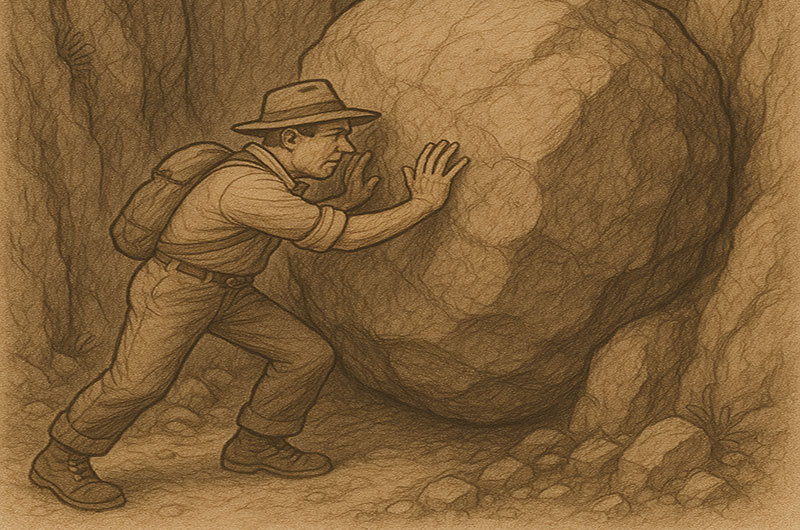
The sixth name, “stone” or “rock,” represents something more akin to a boulder. A large obstruction that has become seemingly impossible to move.
The seventh name, “hidden one,” is the stage where the yetzer yara is so hidden, it isn’t perceived as anything unfriendly but rather at providing good and helpful advice. How is this stage different than the stage we described as impure? Here the totality of the evil is so obscured that the enemy is a friend, and what feels intuitively right is actually evil.
It is one thing to be blind to a flaw, but if it is pointed out and perceived, the person will be remorseful. The yetzer hara, however, can even make sin seem like virtue, make an enemy seem to be a friend, and what is evil seem to be good. That is when the impurity goes deep and ruins a part of the self.
Each of the seven names represents a deeper corruption: from basic misdirection to total moral inversion, where evil masquerades as good. This final stage – “the hidden one” – is the most dangerous, for the yetzer hara disguises itself as virtue. As Yeshayahu (5:20) warns: “Woe to those who call evil good and good evil; who present darkness as light and light as darkness; who present bitter as sweet and sweet as bitter.”
The final name is the most intense, for when evil hides beneath righteousness, it becomes nearly invincible.
Whiteout: When Impurity Turns Inside-Out
Daf 49Our Gemara on amud beis discusses an unusual halacha regarding tzara’as, based on the verse: “Then the priest shall look; and behold, if the leprosy has covered all his flesh, he shall pronounce the one who has the mark pure; it is all turned white – he is pure” (Vayikra 13:13).
Why should tzara’as that spreads over the entire body result in purity? One would think it would indicate the opposite – corruption beyond repair.
The Gemara Sanhedrin (97a) uses this halachic phenomenon in an interesting metaphorical manner: “Rabbi Neḥemya says: ‘During the generation that the son of David comes, arrogance will proliferate and the cost of living will corrupt people so they will engage in deceit. The vine will produce its fruit, and nevertheless, the wine will be costly. And the entire gentile monarchy will be converted to heresy, and there will be no inclination among the people to accept rebuke.’ This baraisa supports the opinion of Rabbi Yitzchak, as Rabbi Yitzḥak says: ‘The son of David will not come until the entire kingdom will be converted to heresy.’ Rava says: ‘What is the verse from which this statement is derived? It is the verse: “It is all turned white; he is ritually pure” (Leviticus 13:13). One is a leper and ritually impure only if he has a leprous mark, however small, but not if his skin is completely leprous. Similarly, the world will be redeemed only when the Jewish people reach their lowest point.”
The Gemara uses this phenomenon as a metaphor: The world will only be redeemed when it reaches total spiritual decay – “it is all turned white; he is pure.”
The Maharal (Netzach Yisrael 35) explains that any new creation involves the destruction of its prior form. Like a caterpillar becoming a butterfly, or an egg transforming at conception, the emergence of a new phase requires the death of the old. The decay of the world at the end of days is therefore the prelude to its rebirth.
Similarly, the metzora whose flesh turns completely white symbolizes the destruction of the prior self, allowing for spiritual regeneration. As with a clay vessel that can only become pure by being shattered and remade (Vayikra 11:33), sometimes life’s utter breakdown is the beginning of renewal.
Though painful, such “whiteout” moments – when it feels like you have nothing left – can mark the hidden point of transformation.
Thank G-d, I’m Guilty: The Psychology of Gomel
Daf 50Our Gemara on amud aleph discusses the thanksgiving offering, noting that since it is voluntary, maaser sheni can be used. While one should bring a thanksgiving sacrifice, it is apparently not as obligatory as a Chattas or other ritual requirement.
There is an equivalency between the Todah sacrifice and the Gomel blessing said after miraculous salvation – one substitutes for the other (see Rashi on Vayikra 17:12; Rashi on Ksav Yad Menachos 79b; Rosh on Berachos 9:3).
The Gomel blessing contains the phrase: “Blessed are You, Hashem…Who grants goodness to those who are found to be chayyav.” The word chayyav means culpable, owing, or guilty. The simple meaning, then, is to thank G-d for granting us goodness despite our being undeserving.
Many poskim take this literally, ruling that a minor should not recite Gomel even for chinuch purposes, as he cannot be held liable for punishment (Magen Avraham 219; Mishna Berura 219:3-4).
However, Mor U’ketzia (219, “Umatzasi”) argues that this cannot be the meaning. Why would a person incriminate himself? This seems to violate the dictum “Al tiftach peh leSatan” – Do not give the heavenly prosecutor an opening (Berachos 60a). Rather, the phrase praises G-d’s general benevolence, recognizing His forbearance toward all – even the undeserving – without asserting guilt upon oneself.
Another fascinating halachic discussion concerns one who attempted suicide or was negligent with his health but was miraculously saved. Some poskim rule that such a person should not recite Gomel, as blessings are not said over sins (Tzitz Eliezer 10:25:23; Halichos Shelomo 23, note 2). However, Rav Azriel Hildesheimer (1:19) argues the opposite – that the phrase “Who grants goodness to those who are found to be chayyav” could not be more apt.