 October 16, 2026
 Categories: Featured / Parsha / Torah
The Strangers Among Us: When Belonging Breaks Down in Parshas Emor
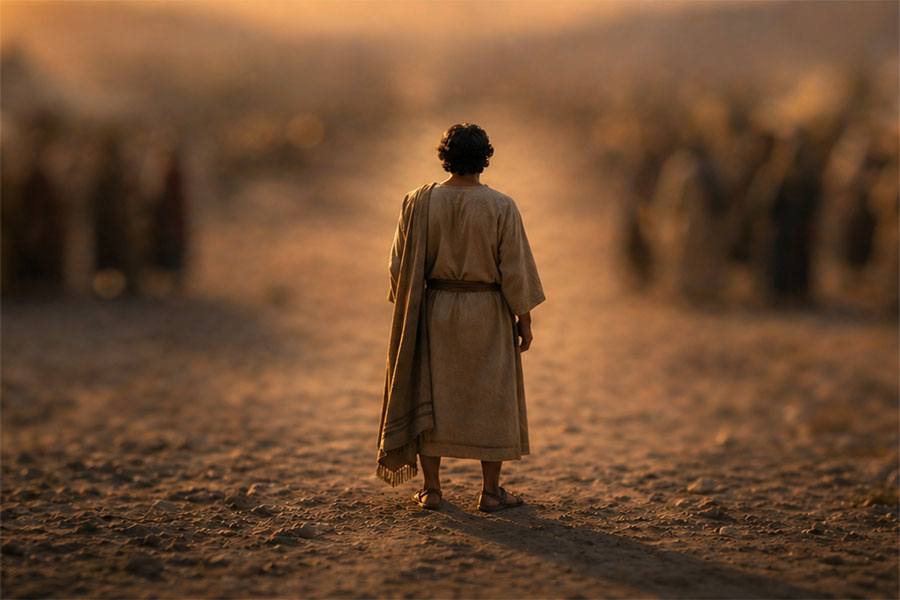


There is a moment at the end of Parshas Emor that many of us pass over quickly. A fight breaks out in the camp. Harsh words are exchanged. Tempers flare. In the heat of the moment, a man curses the Divine Name. The Torah offers only one biographical detail about him. He is the son of an Israelite mother and an Egyptian father. He stands inside the camp, yet not fully within it. He belongs, and at the same time, he somehow does not.
This is not simply a story about forbidden speech. It is a story about belonging, or the painful absence of it.
The Torah could have introduced this man in many ways. It could have told us his name, his background, his character, or his spiritual journey. Instead, it tells us only his lineage, and even that is incomplete. His mother is named. His father is not. His identity is half claimed and half obscured. He is the first Jew in the Torah whose very existence raises a question that echoes through generations: Where do I fit?
And the tragedy of the episode is that no one around him seems to know how to answer that question.
Two Kinds of Strangers in Emor
Emor presents two very different kinds of “strangers,” and the distinction is essential for understanding the parsha. The first is the ger, the genuine outsider, the non‑Jewish resident who lives among the people of Israel. The Torah commands us to treat this individual with justice and dignity. “One law shall be for you, for the citizen and for the stranger who resides among you.” This is a halachic category and a moral one. It teaches us how to relate to someone who is not part of the covenantal community but who lives within our gates and under our protection. The second type of “stranger” is far more subtle and far more painful. It is the Jew who is made to feel like an outsider because the community does not know how to hold complexity. The blasphemer at the end of Emor is not a foreigner. He is not a ger. He is one of us. His mother is from the tribe of Dan. He lives in the camp. He is part of the people. Yet the text hints that he never found a place where he truly belonged. His identity did not fit neatly into the categories the community was accustomed to, and the uncertainty around him created discomfort that left him standing at the margins. This second kind of “stranger” is not defined by halacha but by experience. It is the insider who is treated as if he were outside. And that is a very different kind of wound.What the Fight Was Really About
The Torah does not tell us what the fight was about, but Chazal do not allow the silence to stand. The Talmud and the classical mefarshim search the episode for meaning, and what they uncover is remarkably consistent. Every explanation they offer centers on the question of belonging. The Talmud in Sanhedrin teaches that the dispute began with something very basic. It was about where this man was permitted to live. Since tribal identity follows the father, and his father was Egyptian, he had no shevet, no portion in the land, and no assigned place to pitch his tent. He attempted to settle among the tribe of Dan, his mother’s tribe, but they rejected him. They told him he had no portion with them. He brought the case before Moshe Rabbeinu and was told the same. He had nowhere that was truly his. Rashi brings this teaching and highlights the human pain behind it. The man was not only displaced. He was humiliated. He was told, in effect, that he did not belong anywhere in the camp of Israel. His very presence raised questions the community did not know how to answer. The Sifra adds another dimension and suggests that he was mocked for his mixed identity. People taunted him about his father and used his lineage against him. According to this view, the altercation was not about theology at all. It was about dignity, identity, and the hurt of being pushed to the margins. Ramban deepens the picture even further. He explains that the man felt the system itself was unjust. He was angry not only at the individuals who rejected him, but at the structure that left him without a place. His anger turned upward not because he was inherently rebellious, but because he felt wronged and unseen. Taken together, these explanations point to a single truth: The fight was about belonging, about place, about identity, and about the ache of being inside the camp yet not fully claimed by it. The eruption at the end of Emor is not the story of a man who despised Hashem. It is the story of a man who had nowhere to stand.The Pain of Being Inside but Not Fully Claimed
The Torah tells us that the man “went out,” and the mefarshim pause over this phrase. What exactly did he leave? Did he step out of his tent? Did he walk away from his mother’s home? Did he leave the protective boundaries of the camp? Or, as some suggest, did he step out of the fragile sense of belonging he had been trying to hold together? Some understand the verse as describing a physical movement, while others see it as describing an inner shift, a kind of emotional exile. But all agree that something in him was already outside before the argument ever began. This is the experience of being caught between worlds, of living in a space where one is technically inside yet never fully claimed. It is the quiet ache of sensing that you do not quite match the picture others carry of who belongs in the community. It is the subtle weariness that comes from being asked – directly or indirectly – to explain yourself, to justify yourself, to prove what others are simply assumed to be. It is the loneliness of feeling like a stranger in the very place that should have been home.My Vantage Point as a Convert Who Has Seen the Edges
I write this not as someone standing outside Jewish life, but as someone who entered it with intention, commitment, and love. As a giyores, I know something about what it feels like to stand at the edge of the community. Even years later, there are moments when I sense the subtle questions, the quiet checking, the unspoken need to confirm what others are simply assumed to be. It is not constant and it is not malicious, but it exists as a faint outline around the borders of belonging, a reminder that my path into Am Yisrael was different. At the same time, I am fully aware that my experience is shaped by the fact that I am white. Whatever moments of otherness I have felt, they are not the same as the experiences of those whose very faces mark them as different. I have watched Jews of color, people who are unquestionably part of Klal Yisrael, navigate hesitations and assumptions that I will never encounter. I have seen the double-takes, the quiet pauses, the small but telling moments in which someone is measured before they are welcomed. These are not my stories to tell, but they shape the place from which I approach this parsha and the responsibility I feel when reading it. Over the years, I have seen how belonging is not always offered as instinctively as we imagine. I have seen how easily we slip into sorting people into categories of insider and outsider, familiar and unfamiliar, even when halacha has already made the category clear. And I have seen the pain that arises when someone who is fully part of us is treated as if they are still standing at the edge. The Difference Between the Ger and the Jew We Treat Like a Ger This is the point in Parshas Emor where the text becomes uncomfortably relevant. The Torah commands us to treat the ger, the true outsider who lives among us, with justice and dignity. That is one clear halachic category. But the man at the end of the parsha is not a ger. He is not an outsider, not a visitor, not a guest. He is a Jew. His mother is from the tribe of Dan. He lives within the camp. He is counted among the people. Yet the Torah hints that the community did not quite know how to relate to him. His lineage did not fit the familiar template. His identity did not align neatly with the categories they had inherited. His presence raised questions they did not know how to answer. In that uncertainty, he was treated like a stranger, not because halacha placed him outside, but because human discomfort did. This is the danger that Emor brings to the surface. When we blur the line between the ger, whom the Torah explicitly identifies as an outsider, and the Jew who simply does not fit our expectations, we create fractures that the Torah never intended. The ger requires justice and fairness. The insider who is treated like a ger requires something entirely different: a sense of belonging, recognition, and a place within the community. These are not the same requirements, and the Torah asks us to hold both with care and clarity.The Cost of Our Narrow Imagination
Communities begin to fracture when they cannot hold complexity. Individuals begin to break when they are asked to live in the space between categories. The eruption of the mekallel is not simply a theological failure. It is an existential cry. It is the voice of someone who has been standing at the threshold for far too long, someone who has been told in subtle and not so subtle ways that he does not fully belong. And this is where Parshas Emor speaks directly to us. We live in a world that is very skilled at drawing lines and far less skilled at welcoming those who fall between them. In the broader society, the ger of today – the immigrant or refugee or person seeking safety – is often spoken about as an abstraction or a problem rather than as a human being created b’tzelem Elokim. The Torah’s insistence on dignity and fairness is too easily replaced by political language that forgets the person at the center. But Emor also turns our attention inward. Within our own community, we sometimes struggle to embrace Jews whose stories or appearances do not match the image we inherited of what a Jew looks like. Jews of color. Converts. Adoptees. People with mixed heritage. Families whose paths into Am Yisrael are different from our own. People whose lives do not fit neatly into the categories we are accustomed to. These Jews are not strangers. They are not outsiders. They are not guests. They are part of us. Yet, like the man in Emor, they are sometimes treated as if they must still earn their place, as if their belonging is conditional or uncertain. This is not a political issue. It is a spiritual one. It reflects a failure of imagination, a reluctance to see the fullness and diversity of Klal Yisrael as it actually exists. When we cannot stretch our understanding of who we are, we risk pushing away those whom the Torah has already brought inside.Emor’s Radical Ending: One Law for Citizen and Stranger Alike
The parsha concludes with a legal principle that should echo across the generations. One law shall be for you, for the citizen and for the stranger who resides among you. This is not a call for sameness. It is a call for justice. The ger, the true outsider who lives among us, must be treated with fairness, dignity, and equality. That is the Torah’s clear demand. But the Jew who is treated like a stranger requires something entirely different. He requires belonging. He requires recognition. He requires a place to stand within the community that is already his. The Torah does not collapse these categories, and neither should we. Justice for the outsider and belonging for the insider are two distinct responsibilities. Both are sacred. Both are necessary. And both are part of what it means to uphold the integrity and compassion of Klal Yisrael.Whom We Refuse to Lose
The tragedy of the mekallel is not only that he sinned. It is that his outcry came from a place of fracture that the community never addressed. He stands as a cautionary figure, a reminder of what happens when we fail to make room for those who are already inside our gates but do not yet feel fully held. Every generation has children who live in the in‑between spaces. There are those who cross borders, those who carry more than one story in their mouths, those whose identities do not fit neatly into the categories we inherited. Parshas Emor asks us whether we will make room for them, or whether we will allow them to break before we ever let them belong. Belonging is not a gift we bestow. It is a responsibility we bear. The ger we welcome with justice. The Jew we embrace as family. And when we do, the circle of Klal Yisrael becomes wide enough, generous enough, and faithful enough to hold every soul Hashem has placed within it.