October 2, 2026
 Categories: In Print / Headline / Torah
The Torah’s Timespan & The Meaning of Brit Milah


Parshat Lech Lecha
Before we get to Lech Lecha, let’s take a look at the timespan of the whole Torah as compared to Parshat Bereishit and Parshat Noach.
We will not count the first two pesukim – “Bereishit bara…” and “V’Ha-Aretz…” – because, according to one major school of thought, these describe an undefinable and unmeasured period that occurred before Day One of Creation.
So, beginning with “Vayomer Elokim ‘Yehi or...” (Bereishit 1:3) and going to the end of the Torah, we're talking about 2,488 years. At that point, Bnei Yisrael are poised on the threshold of Eretz Yisrael.
Now, Parshat Noach begins with G-d’s command to Noach to build the ark and prepare for the coming Flood. According to Tradition, that command came 120 years before the Flood began. The Flood started in the year 1656 from Creation, and thus Parshat Noach begins in the year 1536.
This means that Parshat Bereishit spans 1,536 years. That’s almost 62% of the entire Torah’s timespan – in just one sedra out of the 54 sedras of the Torah!
Parshat Noach ends with the death of Terach at age 205. That was in the year 2083. Thus, Parshat Noach spans 547 years. That’s 22% of the whole Torah’s timespan, bringing the first two sedras to a whopping 84%!
You might think that this leaves only 16% for the rest of the Torah – but that is not accurate. Why not?
Let’s look at the numbers more closely. Terach was 70 years old when Avra(ha)m was born. Terach died at 205 years old. So, Avra(ha)m was 135 years old at the time. Yet the Torah tells us that Avra(ha)m was 75 years old when Hashem told him to “Lech lecha…” (in the year 2023 from Creation). Which means that there is a 60-year overlap between Noach and Lech Lecha. Thus, the actual timespan from Parshat Lech Lecha to the end of Vezot HaBeracha is 465 years, which is 18.7% of the Torah’s whole timespan.
Numbers and more numbers. So, what’s my point?
The Torah was given by Hashem to Am Yisrael, the Jewish People. Whatever the rest of the world has learned or failed to learn from the Torah, the Torah is ours. It is the life of the Jewish People; its mitzvot are for us. It is the testament to the special and unique relationship between G-d and His Chosen People. And yet, four-fifths of the timespan of the Torah deals with over 2,000 years before Judaism began. How come?
It is because we are not just Jews. We are human beings. Our Judaism does not replace our membership in the human race – it adds to it. All that G-d expects and requires of all the other peoples of the world is basic human decency and morality, as delineated by the Sheva Mitzvot Bnei Noach – the Seven Noahide Laws. They are the formula for all descendants of Noach (which is everyone on Earth) for the proper behavior of individuals and the proper functioning of society.
And the remaining one-fifth of the Torah’s timeframe, presented in the 52 sedras from Lech Lecha and on – that is for the spiritual and religious life that G-d commands and wants for the Jewish People alone.
Now let’s talk about Lech Lecha. How big a sedra is it? Let’s divide the sedras into three categories: the top 18 sedras, the middle 18, and the bottom 18. Rankings change from statistic to statistic.
Lech Lecha is written on 208 lines in a Sefer Torah. Ranking: 23rd. In that regard, a middle-size sedra.
But its 128 pesukim rank it 13th for that measure – putting it in the top third.
For words and letters, Lech Lecha ranks 18th and 19th, respectively. That’s right around the line between the top and middle third.
The variations in Lech Lecha’s ranking are due to its shorter-than-average p’sukim.
Lech Lecha contains one of the 613 mitzvot – brit milah. Note that of the 54 sedras, 17 (almost one-third) have no mitzvot of the Taryag. Another 5 have only one mitzvah.
The command to circumcise Jewish males is stated clearly in Parshat Tazria, and yet the popular source for the mitzvah is Parshat Lech Lecha, in the story of Avraham’s circumcision as well as that of his son Yishmael and the males of Avraham’s household.
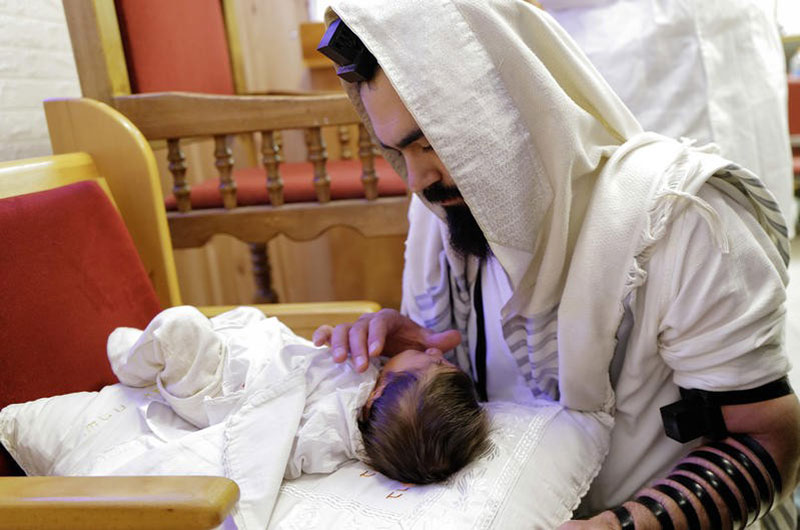
The mitzva has a few names. We say, “I’m going to a brit tomorrow morning.” Sometimes, it is referred to just as milah. But its full name is brit milah. The two halves of the full name reflect the two berachot recited on the occasion. And the berachot point to the two aspects of the mitzvah.
The first is the physical act of removing the foreskin and other actions that are performed by the mohel. When a father assigns a mohel to do the milah, it is the mohel who makes the bracha “...asher kid’shanu…al hamilah.” This aspect of the mitzvah is accomplished in a matter of seconds. Immediately after the mohel’s bracha, the father of the baby boy recites a second mitzvah-bracha: “...asher kid’shanu l’hachniso bivrito shel Avraham Avinu” – to enter the child into the covenant of Avraham. If the mohel’s job is the milah part of the mitzvah, the father’s – and mother’s – part of the mitzvah is the brit – to raise the child in a loving manner to practice and appreciate all the mitzvot of the Torah. It is significant that the father gives over the milah to the mohel but retains for himself and his wife the commitment to prepare a new member of Klal Yisrael for a life of Torah and mitzvot. Milah: a matter of seconds; brit: many years.
Milah is one of the mitzvot of the Torah; the brit represents all of the mitzvot (we could say, the other 612 mitzvot). The gematria of brit is 2 + 200 + 10 + 400 = 612. So, brit (612) + the one mitzvah of milah = 613.
Let’s take another look at the two brachot (not counting the She-he-che-yanu, which is said in Israel and often not said in Chutz LaAretz, though customs may vary). Mitzvah-brachot come in two styles: Al and L’ – “on [the mitzvah]” and “to [the mitzvah].” A gerund noun and an infinitive verb. Examples: On the eating of matzah. On the reading of the Megillah. On the washing of hands. On taking the lulav. On the milah. And many others. Versus: To light the candle of Shabbat. To light the Chanuka candle. To affix the mezuzah. To dwell in the sukkah. To enter the child into the Covenant of Avraham Avinu.
These bracha-forms are not random, nor are they interchangeable. And each form tells us something different about the mitzvah.
It is a mitzvah to eat matzah on Seder night. You take a kazayit (or two), make the bracha, bite, chew, swallow – and the mitzvah is completed. You make a bracha on Megillah-reading, and 35-50 minutes later (more or less), the mitzvah is done – the reader and the listeners have done the whole mitzvah. You wash for HaMotzi, wash your hands, make the bracha, dry them – and you’ve done the whole mitzvah. The mohel makes his bracha and then performs the milah – done.
But when you light Shabbat or Yom Tov candles, you only start the mitzvah off. The candles must continue to burn beyond the performance of the mitzvah. The mitzvah keeps on going. “Lehadlik ner…” The same with Chanuka candles – they must burn for at least a half-hour after the stars come out. You set the mitzvah in motion and it continues beyond your action.
You must affix a mezuzah to your doorpost, and it must remain there beyond your initial act. If you take it down for painting or if it falls off, you must put it up again. The mitzvah is ongoing, and therefore the bracha is “Likbo’a…” rather than “Al k’vi’at…”
You eat in the sukkah. But the mitzva is not completed yet. It is ongoing. Ideally, you learn there, read there, play games with your kids there, sleep there… So, it’s “Leisheiv…” rather than “Al…”
Likewise, the brit part of brit milah is ongoing. As long as parents are capable and the children are – hopefully – responsive, chinuch is an ongoing part of the mitzvah.
There is so much more to discuss about Parshat Lech Lecha, but we can’t get to it all. Let’s just look at a few more numbers.
In the Book of Bereishit, we find the name Avram mentioned 59 times. It’s mentioned only two more times elsewhere in Tanach. Avraham is mentioned 133 times in the Book of Bereishit.
Avraham died at age 175. The name Avraham is mentioned 175 times in Tanach. Does this mean something? I have no idea, but it is interesting nonetheless.
Shabbat Shalom.