 October 16, 2026
 Categories: Front Page / Perspectives
Turkey in NATO: A Mockery of the Alliance, A Menace to Israel


On the night of August 18, Israeli aircraft struck the Abu al-Duhur airbase in Syria’s Idlib province. The target was not Iranian. It was not a jihadist training camp. Israel cratered the runway to prevent troops of a NATO member from establishing a presence there.
You read that right: a NATO member.
Prime Minister Benjamin Netanyahu’s office explained that Syria was on the verge of breaching its security understandings with Israel by permitting Turkish troops to deploy at the base. Ankara denied that any such move was planned and dismissed Israel’s charge as “frivolous.”
Tom Barrack, the U.S. ambassador to Turkey and special envoy for Syria, called the strike an “unnecessary escalation” – and went to work building a deconfliction mechanism among Israel, Syria and Turkey.
In other words, the United States is now brokering arrangements to keep Israel and a NATO member from firing on one another.
How did a NATO member become a threat to Israel?
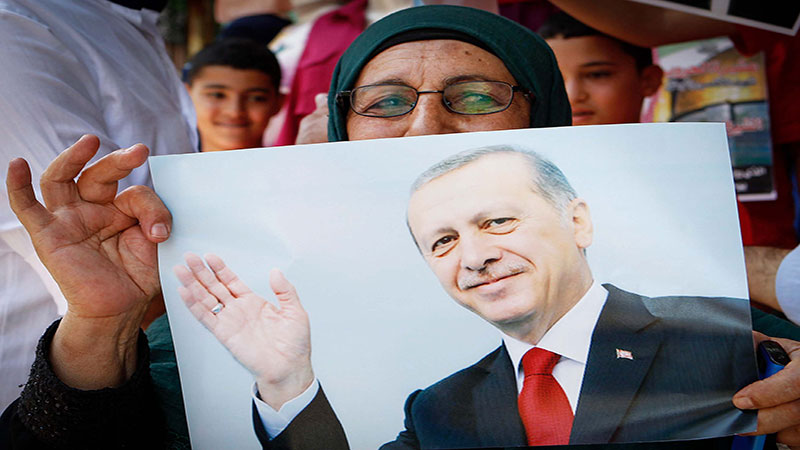
The answer is more outrageous than the diplomatic language suggests. NATO’s second-largest military is controlled by an Islamist authoritarian who embraces Hamas, a U.S.-designated Foreign Terrorist Organization; whose troops occupy Cyprus territory; who menaces Greece, a fellow NATO member; and who has threatened military intervention against Israel.
Yet Washington is considering selling his government the F-35, one of the most advanced combat aircraft in the American arsenal.
Erdogan’s Islamist Turkey
This isn’t a sudden aberration. It’s the predictable result of the course Turkey’s strongman, Recep Tayyip Erdogan, has pursued for years. He has never disguised what he is or what he wants.
In October 2023, weeks after the massacre of October 7, he told his parliamentary caucus that “Hamas is not a terrorist organization” but “a liberation group.”
That wasn’t a rhetorical slip. Turkey has hosted senior Hamas figures for years – Ismail Haniyeh, Khaled Meshaal and Saleh al-Arouri. When Haniyeh was killed in Tehran in 2024, Erdogan declared a day of national mourning and Turkey’s embassy in Tel Aviv lowered its flag to half-staff.
A NATO government observed a day of mourning for the head of a U.S.-designated terrorist organization whose forces and their accomplices had murdered approximately 1,200 people, most of them civilians, less than 10 months earlier.
Erdogan has branded Israel a terrorist state and likened Netanyahu to Hitler. In March 2026, speaking at an Istanbul mosque during Eid al-Fitr prayers, he publicly prayed that Allah would “destroy and devastate Zionist Israel.”
In July 2026, a Turkish court issued an arrest warrant for Netanyahu on “genocide” and other charges arising from Israel’s interception of a Gaza-bound activist flotilla the previous year. Ankara has now asked Interpol to circulate a red notice against him.
Nor has Erdogan confined himself to denunciations and prayers. In July 2024, he suggested that Turkey could intervene militarily against Israel, invoking Turkey’s actions in Libya and its support for Azerbaijan in Nagorno-Karabakh.
“Just as we entered Karabakh, just as we entered Libya, we might do something similar to them,” Erdogan said.
He offered no details, and the threat may have been intended primarily for domestic consumption. But it revealed how Erdogan conceives Turkey’s role: as the armed champion of a transnational Sunni Islamist cause, commanding NATO’s second-largest military and sheltered by the alliance’s collective-defense guarantee.
NATO Membership as a Weapon
What makes Erdogan’s hostility toward Israel especially dangerous is Turkey’s NATO membership, which gives him institutional power over the alliance itself. Turkey holds a veto inside NATO, and Erdogan uses it against the Jewish State.
He has said that Turkey will not approve cooperation between NATO and Israel. Ankara has blocked Israel from alliance exercises and frozen practical coordination – the intelligence sharing, missile-defense work and counterterrorism cooperation that a country facing Hamas, Hezbollah and Iran’s proxy network has every reason to seek from the West.
A single NATO member, acting out of ideological sympathy with Israel’s enemies, can block alliance-wide cooperation with Israel.
This is not the Turkey NATO admitted. Turkey joined the alliance in 1952 as a staunchly secular republic anchoring its southeastern flank against the Soviet Union – strategically vital and, more to the point, aligned with the alliance’s purposes.
Erdogan’s Turkey is an authoritarian Islamist power pursuing regional dominance under a neo-Ottoman banner, using NATO membership as armor while working against the interests the alliance exists to protect.
Israel isn’t the only democracy menaced by Turkey. Some 35,000 Turkish troops remain in the northern third of the Republic of Cyprus, an EU member – land Turkey has occupied since its 1974 invasion of the island.
Ankara also contests Greek maritime and energy rights, challenges Greek sovereignty in the Aegean Sea and has repeatedly directed coercive threats at Greece. An alliance built to deter aggression against its members now includes a government that threatens one of them.
Turkey’s conduct during the U.S.-Israeli war against Iran exposed an even wider gulf between Turkey’s formal status as a U.S. ally and Erdogan’s actual alignment. Ankara refused to allow its territory, airspace or military bases to be used for operations against Iran and declined broader logistical cooperation with the U.S.
Erdogan went well beyond neutrality. He condemned the U.S. and Israeli attacks as a “clear violation of international law,” blamed the war on Israeli provocation and declared that Turkey shared the pain of the Iranian people.
The F-35 and the Larger Question
Incredibly, the Trump administration is considering rewarding Turkey with F-35s, fifth-generation stealth fighters designed to penetrate advanced enemy air defenses – the same warplanes Israel depends on for its defense.
Until now, Washington had drawn a firm line against that. Turkey bought Russia’s S-400 air-defense system despite explicit U.S. warnings that operating Russian radar in proximity to the F-35 could help Moscow learn how to detect the aircraft and compromise its stealth advantage.
Turkey was expelled from the F-35 program in 2019, and the first Trump administration imposed sanctions on Turkey’s defense industry in 2020 under the Countering America’s Adversaries Through Sanctions Act, or CAATSA. F-35 transfers have remained blocked ever since, on a simple condition: get rid of the S-400.
On July 7 of this year, standing beside Erdogan in Ankara, President Donald Trump announced that he would lift those sanctions.
“We don’t want to sanction friends,” Trump said.
He waved off concerns about the S-400 and signaled willingness to reconsider the F-35 sale – including the six aircraft Turkey has already paid $1.4 billion for. Erdogan said Trump had pledged to address the issue.
Six weeks later, Israel was bombing a runway to keep Turkish forces off its northern frontier.
Turkey has not relinquished the S-400, and the case against providing it with F-35s has grown stronger.
Against whom does Erdogan need the F-35? The only plausible regional targets are Greece and Israel. Russia isn’t a convincing answer. Turkey maintains an accommodating relationship with Moscow, as shown by the S-400 purchase. Nor does Iran provide a credible justification. Despite their regional rivalry and religious differences, Turkey has extensive diplomatic and economic relations with Iran’s Shiite Islamist regime and has repeatedly resisted Western efforts to isolate it.
Greece and Israel are the two regional democracies Turkey increasingly treats as adversaries. This does not mean Erdogan necessarily intends to attack either country. It means that the most likely purpose of acquiring the aircraft would be to challenge, threaten or intimidate them. No responsible American government should give him that power and trust that he will never use it.
The F-35 sale is the immediate test. Behind it lies a larger and more difficult question: Why is Turkey allowed to remain in NATO?
Two considerations have shielded Turkey from a reckoning. The first is legal. The North Atlantic Treaty permits a member to withdraw voluntarily but contains no express mechanism for suspending or expelling one. The second is geography. Turkey’s geographic position has long been invoked as a strategic imperative requiring automatic Western support.
But that argument belongs to an earlier era. During the Cold War, Turkish control of the Bosporus and Dardanelles, proximity to the Soviet Union, and location on NATO’s southeastern flank made Ankara an unusually valuable military partner.
Continuing to treat Turkey’s geography as a permanent claim on Western backing and deference no longer makes sense. The U.S. and Europe have alternative basing, transit, intelligence, energy, and security relationships across the Eastern Mediterranean, the Balkans, the Gulf, and the Black Sea region. A durable alliance cannot rest on the assumption that one country’s map location excuses conduct that undermines allied interests.
What, then, should NATO do about Turkey? While it may provide no way to expel Turkey, NATO’s treaty does not require the U.S. to arm Erdogan with the F-35 or require the other allies to allow his vetoes to dictate their wider cooperation, reward his hostility or ignore the danger he represents. Fortunately, lifting the CAATSA sanctions would not by itself clear the legal barriers to an F-35 transfer. Sanctions relief is subject to Congressional review. Congress should block the sale.
NATO members can route around the Turkish veto through bilateral agreements and coalitions operating outside the alliance’s formal machinery. They can also shift basing and logistical operations toward Greece and Romania and deepen cooperation with Cyprus.
In short, NATO should begin treating Turkey according to what it has become rather than what it used to be. Until then, Turkey’s continued membership will make a mockery of NATO’s purposes while Erdogan’s government threatens Greece and Israel and undermines the alliance from within.