יום חמישי, י״ז תמוז תשפ״וThursday, July 2, 2026



Follow Us



By Alan Zeitlin
By Etgar Lefkovits - JNS
By Mike Wagenheim - JNS
By Jessica Russak-Hoffman - JNS
The United States is pressing Iran to abandon plans to charge tolls for passage through the Strait of Hormuz, offering access to Iran's frozen funds as an inducement, even as no frozen assets have yet been released…
The United States is pressing Iran to abandon plans to charge tolls for passage through the Strait of Hormuz, offering access to Iran's frozen funds as an inducement, even as no frozen assets have yet been released. Under the memorandum of understanding signed on June 17, the United States committed to making Iran's frozen funds available upon implementation of the deal, and guaranteed toll-free passage through the strait for 60 days only, after which Iran says it will impose what it calls service fees. A U.S. official said the American message to Tehran was to "think bigger," arguing that the revenue Iran could earn from developing and selling oil once sanctions are lifted would be far more valuable than fees on the waterway, which the official called a gangster tactic. Washington also maintains that because Hormuz is an international waterway, any new arrangement for it must be endorsed by the Gulf states, while Iran insists the strait lies in its territorial waters and that it will manage passage together with Oman. Two days of indirect technical talks concluded in Doha on Wednesday, mediated by Qatar and Pakistan, focused on the strait and on Iran's frozen assets, with no sign of progress toward a final agreement. Al Arabiya and other regional outlets reported that the sides reached an understanding on releasing a first tranche of roughly $3 billion in Iranian funds held in Qatar, to be used not as cash but for the purchase of humanitarian goods, some of them from the United States. No U.S. official confirmed the report. Iran's deputy foreign minister, Kazem Gharibabadi, who led the Iranian team, said the funds had been discussed and that goods would be purchased based on Iran's stated needs, and that the parties agreed to set up an emergency channel to address violations of the memorandum. He said all contacts had run through the mediators and denied any direct talks with the Americans. Traffic through the strait has partially resumed but remains well below prewar levels, and the two sides exchanged strikes last weekend after an Iranian attack on a cargo ship before agreeing on Sunday to keep the waterway quiet for a week. Parliament speaker Mohammad Bagher Ghalibaf said Iran was not negotiating with the United States at all and would not do so until Washington implemented every clause of the memorandum, while senior Iranian sources said Tehran was determined to retain control of the strait even by force. President Trump played down the prospect of renewed war, saying of Iran, "I think they've come a long way," and oil prices fell to a four-month low after his remarks. Qatar's Foreign Ministry said the next round would take place after ceremonies for Iran's late supreme leader.
The IDF says the sirens were a false alarm.
The IDF says the sirens were a false alarm.
The IDF says the sirens were a false alarm.
The IDF says the sirens were a false alarm.
Sirens are sounding in Yir'on and Avivim, communities on the Israel/Lebanon border.
Sirens are sounding in Yir'on and Avivim, communities on the Israel/Lebanon border.
By Rabbi YY Rubinstein
By Rabbi YY Rubinstein
By Rabbi YY Rubinstein
By Rabbi YY Rubinstein
By Rabbi YY Rubinstein
By TheBoss

By Jewish Press Staff



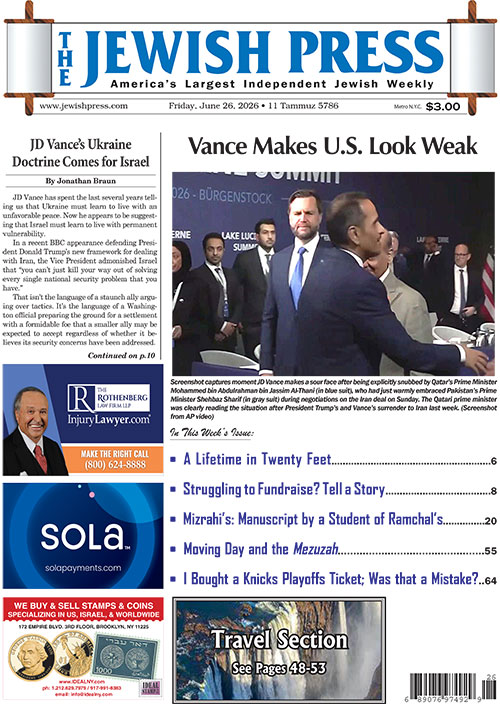 June 26, 2026