יום ראשון, ז׳ חשוון תשפ״זSunday, October 18, 2026



Follow Us


Read More
Your body has two primary operating modes: Sympathetic (stress mode), which produces fight, flight, tension, reactivity, and worry; and Parasympathetic (calm mode), which produces clarity, composure, focus, and regulated breathing.
Unresolved tension drains capacity. Without recovery, everything feels heavier than it is. And the effects are carried forward.
Overthinking triggers physical stress. Stress narrows perception. Narrowed perception produces more fear. Fear demands more thinking. It becomes self-perpetuating.
Panic is driven by the amygdala, not the thinking brain. You cannot out-logic an amygdala. But you can stop giving it reasons to stay activated. Acceptance plus anchoring signals the brain: Stand down. It listens.
You imagine a threat, your body reacts, you interpret the reaction as confirming danger, and fear intensifies. This loop runs endlessly unless interrupted.
Identify where anxiety first appears in your body. For some it's the chest. For others, the stomach, throat, or a sensation of unreality. Knowing your personal early-warning system is half the battle.
Those who project arrogance and self-assurance often battle the same cycle—driven not by appeasement but by domination.
Fear reinforces the belief that we don’t deserve love or connection, which in turn fuels anger—the ego’s counterfeit form of control, a desperate attempt to mask powerlessness.
A person with theoretically perfect self-esteem and zero ego would feel no urge to control others or the world. They would see clearly that their true domain lies solely in their own choices – nothing more, nothing less.
When a person descends into absolute nature, his conduct brings no real value to his neshama or to Creation. Absent teshuvah, there is nothing he could do that would outrank the benefit of being used as a kli to openly demonstrate free will.
When we misuse our free will, we become a kli (a "vehicle" or a "vessel") whose role shifts to supporting those who are fulfilling their primary Divine purpose (Rabbi Eliyahu Dessler, Strive for Truth, Vol. II, 75-76).
Fear doesn't just unsettle us; it can help bring about the very outcomes we dread. Worry is a misuse of the imagination that can lead to dire consequences.
All the good we help bring into existence benefits us in the Next World, to the extent that the soul grows from the experience.
Bitachon is not an excuse for recklessness; it does not absolve a person of the responsibility to use the intelligence and discernment Hashem gave him. One who deliberately disregards danger is not relying on Hashem—he is acting negligently.
When we transgress, either willingly or unknowingly, our soul becomes tarnished, and Hashem allows us to cleanse ourselves of these spiritual blemishes.
While the mitzvah of tefillah obligates us to ask for what we believe we need, we do so with the awareness that only Hashem knows what is genuinely good for us.
The more responsible our choices → self-esteem strengthens → ego shrinks → perspective widens → more of reality comes into view → our madreigah rises → bitachon deepens.
Chazal observe that lifespan, children, and livelihood are not contingent on merit or effort but on mazal. In these matters, we usually need to do what is considered to be the normal hishtadlus.
Our core identity must be rooted in the awareness that we are a neshama – a soul experiencing life through a body, not a body that happens to house a soul.
We recall that a person suffering from a phobia – such as claustrophobia – acknowledges reality. He is not deluded; he knows his fear is irrational. This is fundamentally different from someone who insists that their distorted perception is correct.
If we have wronged someone, it is essential to seek their forgiveness before turning to Hashem.
We must remind ourselves that these experiences are not the “luck of the draw” or mere happenstance. Our strengths, weaknesses, and struggles – whether physical, emotional, or spiritual – are all a function of mazal, tafkid, and tikkun, designed for our ultimate growth and emanating from Hashem’s infinite love.
Forgiveness is strongly associated with lower levels of anxiety, stress, and hostility, as well as fewer symptoms of depression and a reduced risk of alcohol and substance abuse.
Fundamentally, bitachon is the acceptance and recognition that every experience comes directly from Hashem, given out of His love for us. It means knowing unequivocally that nothing happens by chance and that every aspect of our lives is under complete and total Divine supervision.
Unlike legitimate shame, which is a productive, self-correcting mechanism that says, I am less because of what I’ve done, this is toxic shame: I am less because of what was done to me.
We wonder, why am I not passionate about anything significant? The answer is rarely found in more searching – but in more refining.
When the ego dominates, we instinctively sacrifice our true selves to avoid discomfort or looking foolish. Shame, in contrast, exists in private—it is an internal reckoning, the pain of knowing we've acted beneath ourselves, regardless of whether anyone else knows.
Repeated behaviors become ingrained, forming habits that ultimately shape our identity. Each small action either reinforces fear-based patterns or builds confidence-based ones, creating what psychologists call behavioral momentum.
Engaging in aimless activity creates the illusion of progress, allowing us to sidestep decisive action that could expose us to failure.
Perfection—the henchman of procrastination—is deeply demoralizing. Neither intelligence nor talent grants immunity from its grip.
Compassion is the foundation of validation. How we speak to ourselves — and how we listen — is just as important as what we say.
Recognizing that having an anxious thought doesn’t mean we must feel anxious allows us to break free from its grip and regain control.
The theory of ironic processes explains that the more we deliberately attempt to suppress a specific thought, the more we find ourselves attached to it.
It’s important to emphasize that diversion is not suppression. For instance, we wouldn’t say we’re suppressing thoughts of unicorns just because we’re not thinking about them; they’re simply irrelevant to us, so our attention is elsewhere.
In the previous columns, we laid out the mechanics of bitachon. Now, we begin the step-by-step protocol to confront anxiety and fear head-on—starting with a powerful, science-backed technique to intercept anxiety the moment it strikes and shift both body and brain out of panic mode.
Anxiety and fear are distinct phenomena, each with unique origins and requiring different strategies for management. Anxiety prompts us to anticipate future dangers and imagine worst-case scenarios that might never occur. In contrast, fear is a reaction to a known threat that usually subsides once the threat is removed or conquered.
A narrow lens doesn’t just blur what matters—it warps scale. We lose the ability to gauge how much something matters.
Our choices shape our perspective. Our perspective sets the context. And that context determines the meaning we assign to any experience.
When perspective is lacking, even the good in our lives remains out of focus. We fixate on what’s missing, what we’re owed, and where life falls short.
We may fear pain, but it’s crucial to recognize that pain leads to suffering only when it lacks proper context and meaning.
The people who love or care about us are the ones we affect most deeply. For someone who feels they have so little control, this becomes the last lifeline - the only power they have left to hold onto.
As the ego grows and our perspective narrows, unhealthy aspects of our personality begin to surface, filtered through the prism of our insecurities.
The bigger our ego, the greater our need to predict and control our world. The ego is thus inclined to dwell on the worst-case scenario in a futile attempt to protect itself.
People with anxiety or depression gravitate towards feelings that match their internal emotional landscape. For example, someone with anxiety might repeatedly engage in activities that provoke worry or fear, while a person with depression might immerse themselves in environments that elicit sadness or hopelessness.
The clearer our perception of reality, the more each moment reinforces our emunah. In contrast, those who deny the truth must continually adjust their experiences, filtering their lives through an ego-distorted lens.
When the ego is engaged, it instructs us about what is important. However, in this space, we can’t access it and have little or no connection to the reality into which we have been thrust.
Bitachon means knowing in our hearts and minds that there is no such thing as chance and that all of our life experiences are under complete and total Divine supervision (Emunah U’Bitachon 2:1).
Bitachon means knowing that Hashem not only supervises all aspects of our lives—down to the tiniest detail—but that He actively optimizes the entirety of our lives and life experiences toward our greatest good and growth.
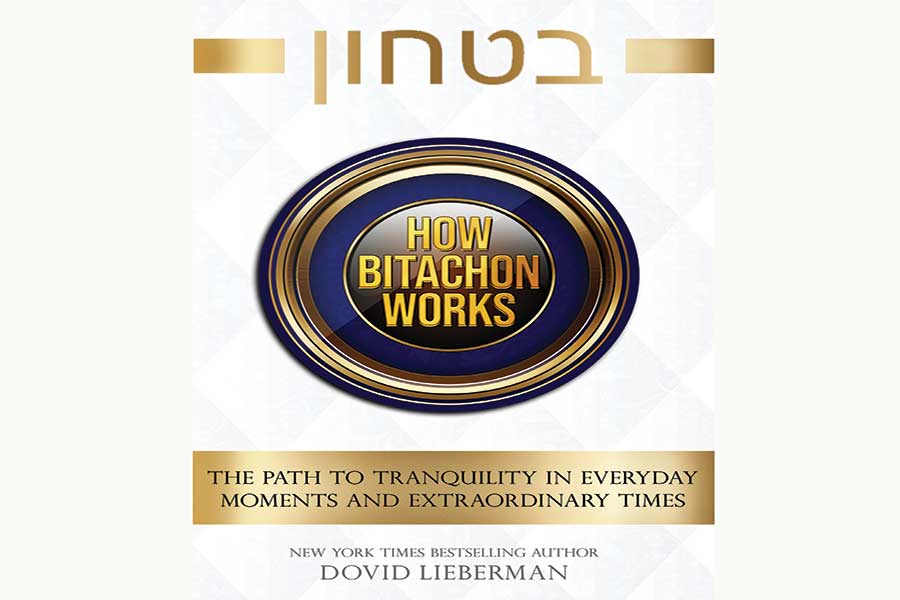
How Bitachon Works is not a collection of stories, parables, or motivational quotes. Instead, it draws on the wisdom of the Torah, classic sources, and principles of human nature to provide a logical exploration of bitachon — a clear framework for understanding how it operates and how to access it.


 October 16, 2026