 September 18, 2026
 Categories: Features
Judge Jill Epstein Elevated to NY Supreme Court
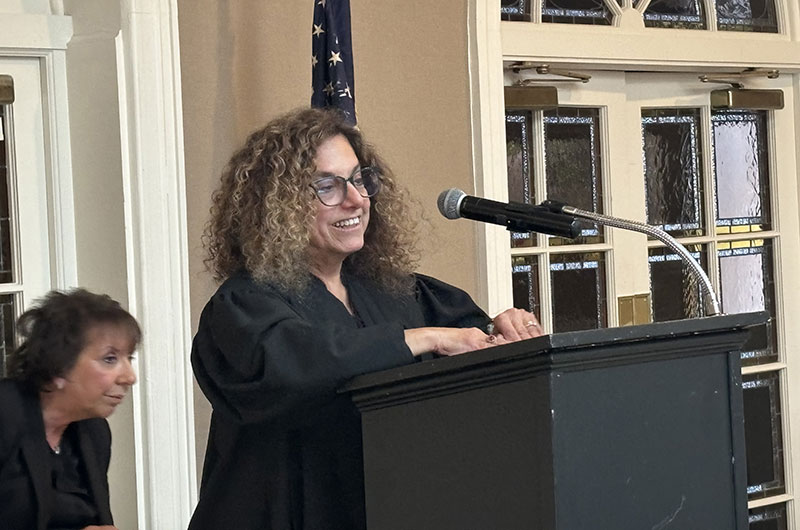


At a Coney Island catering hall packed with legal and political figures, Judge Jill R. Epstein was sworn in on Sunday as a New York State Supreme Court Justice, 2nd Judicial District.
“This has been an amazing journey,” Epstein said in her remarks at the podium. “I'm grateful to have the support of the Democrat, Republican, and Conservative parties. I’ll never forget your kindness and how much you welcomed me.”
“We are very happy to have another Jewish member on the bench,” New York Assemblymember Rodneyse Bichotte-Hermelyn told The Jewish Press at the swearing-in. “She should have been on the Supreme Court many years ago.”
Judge Epstein's legal career began when she was admitted to the New York bar in 1984 and includes extensive experience within the New York State court system. Before ascending to the bench, she served as a senior law clerk for Kings County Civil Court from 2005 to 2012 and then as a principal law clerk for Kings County Supreme Court from 2012 until her election to Civil Court in 2019.
During her time as a law secretary, Epstein worked on high-profile cases, including the complex litigation surrounding Long Island College Hospital. Her work in both civil practice and the court system positioned her well for her role as a judge, her supporters said at the ceremony. She earned her law degree from Benjamin N. Cardozo School of Law at Yeshiva University.
As a Civil Court judge, Epstein presided over civil cases in Kings County (Brooklyn). In her 2025 campaign for the Supreme Court, she ran unopposed and received the endorsement of the Democratic, Republican, and Conservative parties.
“The great thing about Jill is she has vast experience not just from the judge’s side of the bench, but from the attorney side of the bench,” New York Assemblymember Kalman Yeger told The Jewish Press at the event. “She has compassion and passion. She recognizes that people don't come to court because they’re having a great day. They come to court because something is wrong. And she knows how to treat people.”

The state operates on a three-tiered court structure. At the base level are various trial courts of both general and limited jurisdiction. These include the Supreme Court (which, despite its name, is actually the first level trial court), County Courts, Family Courts, Surrogate's Courts, and local courts such as City Courts, Town and Village Courts, and in New York City, the Civil and Criminal Courts. The middle tier consists of the Appellate Division of the Supreme Court, and the New York Court of Appeals, located in Albany, is the state's highest court.
Elevation to the New York State Supreme Court represents a major advancement in a judicial career. Supreme Court justices handle some of the most significant and complex legal matters in the state, from high-stakes commercial litigation to serious criminal cases. The 14-year term provides stability and independence, allowing justices to develop deep expertise in their areas of practice. Moreover, service on the Supreme Court opens the door to potential appointment to the Appellate Division, as only Supreme Court justices are eligible for such appointments.
“I can't think of anyone better to represent our community and Brooklyn on the Supreme Court,” Civil Court Judge Jacob Zelmanovitz, who has known Epstein for years, told The Jewish Press. “She’s really done it all and she'll be an asset to the bench.”