 October 23, 2026
 Categories: Featured / Parsha / Torah
Taking the Plunge


Parshas Shelach
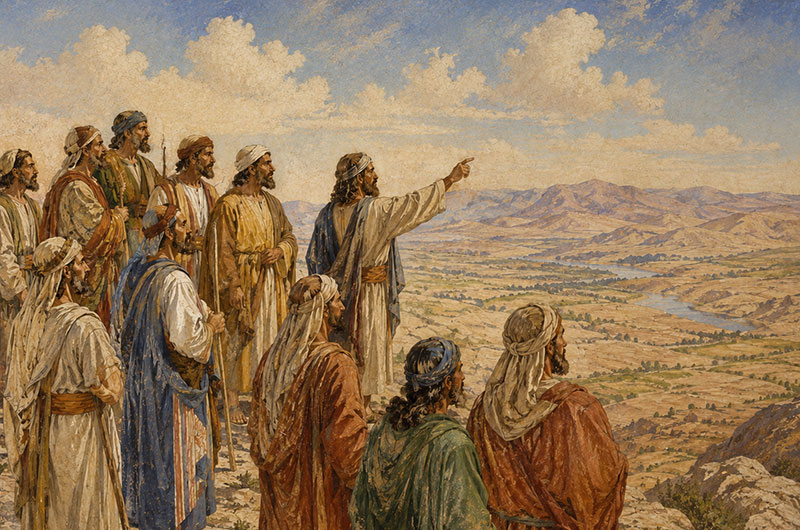
The spies were given a formidable mission. They had to convince the people that they could win a series of battles against enemies more powerful than they and with seemingly impenetrable defenses. The spies, all of whom were G-d fearing men and heads of their tribes, knew that the only way this could be achieved was by the people keeping G-d on their side through their loyal adherence to His Torah and mitzvot.
But the spies knew their people all too well. After all, these were the people who never stopped questioning G-d, even after all the miracles they had witnessed from the Exodus on. Just recently they had complained about the manna and doubted G-d’s ability to provide them with meat. Were these the people who were going to believe in G-d’s ability to vanquish the seven nations on their behalf? If even Moshe had lost confidence in his ability to influence them (11:14-15), what chance did they have?
Chazal tell us that a person’s character can be found in his name. If one looks at the names of the spies, one can discern certain innate positive qualities, but one cannot be certain whether the bearer of the name will use those attributes for good or for the bad.
Take for example the spy called Setur ben Micha’el. Setur means to break. The bearer of this name has the potential to break the mold of nature and do the impossible, because he relies on G-d. And the name Micha’el means that this person so trusts G-d that he calls Him “Mi ka’Kel – nobody is like G-d.” But the name Setur can also signify one who contradicts G-d and his commandments. And Micha’el can also mean that by doing so, he renders G-d moch, which means weak, because G-d derives His strength (so to speak) to fight the enemies of the Jews from their adherence to his mitzvot. So, a name can go either way. It all depends on where the bearer takes it.
Rashi takes this ambiguity in the character of the spies a step further. When Moshe consulted with G-d about whether to send spies to scout out the land, G-d was not happy with the idea. “I told the people that the land is good,” He said, “so why do they need spies to investigate whether I am telling the truth? By their lives, I shall give them room to err by listening to the spies so that they will not inherit the land” (Rashi to 13:2)
In other words, it seems as if G-d has already made up His mind that the spies will fail in their mission and will not succeed in convincing the people to fight for the land. If G-d, who sees into the future, has already decided what is going to happen, where is freedom of choice? Granted, the names of the spies suggest that they will turn against the land, issue a bad report and dissuade the people from going, but the same names also suggest that they might issue a good report and encourage the people to go. So why has G-d preempted their choice and prejudged the outcome?
The same question could be asked about Yaakov. How could Yaakov repeat the mistake of his father Yitzchak, who favored Eisav and prefer Yosef to his brothers? Didn’t Yaakov suffer the consequences of this favoritism and have to flee for his life because of Eisav’s threats?
Yet, we know that it was this very relationship between Yosef and his brothers and his eventual sale by them to Egypt that started the ball rolling to implement G-d’s great plan of enslaving the Jews in Egypt, freeing them and giving them the Torah. Was this why Yaakov favored Yosef? Given G-d’s plans for the Jewish people, did Yaakov even have a choice to favor Yosef or not, or was he merely an instrument in G-d’s tool box of Jewish history?
The answer is that Yaakov did have freedom of choice. He could have resisted, as every parent should, favoring one child over the other. And yes, G-d does have his plans. But Yaakov was human. Humans make mistakes and Yaakov’s mistake was to give in to the understandable urge to favor one child over the other. So what does G-d do with Yaakov’s mistake? He uses it to further His plan. G-d puts our wrong choices to constructive use.
The same happened here. The spies did have freedom of choice. And G-d did have a plan. G-d’s plan was to keep the people in the desert for forty years to train them in trusting him, so that by the time they would arrive in Israel, they would understand that they need Him for everything, even as they would work to earn their own living. G-d’s plan would have materialized with the help of the spies or without it. But, like with Yaakov, G-d used the spies’ wrong choice to implement His plan. That is the meaning of Rashi’s words “By their lives, I will give them the opportunity to err.”
But, unlike the other spies, Yehoshua and Kalev made the right choice. It was not easy for them to go against the tide of criticism that the spies leveled against the land of Israel. They almost paid for it with their lives (14:10). That is why Kalev made a trek up north to Hebron where he prayed at the graveside of the patriarchs and matriarchs for strength to do the right thing.
After all, trust takes courage. The courage to risk failure. Even though the odds were against conquering the land, Kalev, like Nachshon before him, took the plunge and was ready to face the daunting enemies because he believed that when G-d said “I will give the land to the Jews” (13:2), this was a guarantee he could rely on.
Often the road to success begins with action. We don’t know for sure what will be, but we summon up the courage to take the first step and then things will work out for themselves, with the help of G-d. This was the message of Yehoshua and Kalev who said “Aloh na’aleh – we shall surely go up” and conquer the land. The word aloh is in the present tense whereas the word na’aleh is in the future tense. The key to success is to act now without fear of what the future might bring, because at least one thing is certain: if we don’t do it, it will not be done. The na’aleh part, the future, we must leave to G-d.