 September 18, 2026
 Categories: Featured / Parsha / Torah
The Glory of the Temple for Those Who Behold It


Philo of Alexandria can make a viable claim to the title of first Jewish philosopher, but has become unjustifiably obscure. This is likely due to the fact that he is generally considered a “Hellenistic” philosopher, and probably as a consequence of this, he was largely ignored by Chazal. His influence on early Christian theology and medieval philosophy in general is profound, but this is another strike against him among the Jews. And by the time philosophy became popular in the Enlightenment, most of the gentile philosophers weren’t eager to claim Jewish influences either.
However, on the evidence of his writings, Philo was almost certainly a Torah-observant Jew who believed in the Divinity of the Torah and the uniqueness of Moshe’s prophecy. He wrote treatises in support of Torah Law, including Rabbinic edicts, in spite of being shunned by the Sages. He was a leader of the Jewish community in Alexandria, scion of a family of leaders of that community – which probably was also a factor in his failing to achieve prominence within the normative Jewish tradition. The Sages of the Mishna, who were Philo’s contemporaries, lived almost exclusively in Israel. Those of the Gemara were found between Israel and Babylon. The Jews of Alexandria were the most populous, the most affluent, and the most politically influential community of Jews in the ancient world, but they opted to remain in Egypt even after the Second Beit HaMikdash was built in Yerushalayim. In fact, by his own account, Philo visited the Beit HaMikdash at least once. The Gemara’s discussion of the Jewish community of Alexandria tends to be ambivalent and ultimately dismissive. There is very little of substance they are known to have contributed that is of lasting value to the future development of Judaism. The writings of Philo might be construed as an exception to this principle, but this is still not widely accepted.
In any event, Philo was certainly ahead of his time, in particular in his efforts to reconcile traditional Judaism with Greek philosophy. This was not a popular pursuit with either the Romans or the Jews of antiquity. Philo is remembered by historians of philosophy as a preeminent Platonist, while Rambam is known as one of the greatest disciples of Aristotle. Although there are significant differences between them, Philo wrote many of Rambam’s most famous ideas about the rational understanding of Torah in a time about as long before Rambam’s birth as the period between his life and our time. In light of the eventual acceptance of Rambam’s encounter with Greek philosophy and even its mainstreaming within Jewish belief and practice, it seems deeply unfair that Philo has not been granted the same respect. In truth, the crimes which led to Philo’s ostracism from the mainstream of classical Judaism are the same which led to Rambam’s own ostracism, and it is widely accepted today that the opponents of Rambam were mistaken.
In Part I of Philo’s treatise on the Oral Torah, On the Special Laws (widely known by its Latin title, but Philo wrote in Greek), he explains how the design of the Mishkan (and by extension the Beit HaMikdash) is given in response to Moshe’s request to perceive the Glory of Hashem. Because Hashem is infinite and cannot be contained by human reason, Hashem instead instructs Moshe how we mortals may serve Hashem in a manner appropriate to us and to Him. There is an archetype for our Temple in realms above which was seen and described by our prophets, but Moshe (along with Betzalel and Oholiav) is given the knowledge and tools to build a version here on earth. Philo emphasizes that the Mishkan is built in emulation of the celestial bodies, laid out according to astronomical and astrological principles, but that there is only ever one Sanctuary as Hashem is also One.
Philo explains how the layout of the Temple is conducive to a spiritual encounter with the Divine in a physical space designed for that purpose. The outer courtyard, whether in the Mishkan or the Beit HaMikdash, is much larger in proportion to the rest of the structure and is also designed to keep the impure and unsanctified out of the sacred space. It is noble and imposing so as to impress itself upon the sensibilities of the uninitiated in a manner befitting a “House” of the Deity. But of course, no house can truly contain Hashem, Who is the place of all things and no thing is His place (Philo said this long before it was written down in the Gemara!). So the inner courts and chambers are much simpler and utilitarian, suited to the practical performance of the Service by the Kohanim inside its walls. The innermost chamber, the Kodesh Kedoshim, is the most beautiful and glorious of all, but it is only ever seen by the Kohen Gadol, and even he sees it enveloped in smoke while averting his eyes. This space, where the Divine encounters the human, is thus, according to Philo, invisible (at least that’s how it’s been translated from Greek to Latin to English).
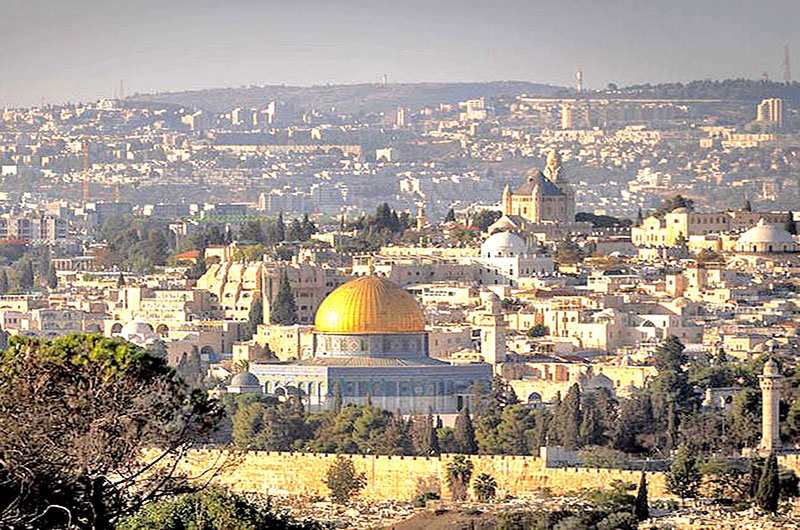
As the Kohen Gadol is performing the intricate and dangerous service within, all the tribes of Israel come together outside to have a massive party. Philo points out that the entire area of the Temple Mount that surrounds the Sanctuary is without trees or ornaments, in a manner very much at odds with the pagan practices that had been prevalent in his time. He gives a number of reasons for this, mostly concerned with not impeding the sanctity of the surroundings and also to be conducive to this gathering of the tribes which takes place without passing through hidden groves or areas of shadow. Everything is revealed and majestic outside the Beit HaMikdash, even as everything is hidden (and even more majestic) inside.
The role of the Beit HaMikdash in unifying and inspiring Israel is central to our communal life and our encounter with the G-d of Israel, both as individuals and as a collective. When we ascend the Temple Mount to celebrate with G-d and with each other, it gives meaning and focus to the rest of our lives that we spend as individuals and away from the House of Hashem. It’s almost as though everything else in our lives is the insignificant activity we engage in to grow the fruit and earn the money to pay for the sacrificial animals we will bring in the times when we manifest our true spiritual selves.
Happy were the people of those generations who saw the Beit HaMikdash with their own eyes and could report on the experience. How tragic for us that we can only hear of it and imagine. May it be the will of the One who resides eternally atop the Temple Mount that we will merit to rebuild it and see the service restored and celebrate the Festivals there in our lifetime.