October 2, 2026
 Categories: Headline / Parsha / Torah
The Kingship of Hashem Outside of Space and Time
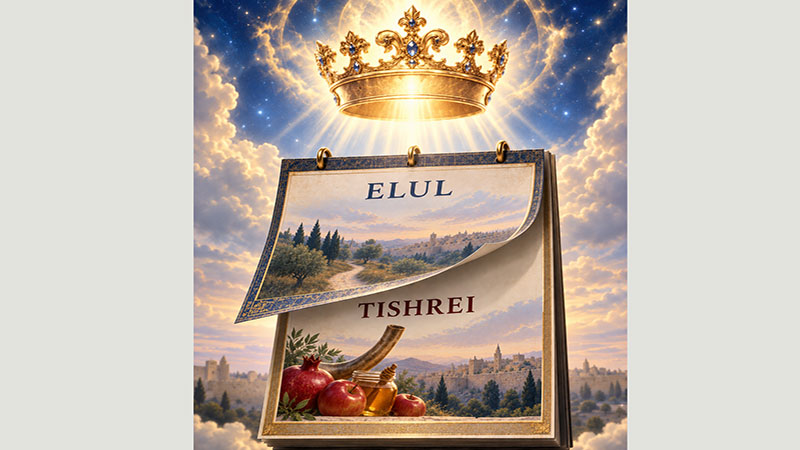


A persistent theme in the liturgy of the High Holidays – and indeed of our entire conception of this time of year – is the eternity of the kingship of Hashem. Of particular note are the conspicuous manner in which we recite “Blessed is the glorious Name of His sovereignty for eternity” aloud after the Shema on Yom Kippur, and the recurrence of the formula “Hashem reigns, Hashem reigned, Hashem will reign for eternity” with which we conclude the services of the day.
But in a broader sense, which we will only briefly outline here, the fundamental premise of Rosh Hashanah derives from the idea that time is only demarcated when a temporal consciousness – that is, we as human beings – becomes aware of it. This is the reason why we mark the time since Creation from the birth (or emergent awareness) of Adam, the first human. It is also resonant in the name of the holiday of Rosh Hashanah, where Shana refers to the passage of time itself and not simply the counting of another year.
This idea, although it has been discussed by many great expositors of Jewish thought over the centuries, is perhaps first and most clearly expressed in the Sefer Yetzira, which divides our conception of reality into Olam, Shana, and Adam. Of all the days of the year, Rosh Hashanah is the one (well, two) that most exemplifies this approach to existence and is designed to elicit the deepest understanding of each of these three modalities. Shana is etymologically connected to the Hebrew word for change, and time, of course, is the manner in which we measure and relate to the process of change as it unfolds before us. Thus, Rosh Hashanah is not merely, and somewhat allegorically, the “beginning of the year,” but it is also quite literally the “head of the change.” On each and every Rosh Hashanah, we confront our own temporality and limitation in juxtaposition with the eternity and the majesty of G-d. This, in a very real sense, is the essence of the day, reflected by its name and in its mode of observance.
Rav Shimon Gershon Rosenberg, better known by his acronym “Shagar,” compiled his sermons on the High Holidays into two volumes focusing chiefly on Rosh Hashana and Yom Kippur, respectively. Many of these essays are among the relatively few of his writings that have been translated into English so far since his untimely passing in 2007. The first of the Hebrew editions, the title of which can be translated to “A Recollection of the First Day,” concludes its discussion of Rosh Hashanah with a detailed foray into the nature of time and its implication for the Kingship of Hashem. In particular, Rav Shagar examines how on the one hand, we are defined as mortal and delimited by our subordination to time, but on the other hand, in “coronating” Hashem on Rosh Hashanah – that is, recognizing and testifying to His eternal reign – we become partners in Creation and in our own election and eventual redemption.
As noted above, on Rosh Hashanah we mark the beginningoftime, and Rav Shagar indicates that the unique spiritual quality of Rosh Hashanah is that it affords us an opportunity to truly begin anew. This is also the nature of teshuva, which we’ve been discussing in this column for a few weeks now and experiencing as a community with the recitation of Selichot in our daily prayers. On Rosh Hashanah, we are concerned not so much with the beginning of a new year as such – with the changing of the digits on the calendar – but with the putting an end to the time that has preceded this moment, and facing the beginning of the “new time” that begins here and now, today, on Rosh Hashanah.
On the subject of proclaiming Hashem’s kingship on Rosh Hashanah, Rav Shagar delves deeply into how we as mortal beings inhabiting the physical universe are constrained by both space and time, whereas Hashem’s kingship is understood by us in part by His being beyond and outside of these confines. While sometimes we can abstract and imagine our way out of the confines of space, we are generally trapped in the flow of time. For us, everything always changes, nothing can ever be exactly as it was, and even our own experiences from the past become colored by the events of the present and future until our conception of ourselves necessarily shifts and changes in light of subsequent events.
Hashem is “the king of justice,” as we say in the Amidah on Rosh Hashanah and thereafter through Yom Kippur, along with other similar modifications in our liturgy. His justice is superior to our own, because He alone sees and understands everything as it has been and as it will eventually come to pass. Thus, His assessment of our deeds and our worth is not limited by a partial view of events and their consequences. Only through His eternity can He be supremely just in a manner that will be forever unattainable even to the wisest mortals. In this quality, too, His kingship inheres.
However, we as Israel establish His kingship here below in the realms of mortal men. This is also connected to our relationship to time. We are not witless passengers on the ebb and flow of time, like the other nations that mark their calendars and measure their seasons by the movement of the sun and constellations. The Jewish calendar and all its celebrations and fast days are determined only by the judgment of our earthly courts in the physical world, which operate within space and time. In sanctifying time and setting the calendar, we establish Hashem’s kingship and we also inhabit our proper role as His emissaries on earth, glorifying Him who is outside of time.