יום שבת, ט״ז אלול תשפ״וSaturday, August 29, 2026



Follow Us



Presumably, the Yerushalmi calls the mice wicked because instead of merely eating what they need to survive, they also invite their friends over to party.
Although the redemption happened over three thousand years ago, it has different meaning in every generation.
Since the beginning of the year we have been going thought so much pain and devastation. So much grief and lamentation. We have troubles from outside and troubles from within. G-d in heaven hear our cry. Master of the world, see our pain. Hashem, our Father save us.

One can say that eclipses could be different from all other created natural anomalies as a matter of Jewish law and are not covered by the general idea of a wonder such that a blessing should be made.

If a shadchan from one place went and made a shidduch elsewhere, his default fee is according to the place where he made the shidduch.
Ensnarement and Atonement: ‘The Only Proper Guarding of Coins Is in the Ground’ (Bava Metzia 42a)

I listen as one woman, Chaya, as she is being interviewed about her twin brother, Arnon. She describes how on October 7, her brother was not called up. He simply went to the Gaza border when he heard what had happened. ‘But you have no ammunition! You were not yet called!’ he was told.
Halacha is not “fact.” It is not one decision, but is determined by the Rabbi or Sanhedrin with human intellect to understand how to apply the will of G-d, as expressed by that mitzvah or halacha in a particular circumstance and time.

There are several reasons for the requirement to use mayim shelanu. According to some, the reason is that the wells and springs are warm in the springtime, and cold water must be used for baking the matzot.
When I asked my class why we give shalach manos on Purim, one of my students replied, So that our friend gives us back!

Those who are cleaning for Pesach must remember that preparation for Pesach is a mitzvah and that theme should always be portrayed so that their children will learn from their actions.
Today, in our generation there is so much confusion and promiscuity. So what do we think about when we want to prepare for such a holy holiday with so much meaning?

The book is worth more with M.F.'s autograph, insisted David. I got it autographed, so I should be able to keep the autographed copy! If you insist on getting your book back, at least pay me the added value of the book!
The Difficult Choice ‘His Father’s Lost Object and his Rebbi’s Lost Object…’ (Bava Metzia 33a)

In this column, I focus on one aspect of the war most commonly experienced by soldiers and other military service members, namely the perpetration of an act that, in the soldier’s perception, violates his moral code and inappropriately caused or contributed to the harm or death of an undeserving victim.

In her mind, all of her ancestors are swaying with her and she hears Baruch Levine singing harmony as she recites the timeless prayer for her children to be scholars and illuminators of the world. And in the middle of the spiritual euphoria (if she is lucky enough to get so far) she feels a tug on her leg. Mommy, can I have apple juice? Mommy, it’s not fair…
There is some fascinating research that seems to show that there is a social function for sarcasm, which actually can aid learning and creativity, notwithstanding the more frequent toxic effects of hostility and passive aggressiveness.
The Majority Rule “If The Majority Are Israelites…” (Bava Metzia 24a-b)

When you buy a raffle for another, even with your own money, you acquire it for him as his agent, replied Rabbi Dayan. All the more so if he asked you to lend him the money (C.M. 183:4; Divrei Chaim C.M. 2:21).

How many times do we stick to our guns because we are too proud to admit we are wrong, doubling down and doubling the damage?

Can one simultaneously discharge the mitzvot of mishlo'ach manot and matanot la'evyonim by giving a poor person a generous food package on Purim?
In honor of Purim, we open up the archives and bring to you some of the classic sheilos rabbanim have been asked this year…

As an aside, especially in our day and age, I think some careful thinking about one’s drinking is warranted. We live in a time of such excess and such abundance that unfortunately there are very many situations where people find themselves with serious drinking problems.
We are living in a generation when open miracles are not seen daily or at all. And yet our daily existence in this homeland is a natural miracle.

A Jew may not borrow money from another Jew at interest in order to lend it to a non-Jew at interest, replied Rabbi Dayan. If Shimon (the middleman) bears responsibility to Reuven, there is a lender-borrower relationship between them, so that ribbis is prohibited.
Stop, Thief ‘Are Identifying Marks Biblical or Rabbinic’ (Bava Metzia 18b)

By Rabbi Shimshon HaKohen Nadel
The Land of Israel is central to Torah observance. Hashem placed us on this land to fulfill His will.

According to Kabbalah, the spiritual effects of Haman's evil decree were never completely rescinded. As such, the purpose of the Fast of Esther is to eradicate any harmful effects of Haman's decree that may remain in the world.

Some may feel that doing loving things is enough, even if not verbally expressed. While it is a generosity of sorts, it can be maddening to the receiver who wants to feel more acknowledgement.
As Jews we understand that even after certain things become worn out, they maintain holiness, and must be disposed of properly.
The Piskei Teshuvot ruled that we can listen to music during Taanit Esther, which is generally discouraged on other fast days. This ruling indicates that Taanit Esther is not a sad day.
Women are so innocent and pure. They must be, they bring up the children of Hashem, they give love and attention physically and mentally to all the children of Israel.

There is a coin on the bimah, presumably from one of the tzedakah boxes, said Chaim. It's likely from the box for the shul, since it was near it, but I can't say for sure. What should I do with the coin?
The ‘False’ Rumor “If One Found Notes of Acquisition” (Bava Metzia 14a
One who writes his own Sefer Torah should never give that Sefer Torah away. This is because, according to some authorities, the mitzvah of writing a Sefer Torah also requires one to keep that Sefer Torah in one's possession forever.
By Rabbi Shimshon HaKohen Nadel
Historically, some challenged the permissibility of a modern aliyah, and later the validity in founding the State of Israel, based on the Three Oaths. They argued that we have no right to settle the Land of Israel before the arrival of the Mashiach; some even suggesting that the Holocaust was a punishment for re-settling the land prematurely.

If a deaf-mute and a fully rational person attempt to jointly acquire an object, neither ends up owning it. The deaf-mute cannot function as an agent for the rational person, so the rational person has no partner in acquisition.

How often in life do we think that if we only had that one more thing, then we would be truly happy and then we could really appreciate our blessings. It could be a new car, moving to a different neighborhood, having a little more money, a better boss, better employee, better behaved children, a shidduch, health, etc. That one missing commodity contains the key to our elusive happiness.

Today, IVF enables couples who, in the past, would not have been able to have children to become parents. This is an amazing blessing of our generation.
This woman of Israel. Have the fear and love of a Hashem in their heart, and in their soul. They shall be praised forever and ever.

When the lender instructs the borrower to return his item or money through someone else, replied Rabbi Dayan, the Rishonim derive from the Mishna (B.M. 98b) that the borrower is exempt if the messenger loses it.
The Split “…If There Are Witnesses They Divide Without an Oath” (Bava Metzia 2a)
Adar gives us a message of empowerment. Ani Dar – I live with you; Hashem speaks to us. No matter where we are in the world. No matter the time, the country, the generation. We must know that we are not here alone.

Rabbi Yochanan was sitting upon seven cushions. When he could not answer Rav Kahana’s questions, he removed a cushion from under himself to demonstrate that he was lowering himself out of respect.

While it may not be halachically forbidden for a bride to wear gloves at the chuppa, there are several reasons why it is frowned upon. One reason is that the custom of using a ring at the wedding ceremony is intended to represent the relationship, the bond, between the bride and groom.

By Rabbi Shimshon HaKohen Nadel
Rav Avraham Borenstein of Sochatchov explains that Rambam does indeed consider settling in the Land to be a Biblical mitzvah that applies at all times. However, like in other instances, the Rambam includes it within another, more general mitzvah (Avnei Nezer, Yoreh De’ah 454:5-6.)
The one thing I can say about the flu is that it is very loving and friendly. I don’t know anyone/anything else that can tolerate being around me without a break for over two weeks.

Truth be told, we should do our best to engage even those gentiles we encounter in our everyday course of life who unfortunately commit antisemitic acts, mostly out of ignorance.

We know that we're living for something higher. We know that there is a king and that is Hashem. We know that He's looking down on us all the time and He wants us to go in the right direction.

A thief is required to return the stolen item when it is intact. However, if it got ruined or changed significantly, the Mishna (B.K. 93b) teaches that the thief is required to pay the full value of the item, and he is left with the ruined item.

His Silence Is Deafening ‘One Seized it in Our Presence’ (Bava Metzia 6a)

It is said that greeting people with Shalom aleichem brings people closer together.6 As such, a man should not greet a woman with Shalom aleichem so that they do not become overly social with one another. According to this approach, there would be no problem for a man to greet a woman with good morning or how are you?

By Rabbi Shimshon HaKohen Nadel
While generally travel is prohibited on erev Shabbat, the Shulchan Aruch rules that if one is ascending to the land of Israel and his caravan is leaving on Friday, he may leave with them because of the mitzvah of dwelling in the land of Israel (Orach Chaim 248:4).
It was a very sweet and thoughtful gesture, and, thankfully I still have my teeth and was able to enjoy the cake.
For example, if you would normally buy an esrog for $100 and one year there are no esrogim available, if you were to give that $100 to charity, it would count as if you performed mitzvah of taking the esrog!

It is said that in Nissan we will be redeemed. It is also written that only with great joy can we be redeemed.
Most of the drivers drove carefully and obeyed traffic laws, honoring the traffic lights and giving right-of-way to pedestrians. However, he did see his fair share of poor driving and near-accidents, whether between cars or with pedestrians. He also witnessed several accidents.

The Burdensome Beast ‘He Put His Donkey on the Ferryboat’ (Bava Kamma 117b)
At the beginning of bentching we thank Hashem who sustains the entire world with goodness, grace, kindness and mercy. It’s something to think about.

What is the meaning of Man being made in G-d’s image? G-d has no body or form: You saw no form at Mount Sinai, only a voice (Devarim 4:12).

By Rabbi Shimshon HaKohen Nadel
According to the Ra’avad and Ramban, there is no Torah prohibition to fear. Instead, the Torah promises the soldier that he will not fear (see their comments to the Rambam’s Sefer HaMitzvot).

The halachic authorities are somewhat divided on the need to mention the name of a sick individual when praying for them. Several authorities rule that mentioning the name of someone when praying for them is optional.

Secular music with lyrics that are inappropriate due to heresy or lack of modesty is obviously not permitted. Otherwise, it’s not necessarily prohibited – just as secular wisdom is not prohibited merely because its source is not Jewish...

If the store allows returns, I don’t see the problem, replied Eli. If you want, you can ask Rabbi Dayan. I normally wouldn’t bother just to save $2, but I am interested in knowing the halacha, said Shimmy.
The Messenger Or The Message? ‘How Do We View This Agent?’ (Bava Kamma 104a)
At a recent shiur, I spoke of my bubby and her endless nights of tears. I asked that each of us take the time to feel the pain of the mothers, the fathers, the bubbies and zaydies who are waiting for their children to come home from this battle for the existence of our land, and of our people.

Love seems to be the ideal, but only on paper, as human nature also must operate from a degree of fear.
By Rabbi Shimshon HaKohen Nadel
While the Talmud Bavli praises burial in Israel, the Talmud Yerushalmi is critical of bringing the dead from outside the Land for burial in Israel.

Ultimately, there is no color requirement for Shabbat clothes, and they may be of any color. The only requirement is that one have specially designated clothing exclusively for Shabbat that are as nice and dignified as one can afford.

Every morning and throughout the day my phone would buzz nonstop with holy Jews on these groups looking to contribute in any way they could.
According to most, the leniencies that Chazal encourage relate to things that would otherwise be rabbinically prohibited. That is, we seek leniencies in these areas to overcome a deRabbanan, but not a deOraisa.
I then stood at my grandmother’s grave, suddenly the tears started rolling from my eyes, my heart opened up, and it was as if my grandmother was standing right there with me, talking to me and giving me strength. As I spoke the tears kept rolling down my cheeks. I felt like I could hear my grandma as if she was standing there with me.
The Gemara (Makkot 3a) teaches that once a witness testified, he is not believed to retract and say that he testified falsely as an eid zomem (conspiring witness), replied Rabbi Dayan. His testimony remains valid (C.M. 38:1).
Possession Is 100 Percent Of The Law ‘Stolen Chametz Became Forbidden Due to the Intervening Passover’ (Bava Kamma 96b)
I would say that animals are perceptive enough to pick up on their master’s sense of distress and may well realize that some doom awaits them.

It is interesting to note that although an aron kodesh must certainly be treated with respect and reverence, a number of authorities rule that an aron kodesh is not awarded any inherent or exclusive sanctity.
One of my favorite moments was, when to the consternation of our cabdriver, someone honked him. He opened his window and screamed lamah (why) beep beep?
By Rabbi Shimshon HaKohen Nadel
As the blessing of Shehecheyanu is reserved for moments of great joy, it is appropriate only for close friends. But with modern means of communication – phones, email, WhatsApp, FaceTime, Zoom, etc. – it’s very possible that one will have seen or at least heard from his or her friend within thirty days.

A parent may make a request but they must realize that they cannot force any compliance or, if one prefers, any obedience from their married child, son or daughter.

Jonathan knew which trees were orlah, so the leniency of questionable orlah outside of Israel was not applicable, but his partner would not forgo these fruits!
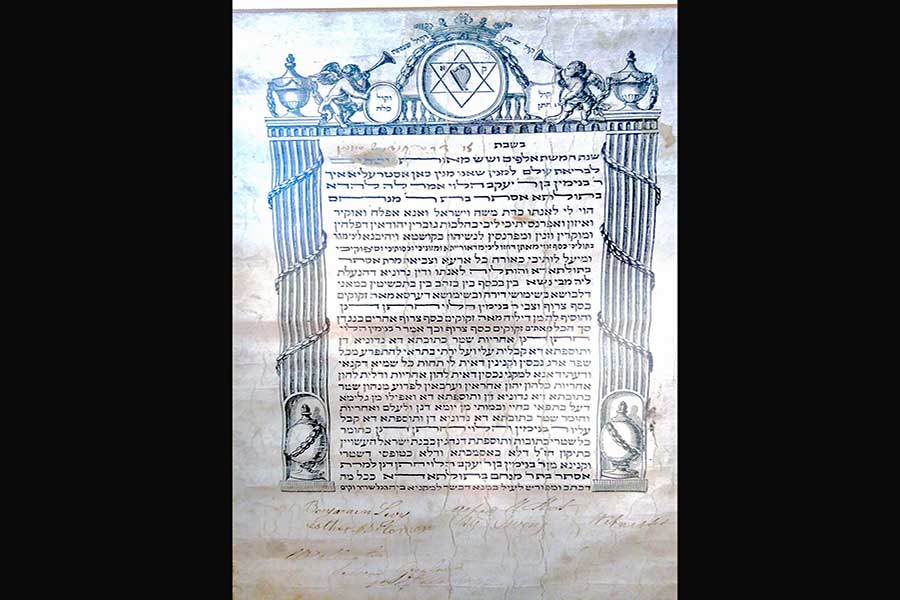
The Lost Or Relinquished Kesubah ‘A Couple May Not Live Even One Moment Without a Kesubah’ (Bava Kamma 89a)
By Rabbi Shimshon HaKohen Nadel
While some poskim rule that a soldier or reservist returning from war – even one who did not see combat – should recite Birkat HaGomel, as he was in potential danger, Rav Shlomo Zalman Auerbach limited the obligation only to a soldier whose life was in imminent danger (Halichot Shlomo 23:1).

Those honored with hagba and gelila on weekdays should first remove their tefillin straps from their hands. This is both for comfort as well as to avoid having an interposition between one’s hands and the Torah.
Should a child with moderate to severe depression be treated inpatient? Should a child with moderate learning disabilities stay in a mainstream school, or in a more supportive environment?
It's not enough to be motivated to accomplish; one has to be motivated enough that he is ready to deal with the inevitable challenges.
You taught me so much about love and respect. About the glory and pride of being Jewish. You taught me to never give up, even if I feel that I'm standing alone, since I'm never really alone, Hashem is always there by my side helping me do the right things always.
Indeed, if we were to view the two cases as one and view your supposed work for Reuven as payment of his loan, you could then demand an oath of Reuven; since he is unsure, he could not swear and collect.
A Dog’s Life ‘Raising Dogs Is Like Raising Pigs’ (Bava Kamma 83a)

The Shalah says the world’s water was never fully connected at creation, because in potential they would ultimately be separated, while Maharal says they had a natural draw to be connected to each other.
By Rabbi Shimshon HaKohen Nadel
Throughout Jewish history, Jewish communities have composed texts on behalf of everyone from the King of Spain to the King of England to Napoleon. Depending on how kind the ruler was to the Jews, sometimes the prayer took an ironic turn, asking for protection from the King!

One who has more than one name should recite a verse that corresponds to both names. Others, however, are not particular to do so and suffice with a verse corresponding to one name.
When I reflect on that amazing trip, our visit to Abayei and Rava was unquestionably the greatest highlight of all. Although at the time it didn’t seem so significant, when thinking back to it, it was an extremely emotional moment.
Learning Kabbalah before one is proficient in the basic knowledge of Torah is like learning calculus before one knows basic arithmetic.

When someone is niftar and leaves debts or liabilities, what is the halachic liability of the heirs or next of kin to cover them from various assets of the estate – real estate, movable items, forthcoming loans, bank accounts, life insurance proceeds, etc.?
Unkosher Tefillin From A Kosher Animal! ‘Shechita Does Not Permit the Meat’ (Bava Kamma 76b)
By Rabbi Shimshon HaKohen Nadel
While one may not intend to imbue the secular calendar with any religious significance, the prohibition of Do not follow their statutes (Vayikra 18:3) includes mimicking gentile customs or practices that have no explicit reason, as they may have originated among idolaters (see Rema, Yoreh De’ah 178:1, citing the Maharik).
Rabbi Akiva said: For what reason did the Torah say that a thief who slaughtered or sold a stolen animal pays the fourfold or fivefold payment? It is because he has become entrenched in sin by slaughtering or selling the animal he stole.
I hear my mother’s voice, in the final years of her life, that she sees her childhood visions haunting her. The world is on fire and we are sleeping, she would insist over and over again.
It is explained that each child was taught his specific verse because it began and ended with the first and last letters of his Hebrew name.
To answer the question, we need to look at the opposite end of the spectrum and ask if we Americans are too sensitive and wimpy.
 August 28, 2026