יום חמישי, ו׳ תשרי תשפ״זThursday, September 17, 2026



Follow Us


In order for Hashem to defeat the power of Pharaoh and Mizrayim and take us out of our predicament, He had to both overthrow the audacity of Pharaoh and elevate the spiritual sanctity of Israel at once.
During the seven years of plenty in Egypt and before the seven years of famine, the pasuk says that Yosef divided the land up into Kematzim, which Rashi explains as – stockpiling grains Kometz on Kometz, handful on handful.
Despite the importance and holiness of Pesach and Mishkan, the weekly, sacred Shabbat should not, and cannot be ignored.

Every vessel or item is only prepared once it has its final piece, a concept we know well from the prohibition to complete labors on Shabbat.
The mitzvot that the dominant nations are most fervently against, automatically require extra valor and self-sacrifice to fulfill. Observing these precepts takes on higher meaning as an expression of emuna.
The melekh does not actually rule over Israel but rather embodies the mission and aspirations of his nation to the extent that he becomes a microcosm of the entire Jewish people and his personal identity is absorbed into Israel’s collective national identity.
The Gemara teaches us in Masechtas Taanis that the day of rain is great like the day of the creation of Heaven and Earth.
God employs several translators; some pieces are translated by age, some by sickness, some by war, some by justice. -John Donne
At the time when a person opens his bundle to others, and shares his good fortune with others, he will merit blessing and his heart will be filled with joy.
There is a widespread custom to begin reading Shir HaShirim on the first of Nissan, in part because “the first shoots are seen in the land, the time of pruning has arrived, and the voice of the turtle dove can be heard in our land” (Shir HaShirim 2:12).
Hashem resorted to Plan B, which began by restoring unity within Am Yisrael, and only when that was in place directing the focus to where it was originally intended.
The Jews were doing well in Persia. Achashverosh afforded them equal rights and even invited them to his banquet. They did not need the Torah any longer to survive, and were doing just fine without it.
Why does Judaism consider counting people dangerous?
It would appear that we are hopelessly divided, especially at this time. But things are not always as they seem.
Following the victory over our physical enemies and the threat to our bodies, we must still overcome the spiritual obstacles placed in the physical world to dissuade us from achieving our destiny.
I believe the explanation for the front-seat positioning of Techias HaMeisim, the resurrection, is that it is the single greatest asset that a person has. Everything else is only temporal-for 120 years.
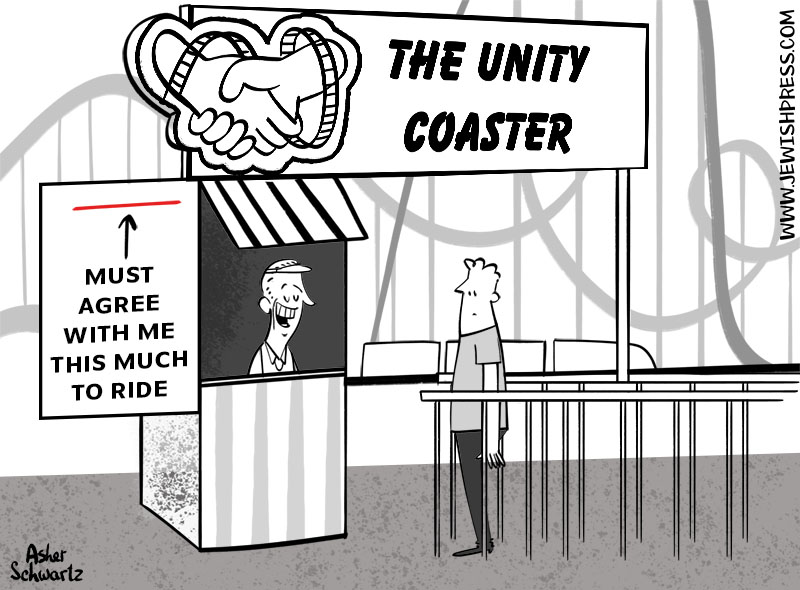
Through a heightened awareness of Israel's true inner essence, we can see past the sharp ideological divisions and appreciate the intrinsic unity beneath and beyond our surface disputes.
It is possible to teach a child a Divine crash course in metalwork or stone masonry overnight, but you cannot give a crash course in childlike innocence.
The Torah is based on the spot-on premise that basic features of the human condition remain constant throughout history
Before I left, my father – who saw in which direction I was heading – told me: Yossel, you’re going to Eretz Yisrael, and we will be separated. It is possible that this will be the last time we will see each other. Please, I beg you, come with me to the Rebbe of Slonim to get his bracha.
It’s enough to look at the picture of Hallel Menachem and Yagel Ya’akov Yaniv in order to appreciate the immensity of this loss. You see the sweetness and goodness that radiates from their faces.
Upon a surface reading of the text, Aharon appears to have lacked the readiness for ultimate sacrifice.
Nature that framed us of four elements, warring within our breasts for regiment, doth teach us all to have aspiring minds. -Christopher Marlowe
An individual may desire to do teshuva, but once he is in the “grip” of aveiros it’s more difficult; it’s as if he is handcuffed.
What’s a chesed tov, a good kindness? Is there such a thing as bad kindness?
What all of these expressions share in common is Hashem’s careful attention to the detail in every matter, concerning every individual and community of individuals.
The consideration the needs of the people of Israel are to be a focal point when the kohen gadol approaches G-d.
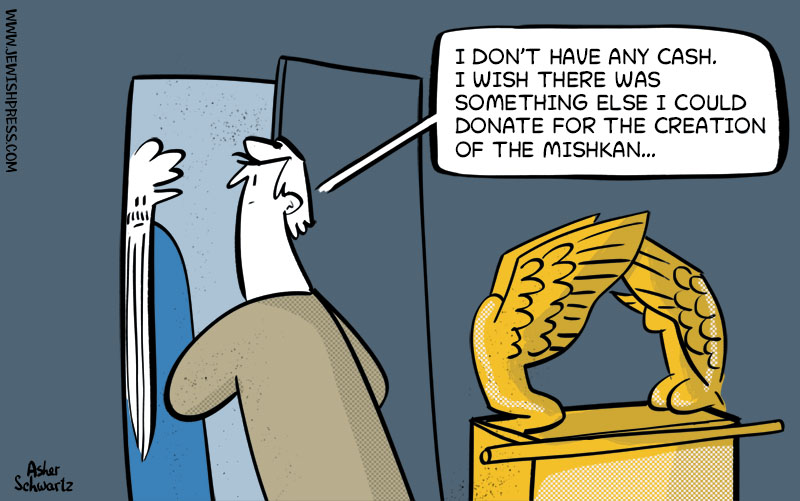
The notion of giving everything to HaShem illustrates the difference between the mentality of redemption and that of the exile.
Where are you right now? And, wherever that is, are you truly present with all your being? In the Torah portion we just read on Shabbat, there is a description of the ascent of Moshe to Mount Sinai as follows: "And the Lord said to Moshe: Come up to the mountain and be there." Why […]
We cannot change our basic human nature, but we can refine it with gold, with the purity of the Torah.
In some letters, the young man would want to discuss different points in the article; at other times he would ask me about Judaism in general. In each letter he would thank me and The Jewish Press for hooking him up with the outside world.
I’ve been asking myself how sophisticated is my prayer and, to be brutally honest, upon contemplation, I was very disappointed at my prayer accomplishments through the decades.
It’s interesting that the language used to describe the smaller stones, hewn (gazit), is identical to the prohibition against using metal implements to carve the stones for the mizbe’ach.
The Shulchan symbolizes material wealth, and everything connected with it relates to the morality of wealth and livelihood.
Whoever speaks Lashon Hara or accepts Lashon Hara, or bears false testimony is fit to be cast to the dogs...
Some things are hard to accept. The world is supposed to be a good place, mostly wholesome and happy. Yet there are evil acts that ruin everything.
In fact, the Hebrew slave must be allowed to continue in his chosen career, whether that be investment banking or phlebotomy.
Israel being a 'kingdom of priests and a holy nation' necessitates the sanctification of individual, interpersonal and national life so as to give earthly expression to the Torah’s lofty spiritual values.
It is very inspiring and gratifying to know that one has successfully guided an individual or a family to radically change his way of life and become an observant Jew.
When we take the time to thank Hashem for all that we have, or when we ask Hashem for continued health, this is living one’s life to the fullest.
The importance of the collection of the half shekel for the process of redemption derives on its surface from the acknowledgment of the importance of every Jewish person and our unification into a whole in the service of Hashem.
The Torah here does not say anything about what Moshe ate or drank during those forty days and nights.
The importance of going beyond the strict law cannot be over-emphasized.
At Sinai, Bnei Yisrael demonstrated that they understood what Hillel said: The essence of the Torah is love your neighbor as yourself.
Vast amounts of information compete for our attention. Every day we are subjected to a glut of news, but how many of us are moved by any of it to do something?
I believe Moshe was not praying for Aaron to be forgiven, but rather he prayed that the example that Aaron portrayed in building the Golden Calf would not impact on Aaron’s children.
The Torah is not a 'religion' relegated to the houses of study or prayer. Nor is it a set of rules meant to coercively modify human behavior.
It is not fair to expect that our Rabbi should be a lamdon like Reb Chaim, a master of parables like the Dubno Maggid, a storyteller like Rabbi Krohn, and a posek like Reb Moshe – all in the same person.
The first two days I calculated the portion of my punishment that I had already fulfilled. It was painful.
This terror seems to accompany the fact that Yeshayahu senses that he is to be sent on an important mission and, in fact, waits hopefully to be asked.
The commentaries teach us that the Torah is not a book of stories. It only details things that have a profound lesson to teach us.
Even the world press spoke differently of this terrorist attack and explained what Shabbat is all about.
By using humor, he could bring home what simple study in a beit midrash could not.
At various historic points, a 'low soul' has prevented the children of Israel from successfully advancing our national aspirations and collective mission.
There is another important parallel between the parsha and the haftara – the miraculous victory over an apparently superior enemy with the aid of Hashem.
We see that the miracle of the Yam Suf was achieved through the righteous ability of conquering the temptations of one’s heart.
Our job, as the Jewish people, is to live up to G-d’s instructions and vision and show the rest of the world how to do so as well.
At the beginning of every act of faith, there is often a seed of fear. For great acts of faith are seldom born out of calm calculation. -Max L. Lucado
While the mann was an enormous chesed that Hashem did for Bnei Yisrael in the midbar, its main purpose was to be a lesson in faith.
Does Hashem need to "look" in order to know if there is blood on the doorpost?
The more we define ourselves as the actors rather than as the characters we play, the more our characters can actually succeed at fulfilling their unique roles in the story HaShem placed us in.
When we look around at the trees and flowers in our land, we should not take what we see for granted. Shevat is not only a month of blossoming and renewed growth, but the realization of a dream that persisted throughout the generations.
Sheep and cattle want to eat; they want to spend time outside and with their young. But can it really be said that they wish to worship G-d?
On a chemical level, chametz is a conundrum. The existence of fermentation is not sufficient to define chametz.
Under all speech that is good for anything there lies a silence that is better. Silence is deep as Eternity; speech is shallow as Time. -Thomas Carlyle
With the plague of lice, the Egyptian magicians admitted that it was the finger of G-d they were seeing.
G-d does not enjoy meting out punishment, neither does He initiate it. Punishment is the automatic outcome of derelict human behavior.
Of course, the good parent praises and rewards the child for a job well done. But, what about the math teacher who turned your child around?
In the end, justice will be served and all the nations who oppressed Israel will be punished, but Israel will at last be redeemed.
When G-d takes something from the body, he gives something else in its place. True, I am physically disabled, but I learn quickly and my memory is very good.
It is through the story of Israel, as it unfolds throughout time, that humanity sees history as possessing Divine meaning and purpose.
Because Pharaoh has set himself up as a god, because he has come to believe that he is the absolute ruler of Mitzrayim, and because the people have accepted this upon themselves, what befalls Pharaoh will affect all of Egypt.
I have not placed reading before praying because I regard it more important, but because, in order to pray aright, we must understand what we are praying for. -Angelina Grimke
Mincha relates to the years of middle-age, and Maariv focuses on one’s golden years. Thus, while davening, it would be proper to focus on one’s children and grandchildren during Shacharis, and upon elderly parents and grandparents during Maariv.
The legitimacy and credence of the person speaking is based on his personal identity and essence.
Consider: Pharaoh is stubborn, cruel, and difficult in every meeting. He claims not to know G-d, he increases the cruelty of his slavery when he is asked for mercy, he ignores the overwhelming and awe-inducing nature of each miraculous event, and he ignores the pleading of his more moderate advisers.
Our Sages say that the reason we whisper the above blessing in Hebrew is that we do not want to openly flaunt a blessing we “stole” from the angels.
They are telling us something about special sights and sounds, flavors and fragrances, about tradition and family, about identity and longing, about an attempt at destruction and the triumph of the living.
When slavery runs deep into the psychology of a person, it becomes difficult to express the crucial courage and self-sacrifice necessary to break the chains of mental bondage.
All events in history are driven by a chain of events dictated from Above.
There is a famous lesson taught regarding B’nei Yisrael in Mitzrayim that they had, over the course of their exile, descended to the 49th and penultimate level of corruption. Had they not been redeemed at that time they would have become irredeemable.
Great doubts deep wisdom. Small doubts little wisdom. -Chinese Proverb

Apparently, God is only actively engaged when man is conscious of Him
Moshe became great because he went out of his palatial comfort zone and identified with this persecuted brothers.
There are some people who don’t easily cry. So, if they are motivated by a moving play or a poignant novel to cry, they should utilize those cries and extend them for the Temple.
What is the major theme of this book? Why does it not conclude with the major event that changed all of history, the revelation at Sinai?
This fact seems to indicate that we did not build the pyramids, as it is unlikely the Egyptians would have fed enormous amounts of meat to their slaves.

Only as a “kingdom of priests and holy nation” that reveals HaShem’s Oneness over all spheres of life can Israel fully express His Ideal and lead mankind to experience a world of total blessing.

How do we want to live our lives? Now that Hanukkah is over, the routine of work, study, and winter begins.
It is less well known that the Zohar there goes on to explain that these 70 years obtained from Adam gave life to David, but didn’t make him exceptional so that he would be able to complete the tasks given to him as the Mashiach,
Our sages point out that at times a person may claim that he has forgiven the other party, but in truth, deep down, he still nurses a grudge. The Ohr HaChaim asserts that Yosef bore no ill will towards his brothers and wholeheartedly forgave them.
There is something behind the throne greater than the King himself. -William Pitt The Elder Chatham
Yaakov Avinu answers him honestly. In truth, there is no positive secret to his old age. He is not as old as he looks, and his life has not been a pleasant one.
It is further interesting to note that the one parsha of the Torah which is has the word ‘death’ refers to the tragic passing of two of the righteous sons of Aharon; Nadav and Avihu. One might wonder why, over here, the chapter is called ‘Achrei Mos – After Their Passing.’
Instinctively, one would think the Torah is more important because it is the reason for the existence of the entire world.
Nearly every foreign land that Jews have settled in throughout history was initially a safe refuge or land of opportunity. And in almost every instance, our false sense of security was shattered.
As we leave Chanukah, we should reflect upon how much we have extra.
When a man's knowledge is not in order, the more of it he has, the greater will be his confusion. -Herbert Spencer
We cannot achieve true unity in the physical world which is built upon division and fragmentation.
 September 11, 2026