יום חמישי, י״א חשוון תשפ״זThursday, October 22, 2026



Follow Us


What were the necessary steps for Israel to develop a national consciousness ahead of leaving Egypt?

A civilization is destroyed only when its gods are destroyed. -E. M. Cioran
Once the corruption has been removed from the Land and the exiles have been gathered, unified in the service of Hashem and freed from foreign occupation, then Yerushalayim and the other holy places can be rebuilt as they were in ancient times.

The experience of the generation that came out of Egypt shows us that the clarity we think we so much want from God would actually hurt us more than it would help us.
Hashem revealed to Chabakuk the foundation of creation that keeps a person strong in any situation. It is our primary exercise and endeavor in the service of Hashem.
Unlike the Egyptians, who couldn’t see and couldn’t move, for Am Yisrael there was light in their places of dwelling (Shemot 10:23).
Hashem doesn't operate according to human presupposition.
Moshe’s complaint to God is that even though he would have the best human understanding of the Divine will, he had difficulty bringing it down to regular people.
We should try, to the best of our human ability, to grasp the essence of Hashem and emulate it.
The ten plagues were part of a deliberate process to educate not only Egypt and Israel but also humanity.
Certainly, Hashem has the power, if He wills it, to bring about redemption in a sudden fashion, as He did in Mitzrayim. However, if after our many centuries of exile we are still not worthy of redemption in our own merit, there are natural processes at work in the universe that will bring it about inevitably.
The beginning of wisdom is to call things by their right names. - Chinese Proverb Sun and Moon
The first two plagues should have convinced Pharaoh that these were the work of G-d, not the work of magic.

One should be galvanized and inspired to plead to the Omnipotent Hashem to be saved from any challenge in any situation. One should never despair of begging for kindness and compassion from the All Merciful.
We say, Shema koleinu Hashem Elokeinu – Listen to our voices, Hashem our G-d. The name Hashem denotes the attribute of rachamim, mercy, while the name Elokeinu is the attribute of din, strict justice.
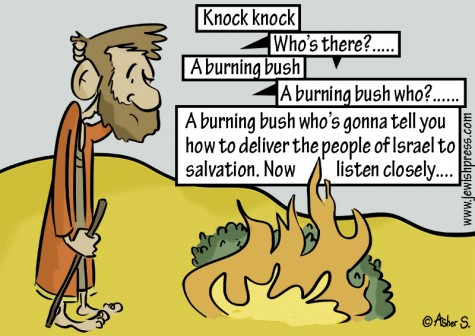
Who or what does the burning bush represent?
This is not only about resiliency or a return to the routine of daily life and normal functioning. It is rather growth as a direct, beneficial consequence of the trauma itself.
According to some opinions (Zohar, Va'eira 25b), Moshe was cured of his speech impediment, along with the rest of Am Yisrael who were cured of their ailments, before Matan Torah.
After despairing of a slave revolt, did Moshe seek to create a new nation in Midian to replace Israel?

Reuven may seem a little silly until we consider that we are all Reuven at some time or another.
At times a student is told that he is not capable of learning b’iyun (Torah study in depth), and he is insulted. Yet, if the student was asked why he doesn’t try to learn b’iyun he will claim that he is not suited for that kind of Torah study.
One of the ways we can perceive the differences between the values of a Torah Jew and the average non-Jew is by contrasting the Top Ten New Year’s resolutions touted for the secular calendar and the commitments a Jew makes before Rosh Hashana.

What are the individual contributions of each Hebrew tribe to Israel's national collective?
Hashem always rewards those who think about and care for others.
We must never fight falsehood with more falsehood or misinformation; our dedication to the truth is our most powerful weapon in the face of this onslaught.
Merchants have no country. The mere spot they stand on does not constitute so strong an attachment as that from which they draw their gains. -Thomas Jefferson
Among the many terrible decrees enacted against the Jews during the reign of Nikolai I was the forceful conscription of young Jewish children into the Russian army, its overriding aim being to destroy Jewish life.
When we say this blessing hoping for salvation, we should reflect that so many people today are in financial distress because we don’t have the shulchan that brought financial stability to Klal Yisrael.
Our Sages tell us that when Hashem creates something or someone, at the same time He creates their opposite.
Yaacov's form of communication with Hashem, was unique.
Did Yosef use the famine to bring his family down to Egypt in hopes of implementing an alternative approach to the Hebrew mission in the Diaspora?

While there is an important place for reflecting about past mistakes, that is only with regards to preparing ourselves to do better in the future.
Notwithstanding the fact that this was a family who was not yet Torah-observant, they could not help but recognize ein od milvado – there is none other than G-d.
A politician thinks of the next election. A statesman, of the next generation. -James Freeman Clarke

What was the difference between Leah’s crying and Rachel’s crying? Leah was weeping for her own misfortune... Did Rachel cry over her own misfortune?
In the political and historical affairs that unfold here in the world of events, we find manifestations of higher spiritual truths, and there are designated roles to be played by each of the two Mashiachs in the final conflicts and clashes that will precede the final redemption.
For us, the words of the Maharal ring true in our contemporary times! Hashem is revealing to us, notwithstanding the tragic and heartbreaking casualties of precious Jewish lives, that He is with us every step of the way.
The meal Yosef prepared for his brothers is associated with the Shabbat meal, with a hint of Chanukah.
The Royal Butler realized that there was a higher power here than Yosef and Pharaoh. He noted, and just as he had interpreted, so it was, despite the fact that the transgression of the two – the butler and the baker – were the same.
Did Yosef seek to transform Egypt into a civilization built on Hebrew values that would repair the world?
We know Yosef never forgot his father. Even though he no longer lived next to him, his father was an ever-present influence wherever he went and whatever he did.
When they do not contain a clear message and require interpretation, a crucial question arises: Who is empowered to interpret the dream?
Yosef was a living Shulchan Lechem HaPanim; through him Hashem channeled sustenance and prosperity to the entire world.
This outcome is anticipated in the Torah, the blueprint of Creation, according to which the intent was always for kings to arise and, in time, to fall.
Neither Yosef nor Yehudah panicked. They did not know how the next parsha would begin, but they did know that the larger story had to have a happy ending.
The Maharal reconciles the two Gemaras by explaining that indeed, normally, it is necessary to broadcast the miracle to the outside.
When Tamar's life was threatened, she did not save herself by throwing Yehuda "under the bus".
The lighting of the menorah was one mitzvah among many mitzvot, arguably not even the most important mitzvah, that had come to be neglected under the oppression of the Seleucid Greeks.
We can say Modim for our health. What about for our car and for our phone? Most of us would be crippled, so to speak, if we were missing just one of these. We could also incorporate into our Modim prayer that we are able to pay the mortgage or pay the rent.
As internal conflict over the Hebrew clan's direction leads to tragic consequences for Yosef and Yehuda, each must discover his own messianic potential.
To become fully alive a person must have goals and aims that transcend himself. -Herbert A. Otto
The potency of a mitzvah lies in the individual’s optimal and enthusiastic execution of the mitzvah with all the proper kavanos (intentions), including mastery of the laws pertaining to this particular mitzvah, and consummating the mitzvah to fulfill the will of Hashem.
Do "clothes make the woman"?
From the outset, there was seething sibling rivalry that eventually erupted explosively. The sons of Leah regarded the sons of the maidservants Zilpah and Bilhah with disdain, and they hated Yosef.
Rashi brings from Chaza"l that the "Nachala" of Yaakov, as opposed to Avraham, is limitless.
The Torah is ambiguous regarding who, exactly, is right in this story. Did, indeed, the brothers go too far? Did Yaakov face a battle shortly thereafter, as one midrash indicates? Were they both right on some level?
As Yaakov returns back home to his land, he and his family are met with new challenges that ultimately transform them into the nation of Israel.
The Yaros Devash teaches us that Yerushalayim is called Kisei Hashem, the Throne of Hashem.
“Flattery is all right if you don't inhale.” -Adlai E. Stevenson

Ya'akov's youth resembles that of his passive and isolated[…] father, his adult life resembles the trials and tribulations of Abraham among the nations.
The Arizal finds not only this earthly, historic struggle in these passages but the roots of corruption in Creation.
R’ Dancziger points out that our sages tell us that before all else Yaakov Avinu prayed, not that he did teshuva. We would think that repentance would have been the more instinctive response if Yaakov Avinu thought he might have sinned. Why did he engage in prayer?

Before becoming Israel, Yaakov had to first spend several years in exile learning to be more like Esav.
Rashi suggests here that while Yaakov has faith that G-d will bring him back in one piece and that his children will inherit the land promised to his fathers, he does not know whether all of his children will be worthy of this promise.
He who knows he has enough is rich. -Lao-Tzu
If we are constantly looking for the ideal, we may never find it, but if we start doing the possible, we may find that the ideal is just down the road
Yaakov is now so confident in his newly acquired ability to protect himself from the scammers of the world, that he feels that he doesn’t need G-d’s help. So he heads straight for the web of deception in Charan. Something makes him pause, however.
There are people who, while they voice Hashem will help, they really put their trust solely in the doctor, or in the medicine, but not in Hashem.
It appears that we have circumstances where the day became dark, even though it was still daytime and, in contrast scenarios where there was light in the darkness. Both portend good for the Jewish nation.
Hashem’s bounty descends from the sources of His will, and the deeds of the tzaddik ascend from the dust of the earth from which we are all made.
Why does Yitzchak's blessing seem to start mid-sentence?
How do the character traits of Esav and Yaakov find expression in the rival civilizations they produced?
It seems that Rivkah understood that she had twins, but she thought that they belonged to the same nation. She worried that they were engaged in a civil war.

I am convinced that meeting Yitzchak was a much more intense experience than meeting Avraham.
Typically, when we think of Esav’s hatred for Yaakov, we don’t first think of the Roman Empire or about gentiles in general. In fact this relationship remains complicated, but ultimately our role of being a light unto the nations entails uplifting them as well.
Nothing will benefit human health and increase the chances for survival of life on Earth as much as the evolution to a vegetarian diet. -Albert Einstein
Who do we see coming to the aid of earthquake victims buried underneath rubble and crumbled buildings in all corners of the world? The little nation of Israel is the first to send assistance and personnel.
In the last few decades, the lowest estimation is that the elite and Ivy League colleges received eight billion dollars in Arab funding. A whopping four billion dollars came from Qatar, the source of the recently proclaimed ‘Global Day of Jihad.’
Yaakov and Esav each had a name from the ethical approach, a name that they chose for themselves through their actions.
Following her death, Sarah's powerful legacy continued to influence Avraham and play a major role in their family's development into a nation.
For six years I underwent dialysis until he arrived and saved me.

In this epic reunion, you have two multi-billionaires, each with a different life philosophy. Eisav’s is rav, a lot; Yaakov’s is kol, everything. How do they differ?
Avraham Avinu, who exemplified the attribute of kindness, purchased Me’arat HaMachpela as a final kindness to his beloved wife and to future generations of Israel.
A prayer in its simplest definition is merely a wish turned Godward. -Phillips Brooks
On the last daf of Sotah, the Talmud speaks of the generation preceding the arrival of Moshiach, and describes dismal conditions, concluding with the words, And upon what is there for us to rely? Only our Father in Heaven.
That Hagar went against her natural inclination and remained faithful to Avraham was a supreme exhibition of breaking her nature and doing good.
Avraham’s plan to outwit the angel of death did not work and for some reason Sarah tarried in Hebron, perhaps packing up the household in preparation of the move, and that is where the angel of death met her.
What can the dynamics between Yitzḥak and Yishmael in Parshat Vayeira teach us about Israel’s ideal relationship with the Muslim world?
It seems that we are living in a dream world. Reality is more outlandish than anything imaginable.
If you look beneath the surface of the story of the three angels visiting Avraham and the feast he served them, you will see it is a replica of a korban todah.
The nosei b’ol thinks about the wife of a soldier or his mother waiting in fear for the next text message to hear that they are still alive.
We should remember that though Avraham was the first Jew, Yitzchak was the first born Jew. In other words, a certain paradigm of Jewish existence is created by Yitzchak’s birth, a birth in total contradiction to the physical reality of other men.
There are times, mercifully limited in their frequency, when the servants of Hashem are tested and given an opportunity to transcend the base materialism and the limited perspective of, for example, the servants of Avraham who were left behind when he and Yitzchak proceeded to the akeida.
Every charitable act is a stepping stone toward heaven. -Henry Ward Beecher
We see how Divine Providence orchestrates everything from the beginning of creation until the end of time – always setting the stage for the future.
Every single person is a galaxy! Every person is a universe! When you look at another person, realize that he is like a star.
 October 23, 2026