יום רביעי, י׳ חשוון תשפ״זWednesday, October 21, 2026



Follow Us


By Rabbi Lord Jonathan Sacks z"l
There is a deeper message in Parshat Tetzaveh - the principle of the separation of powers, which opposes the concentration of leadership into one person or institution. All human authority needs checks and balances if it is not to become corrupt. In particular, political and religious leadership (keter malchut and keter kehunah) should never be combined. Moses wore the crowns of political and prophetic leadership, Aaron that of priesthood. The division allowed each to be a check on the other.
By Rabbi Lord Jonathan Sacks z"l
It is not what G-d does for us that transforms us, but rather what we do for G-d. A free society is best symbolized by the Tabernacle. It is the home we build together. It is only by becoming builders that we turn from subjects to citizens. We have to earn our freedom by what we give. It cannot be given to us as an unearned gift.

In this week’s parshah the Torah discusses many of the various aspects of the mishkan. The Torah dictates in detail the manner in which the walls of the mishkan were to be erected. At the instructions’ conclusion, the pasuk says, “Vahakeimosa es hamishkan, k’mishpato asher har’eisa bahar – and you shall erect the mishkan according to its laws, as you will have been shown on the mountain” (Shemos 26:30).

The entire Jewish nation – every man, woman, and child – experienced the revelation of Hashem on Har Sinai. They saw Hashem as clearly as humans can, and they attained a level of prophecy. Now they were being offered one of the greatest gifts imaginable: Hashem Himself was going to dwell among them.

For most of the nations of the world, the laws governing interactions between people are conventions set up by citizens to enable their society to function. They are bereft of any Divine influence. However, such laws within a Jewish society are very much religious laws as well. To demonstrate this point the Sanhedrin, which was ultimately responsible for all legal aspects of society, was housed in the Temple. By being there it was made clear to all that, for Jewish society, the interpersonal societal laws were Divine in origin, just as the ritual laws were.

The Jewish nation has no such concept as “religion” in the formal sense of the term, as we reject the notion of anything lying outside the realm of HaShem. It is Israel’s mission to elevate every sphere of Creation by infusing it with kedusha and bringing it to its highest potential in our world.
“And men of holiness you shall be to me, and you shall not eat meat in the field of a torn carcass (22:30). The expression “to Me” means “men of holiness that are Mine.” By being holy, they become close to Hashem.
In Parshas Mishpatim, the Torah delineates various prohibitions and punishments. With regard to stealing, we see something unusual. If a man steals a cow, he must pay back five times the amount he stole; however, if he stole a sheep, he must pay back four times the amount. Rashi is troubled by the difference in punishments. He explains that the difference lies not in the crime but in the mental state of the thief.
By Rabbi Lord Jonathan Sacks z"l
First in Parshat Yitro there were the Asseret Hadibrot (the Ten Utterances, or general principles). Now in Parshat Mishpatim come the details.
This week’s parshah, Parshas Mishpatim, discusses many various halachos regarding monetary issues. One of the topics is when one damages another person’s property.
The American Jewish Orthodox community has probably been overwhelmed by the events of the past few weeks in Israel regarding the extremely hostile attacks that have been aimed at the haredi community by the secular press and politicians from across the political spectrum.
We should not be so naive to think Moshe himself could not have thought of the plan of appointing officers. The Elders of the sons of Israel in Egypt were an official and recognized body, not mere old men as are found today in homes for the aged.
“And He does kindness to thousands of generations, to those who He loves and those who guard His mitzvos.” – Shemos 20:6 In the Aseres Ha’Dibros we are told Hashem pays back the wicked for four generations and the righteous for two thousand generations. Rashi explains the ratio of two thousand to four comes out […]

The fourth dibrah of the Asseres Hadibros that is read in this week’s parshah says, “Zachor es yom haShabbos lekadsho – remember to sanctify the Shabbos.” The Gemara in Pesachim 106a derives from this pasuk that one must recite Kiddush on Shabbos over a cup of wine.
“And Hashem turned back the sea by a strong east-wind all the night” (14:21). The wind was entirely unnecessary, for it was naturally unable to split the sea open and create a pathway, as the verse concludes "And it made the sea into dry land and the waters were split apart." This was entirely a […]
By Rabbi Lord Jonathan Sacks z"l
In September 2010, BBC, Reuters and other news agencies reported on a sensational scientific discovery. Researchers at the U.S. National Center for Atmospheric Research and the University of Colorado showed through computer simulation how the division of the Red Sea might have taken place.
After months of witnessing the hand of Hashem, the entire Jewish nation – three million strong – marched out from slavery to freedom with flourish and fanfare.
At the onset of the Bnei Yisrael’s journey through the midbar, we read in this week’s parshah that the Bnei Yisrael’s complaint was for food to eat. Hashem responded that He would send “lechem min hashamayim” (also known as mun), and that the Bnei Yisrael would collect each day’s portion according to the number of members of his household.
“For I have made heavy his heart and the heart of his servants in order that I should put these signs of mine in his midst and in order that you should relate in the ears of your son and your son’s son how I dealt with Egypt, and you should know that I am Hashem” (10:1-2).
After a “natural” disaster, people speak with reverence. Even arrogant individuals, after living through a hurricane, tidal wave, or earthquake, have a sense of humility. Their reality has been changed, and they view life differently. Yet, when Pharaoh and Mitzraim experienced the makkos, that wasn’t their reaction.

By Rabbi Lord Jonathan Sacks z"l
There is a fascinating moment in the unfolding story of the plagues that should make us stop and take notice. Seven plagues have now struck Egypt.
In this week’s parshah Hashem instructs Moshe to tell the Bnei Yisrael that each household should take for themselves, on the 10th of Nissan, a lamb or a kid within its first year for the korban pesach.
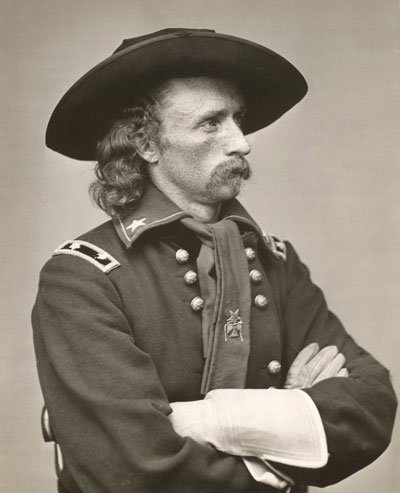
General George Armstrong Custer. The mere mention of his name evokes strong opinions of condemnation or admiration, depending on one’s perspective.
After Hashem commanded Moshe and Aharon to be the emissaries to free the Jewish people, the Torah lays out their lineage. At the conclusion, the Torah repeats the names of Aharon and Moshe, this time in reverse order, with Aaron mentioned before Moshe.

“And Amram took Yocheved.... And she bore to him Aharon and Moshe” (6:20). The names that were given in Egypt were not repetitions of previous names but were original expressions of genuine devotion to Hashem.
By Rabbi Lord Jonathan Sacks z"l
The parshah of Va’eira begins with some fateful words. It would not be too much to say that they changed the course of history because they changed the way people thought about history. In fact, they gave birth to the very idea of history. Listen to the words:
In this week’s parshah (Shemos 6:6) the pasuk reveals the four leshonos of geulah: v’hotzeisi, v’hitzalti, v’ga’alti, and v’lakachti. Rashi, in his commentary to Pesachim 99b, tells us that the four cups of wine that we are commanded to drink on Pesach at the Seder correspond to the four leshonos of geulah mentioned above.
When Moshe came of age, he went out to visit his brothers, to share in their suffering. What he saw caused him great anguish. The oppression, subjugation, and cruelty were present wherever he looked.
After Moshe had agreed to go to Pharaoh to beseech him on Klal Yisrael’s behalf, he began traveling to Mitzrayim with his wife Tziporah and their sons – including the newborn.

The Lubavitcher Rebbe, Rabbi Menachem Mendel Schneerson, zt”l, notes that Yaakov Avinu’s years can be divided into three periods.
Yaakov Avinu spent the final seventeen years of his life in Mitzrayim. While there he lived in peace for the first time in many years and remained in that state for the rest of his life. Near the end of his days he called in his beloved son Yosef and made an impassioned request: “Please do not bury me in Mitzrayim.”
The opening pasuk in this week’s parshah states: “Vayechi Yaakov be’eretz Mitzrayim sheva esrei shanah… – Yaakov lived in Mitzrayim for 17 years…” The Gemara in Kiddushin 82a says that Avraham Avinu kept the entire Torah, even the mitzvos that may not have applied.
 October 16, 2026