יום שני, ז׳ תמוז תשפ״וMonday, June 22, 2026



Follow Us


Sections
E-Edition

The device could be a game-changer in the next step towards reopening shuls on Shabbat.
“This will allow us to positively contribute to helping these couples build healthy new relationships and families in accordance with Halacha and the laws of the State of Israel."
Since the identity of the father is unknown, it could have imposed severe restrictions on whom the woman would be allowed to marry.
"It would have been great if this issue had been resolved amicably between the sides rather than by the court."
"If everyone would ask himself, ‘What does God want from me?’ that would bring us together.”
By Rabbi Dr. Nathan Lopes Cardozo
The book of Bereishit keeps Halacha under control. It restricts and regulates it, and ensures that it will not wreak havoc.

What is the nature of chetzi nezek? Is it compensation or is it a fine?
By JNi.Media
Justice Minister Ayelet Shaked accused the Israeli courts of ignoring Jewish law and promised to set up a steering committee to promote implementing the principles of Jewish law in the Israeli legal system.

By JNi.Media
Rabbi David Lau’s cousin, the Jerusalem Ramban Synagogue’s spiritual leader Rabbi Benny Lau criticized the Chief Rabbi’s attack on Bennett.
A federal court on Wednesday will hear arguments that the conditions prevent him from working and force him to violate Jewish law.
By JNi.Media
“The prohibition against shaming a person, which is Torah-level, supersedes the obligation to read the Torah aloud, which is rabbinic.”
Please note: The video is not from this year in terms of the specific days the rabbi mentions, but the rest of the content is obviously relevant.
If feminism is mentioned at all, it is usually to condemn it as an anti Torah ideal.
An opinion recorded in the Talmud states that prayers correspond to the daily sacrifices offered in the Temple that are mentioned in this week’s portion (Berachot 26b, Numbers 28:4). It’s been argued that this opinion may be the conceptual base for our standardized prayer. Since sacrifices had detailed structure, our prayers also have a set text. […]
One measure for living a "normal" life is Halacha, and the other is societal standards.
Israel Police arrested an eight-month pregnant woman in Yitzhar before dawn Wednesday on suspicion of incitement.

Rebbeim are consulted on all of life’s major decisions and a fair number of minor ones.
Praying in a minyan on an airplane is forbidden if it robs others passengers of their sleep or interferes with the duties of stewards and stewardesses, ruled newly elected Chief Sephardi Rabbi Yitzchak Yosef, son of Rabbi Ovadia Yosef. Replying to a congratulatory letter from El Al CEO Eliezer Shkedy on the election of the […]
I happen to know Gedolei Torah and Roshei Yeshiva who use I-phones and the internet. Are they all doomed?
The Supreme Court has ordered Tel Aviv to enforce the law that prohibits stores from operating on the Sabbath. It overruled a February ruling by a lower court, which accepted the city's claim that it carried out its responsibility by fining business owners without a need to force them to close. The three-judge panel, including […]
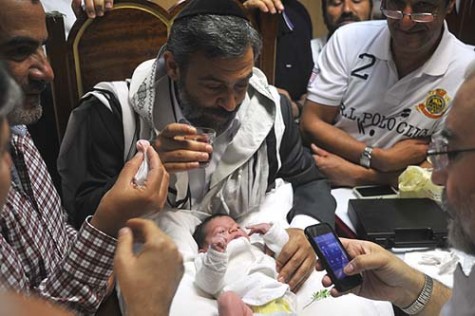
Rabbi Pirutinsky discussed the issue of 'metzizah b'peh' at length, concluding that if medical experts determine that there is a danger to the child, metzizah should be performed by other legitimate methods.
Making gay marriage not just value neutral but something positive. It is in effect koshering a forbidden lifestyle.
By Meir Indor
This is Torah. This is its rightful place in all our lives, both private and public.
There are always people who in cases like this will cast the victim as a provocateur.
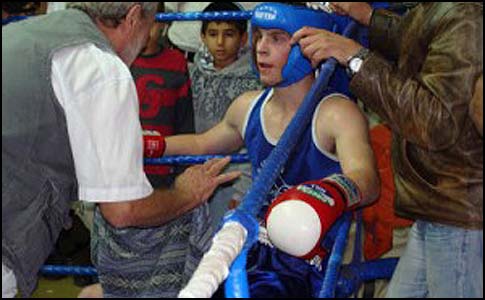
A Chareidi rabbi lamented the attempt to denigrate a kiddush hashem preformed by a dati-leumi (national-religious) student.

The tragedy that we face today is that everyone thinks they are the sole possessors of the answer.

Using the term "Halacha" for policies which are not in fact Halacha, delegitimizes those who differ and causes ill-will towards Jewish law.

The Jews living outside Eretz Yisrael began reciting vesein tal u’matar in the Shemoneh Esrei this week. If one does not say vesein tal u’matar (instead continuing to say “vesein berachah”) and finishes the Shemoneh Esrei, he must repeat the Shemoneh Esrei. If one accidentally does not daven at all, he must daven two Shemoneh Esreis during the following tefillah. If one did not say vesein tal u’matar and finished davening and only remembers this fact at the time of the next tefillah, he must daven two Shemoneh Esreis at the next tefillah.
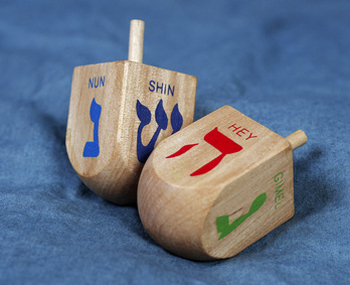
The strength and numbers of Orthodox Jews in America have never been greater, and yet those of us concerned with Judaism’s future must admit we confront a future no less frightening than the future that was evident to Hannah’s noble sons in Modi’in all those centuries ago.
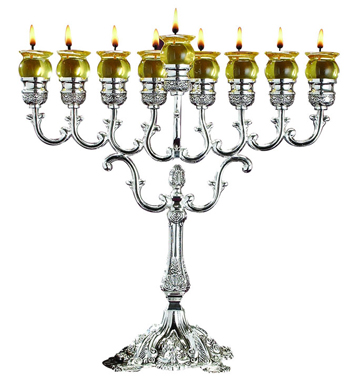
The festival of Chanukah celebrates two miracles – the military victory over the Syrian Greeks and that one small cruse of oil, good for one day, providing light for eight days. The miracle of the light, however, is the main focus and central theme of this festival.
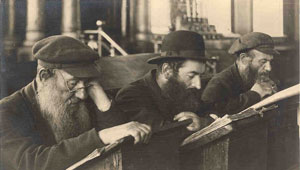
By Rabbi Yaakov Klass and Rabbi Gershon Tannenbaum
Ball And Bat Substitutes 'Cut Palm Branches' (Shabbos 50a)
The Rambam writes in the 10th perek of Hilchos Ishus (halacha 13-14) that if a man marries a woman, he is obligated to have sheva berachos for seven days. If one marries several women at once, he must have separate sheva berachos for each one for seven days – consecutively. The reason for this is because we cannot mix one simcha with another simcha.

In the wake of the presidential election, American Jews must once again ask a fundamental question that seems to defy both societal trends and a clear resolution: why do Jews overwhelmingly support the Democratic candidate, year after year, election after election?
The juxtaposition in the Torah of the laws of Shabbat and the Mishkan, the Sanctuary, not only serves to identify the 39 melachot prohibited on Shabbat but also determines the conditions that must exist before one can be held liable for performing a melachah. One of these conditions is intent.

Hurricane Sandy had knocked down the power lines to Noach's house. After three days with no electricity, he heard that a neighbor had a spare generator.
We learn in this week’s parshah of Eisav’s sale of his birthright to Yaakov Avinu. There are several questions surrounding the legitimacy of this sale. The Rivash (Teshuvos 328) questions why the sale was valid, since Eisav sold something that did not exist at that time. The halacha is that one may not sell anything that is not in the world at the time of the sale. Since the bechor did not yet exist or take effect at that time, how could the sale have been valid?
In this week’s parshah we learn of the episode whereby Avraham sent his servant Eliezer to find a wife for his son Yitzchak. Eliezer met Rivka and decided that she was right for Yitzchak. After discussing matters with her parents and her brother, Lavan, Eliezer was ready to return with Rivka to Avraham and Yitzchak. Prior to their departure Rivka’s family blessed her, saying that she should become “thousands of myriad…” and may her offspring inherit the gate of its foes.

“G-d formed man from the earth and breathed into him a living soul.” The greatest achievement of the biological sciences since that moment in creation has been the Human Genome Project, a massive effort by thousand of biologists, chemists and physicists who isolated and identified the 24,000 genes that Hashem placed in Adam and Eve, […]

We learn in this week’s parshah about the wickedness and demise of the residents of Sedom. Further, we learn from medrashim that the residents of Sedom did not show much hospitality. Similarly, the mishnah in Avos 5:10 says that there are four different types of middos that people live by. The first is one who says, “What is mine is mine and what is yours is yours.” The mishnah says that this is an intermediate middah; others say that this is middas Sedom. Rashi, in Kesubos 103a, says that the people in Sedom would not allow anyone to benefit from their possessions even if it would be of no loss to them.
In this week’s parshah Hashem commands Avraham Avinu to perform the mitzvah of bris milah. The pasuk tells us that Avraham was 99 when he performed the bris milah on himself. The Pirkei D’Rabbi Eliezer (29) and Tosafos, in Rosh Hashanah 11a, say that Avraham’s bris was performed on Yom Kippur. The Pirkei D’Rabbi Eliezer adds that Shem, Noach’s son, performed the bris on Avraham. There are several explanations as to why Avraham had Shem perform his milah.

"I arranged with Simon Cooper, the plumber, to clear the blockage in the kitchen sink this morning," Mr. Laks told his wife. "Oh, great!" she replied. "I'll clean the kitchen before he comes."
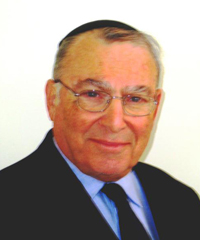
Question: What is unique about Modern Orthodoxy?
By Rabbi Yaakov Klass and Rabbi Gershon Tannenbaum
Where Beis Shammai And Beis Hillel Agree ‘One Must Not Sit Before A Barber Near Minchah’ (Shabbos 9b)
Question: I am a single mother of young children. Their father has shirked all his responsibilities to them. I do my best for my children, but it isn’t easy. Isn’t their father in serious violation of the Torah by neglecting his children and not making any effort to provide them an education? No Name Please (Via E-Mail)
In this week’s parshah the Torah commands us in the first mitzvah: pru u’revu – be fruitful and multiply. We rule in accordance with Beis Hillel that one fulfills this mitzvah when he has fathered one boy and one girl.
We are all familiar with the famous midrash (Vayikra Rabbah 30, 12) that compares the four species we take on the holiday of Sukkos to the four different types of Jews: the esrog, which has both smell and taste, corresponds to those who learn Torah and perform good deeds; the lulav, which has taste but no smell, corresponds to those who learn Torah but do not perform good deeds; the hadasim, which have a pleasant smell but no taste, correspond to those who perform good deeds but do not learn Torah; and finally, the aravos, which have neither smell nor taste, correspond to those who have neither Torah nor good deeds.

Sam Berger and Moti Farber shared a two family house, with a joint driveway in front. The Farbers had an extensive family, whereas Sam was relatively young and just recently had his fourth child.

By Bracha Slae
Title: Land of My Past, Land of My Future Author: Michael Kaufman Publisher: Targum Press, 2012
Question: The Kitzur Shulchan Aruch states that an individual praying selichot without a minyan is not allowed to recite the Thirteen Midot or the Aramaic prayers. What is the rationale behind this halacha? Moshe Jakobowitz Brooklyn, NY
The Gemara in Sukkah says that the sechach that one must use for his sukkah must be detached from the tree in order for it to be fit for use. The Gemara (Sukkah 11a) discusses what a person must do if one put branches on his sukkah before they were cut off from the tree. The Gemara concludes that branches must be detached from the tree and he then must shake them.
Question: The Kitzur Shulchan Aruch states that an individual praying selichot without a minyan is not allowed to recite the Thirteen Midot or the Aramaic prayers. What is the rationale behind this halacha? Moshe Jakobowitz Brooklyn, NY

It was Yom Kippur eve. The shul began filling rapidly as the time approached for Kol Nidrei. Herzl Machlis sat in his seat, cloaked in his tallis and kittel, quietly reciting Tefillah Zakkah, composed by the Chayei Adam 150 years ago.

My name is Eli Freundlich. I was 18 and had just graduated Torah Voddath in Williamsburg. America had entered the war a few years before. I wanted to be drafted so was happy when I received my notice. It was July 1943 - July 27, 1943 to be exact – when I was sworn into the American Army.

Dear Dr. Yael: I am a 20 years old and dating. While I know that people consider me to be an attractive young woman, I have been getting rejected – quite a lot. This might be happening because I am painfully shy. For the most part I clam up while on a date; I become […]

We all know that there are some synagogues that, unfortunately, only reach full capacity several days a year. There is something about these days that arouses even many unaffiliated Jews to attend High Holiday Services. In fact, each one of us also feels the holiness, and it helps us to be on our best behavior. We make sure to come on time to davening and we daven slower than usual. We are extra careful in our observance of halacha and how we treat the members of our family.
Question: The Kitzur Shulchan Aruch states that an individual praying selichot without a minyan is not allowed to recite the Thirteen Midot or the Aramaic prayers. What is the rationale behind this halacha? Moshe Jakobowitz Brooklyn, NY
The Mishnah in Rosh Hashanah 32a lists the Yom Tov’s berachos and the order in which we must daven on Rosh Hashanah. The Mishnah says in the name of Rabbi Akiva that we begin with the berachah of avos. We then recite, in this order: gevuros (atah gibor); kedushas Hashem; kedushas hayom (we incorporate malchuyos in that berachah); zichronos; and shofros. This is followed by avodah hoda’ah and birchas kohanim (sim shalom). The Gemara there brings a beraisa that cites a source in the Torah for reciting each one of these berachos.

Dr. Oren had a small psychology practice and rented office space from his colleague, Dr. Wieder, on Thursday afternoons. The rent amounted to $500 for the month. Since the two usually did not see each other, the arrangement was that Dr. Oren would leave the rent money in the top drawer of the desk.
By Rabbi Yaakov Klass and Rabbi Gershon Tannenbaum
A Vicious Cycle ‘Many Different Kinds Were Set Before Him’ (Berachos 41a)
Sixteen years ago, when I married my husband, I did not give much thought to whether he was Askenazi or Sefardi. Having grown up in what was then a small close-knit Jewish community, it held little importance; my concerns were focused around whether or not my bashert (intended) was Jewish according to halacha, someone who was upstanding in both ideals and actions, and a man solidly committed to a Torah lifestyle.

Modern Orthodox and Chassidic cultural norms may differ, but members of both communities have a respect for Halachah and desire to serve God.
The pasuk from which most of the halachos of gittin (divorce) are derived is in this week’s parshah. The pasuk says: “Ki yikach ish isha… vechasav lah sefer kerisus v’nasan b’yadah veshilchah mi’beiso – If a man marries a woman … and he wrote her a bill of divorce and placed it in her hand and sent her from his house” (Devarim 24:1).

Mr. Morris was home one evening, when an acquaintance, Mr. Roth, knocked at his door. "May I have a word with you?" Mr. Roth asked. "Certainly, come in," Mr. Morris said, welcoming him into the living room. "Perhaps you've forgotten," Mr. Roth began, "but last year I lent you $500, which you never repaid." Mr. Morris scratched his head and thought for a moment. "I never borrowed from you," he replied.
By Rabbi Yaakov Klass and Rabbi Gershon Tannenbaum
No Cell Phones Please! ‘A Kerchief That One Designated For Storing Tefillin’ (Berachos 23)
In this week’s parshah the Torah teaches the halachos of an ir hanidachas – a city where a majority of the inhabitants serve avodah zarah. The halacha is that all of the city’s inhabitants are killed and all of their possessions are burned.
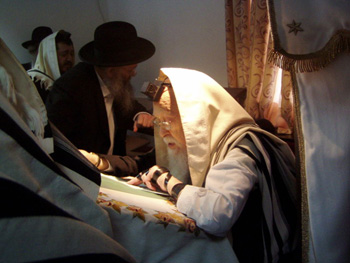
It’s hard to believe that for the past 30 days we have been living in a world without HaRav Yosef Sholom Elyashiv, zt”l, who died at the age of 102. We may never realize the effect his longevity had on our generation. Reb Elyashiv was a true gaon and masmid beyond most people’s comprehension. Although […]
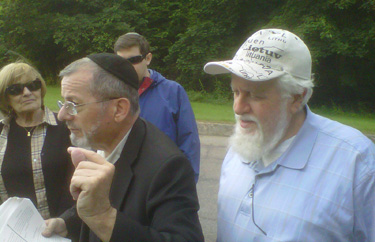
Recently, my wife Clary and I traveled to Lithuania to experience what remains of one of Judaism’s most magnificent centers of learning. My journey, organized by Zvi Lapian of Israel and led by the eminent historian and distinguished scholar Dr. Shnayer Leiman, took me to what was once the world’s center of Torah learning.

Excitement was in the air as the 12th Siyum HaShas of the Daf Yomi cycle approached. Mendy, who had joined the Daf seven and-a-half years earlier, eagerly anticipated taking part in this major event at MetLife Stadium along with 93,000 other participants.
By Rabbi Yaakov Klass and Rabbi Gershon Tannenbaum
Kerias Shema Twice At Night? ‘When One Reads Shema’ (Berachos 8b)
On the sad day that Eliezer Lipman, Reb Elimelch and Reb Zusha’s father, passed from this world, his children gathered for the week of mourning. At the conclusion of the shivah the sons divided their father’s inheritance in the following way: Avraham received the cash and the house was given to Nosson. The jewelry and housewares went to Elimelech and the outstanding debts were to be collected by Zusha.
We doubt anyone attending last week’s massive Siyum HaShas at MetLife Stadium will forget anytime soon the breathtaking sight of more than ninety thousand people breaking out into dance and song in celebration of the Torah following the delivery of the siyum by Lakewood Rosh Yeshiva HaRav Malkiel Kotler. Or the chills they experienced as Cantor Yitzchok Meir Helfgott recited the Kel Moleh Rachamim prayer in honor of the victims of the Holocaust who died Al Kiddush Hashem. Or the inspiration they felt as tens of thousands of Jews prayed together as one. All were testimony to the centrality of Torah to Jewish identity, fealty to the Ribbono Shel Olam and submission to His Will.

I am haredi. I was born in Brooklyn, went to mainstream haredi elementary and high schools, spent two years in Mir Yerushalayim and attended kollel at Beth Medrash Govoha in Lakewood, New Jersey. I wear a black hat on Shabbos and dark pants and a white shirt much of the week. My yarmulke is large, black and velvet, and being a frum and inspired Jew is my most basic self-definition, on par with being human and male.
Question: Is it prohibited to listen to music in the privacy of one’s home (or car) during the Nine Days?
By dvora
The New York Times once asked Rabbi Moshe Feinstein how he became a posek hador, one of the generation’s foremost authorities on Jewish law. Rabbi Feinstein answered that, “people came and asked me questions and they liked what I said and it was accepted, and then more people came and eventually I became widely accepted as a posek.”
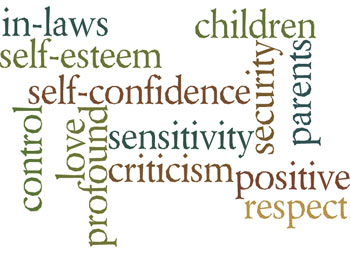
Dear Dr. Respler: My parents, who I love dearly, constantly contradict what I say to my children. They constantly interfere with the way my wife and I raise our children. For her part, my wife is very frustrated with this situation. What makes it harder for her, her parents live out of town while my parents live close by and are thus more involved with our children.
In this week’s parshah the Torah writes about a prohibition on killing a murderer prior to his trial. As the pasuk says: “…v’lo yamus harotzeach ad amdo lifnei haeidah lamishpat – … so that the murderer will not die until he stands before the assembly for judgment” (Bamidbar 35:12). The same rule applies to anyone who commits an aveirah that is punishable by death; no one is permitted to kill him prior to his trial in beis din, including the witnesses that warned him and witnessed the aveirah. The Sefer Hachinuch (mitzvah 409) writes that if one kills a transgressor prior to his trial, he is regarded as a murderer.
Question: I was taught that due to our state of mourning on Tisha B’Av, we are not allowed to learn or discuss Torah – a topic that makes us happy and weakens our mournful state. Why, then, are we allowed to read from the Torah at Shacharit and Mincha on Tisha B’Av? Also, does the halacha of not learning apply to a regular mourner as well? Menachem (Via E-Mail)

Many years ago when I was helping my congregation write a new constitution, I submitted a first draft to an expert who had been involved in setting up new shuls. One paragraph read, “All matters of halacha (Jewish law) will be determined by the congregational rabbi.” Pretty straightforward, I thought.

I believe that Partnership Minyanim are sourced in a culture that is foreign to Judaism - the radical feminist ideal of equating the sexes in all areas of life. In Orthodoxy that idea is doomed to failure. The mere fact that women can never be counted towards constituting a Minyan means that equality can never be fully achieved in the sense that feminism requires it. Even if there are a hundred women and 9 men, there is no Minyan.

The Alperts needed some work done around their house. The contracted Mr. Fixler, a general handyman, to do the job. While working on one of the fixtures, Mr. Fixler accidentally knocked his drill off the ladder. It landed with a thud on the floor of the entranceway, cracking a tile.
The Gemara in Baba Basra 119b relays the following conversation that took place in this week’s parshah: Moshe Rabbeinu was teaching the halachos of yibum when the daughters of Tzelaphchad approached him with the following question: Our father died in the midbar and did not have any sons. Why then is our mother not required to fulfill the obligation of yibum? And if the fact that he had daughters is the reason that she is not obligated to fulfill this requirement, why then can we (his daughters) not receive an inheritance – just like sons would?

By Jeremy Rosen
Real progress is being made to generate lab grown meat that tastes as good as the real thing without the fuss -- isn’t this something we Orthodox Jews should welcome?

Earlier this year I was presenting my survey of Jewish art, “A Jewish Art Primer,” in a West Hartford, Connecticut synagogue and during the intermission a local artist, David Holzman, introduced himself to me. He relayed his rich and fascinating artistic background and then produced a portfolio of 8 black and white prints that he generously gave to me as a gift. As a tantalizing glimpse into recent work, they are truly amazing and I would like to share them with you.

The beginning of this week’s parshah discusses the halachos of a parah adumah (red heifer). The red cow is shechted and burnt, and its ashes are sprinkled on one who is tamei meis. The individual thereby becomes pure.

Mr. Meyers scurried around the wedding hall, making sure everything was properly in place; his son was getting married. "Could you please watch this envelope?" he asked his close friend, Mr. Koenig.
By now just about all of us are in summer mode, and Yom Tov cheesecake and blintzes are out of our minds - though not necessarily off our bodies. Nonetheless, the topic I am addressing is tied to the festival of Shavuot, as I wrote it just after the holiday had ended. (This time warp often occurs when addressing deadlines ahead of time, a necessity when I know that visiting a near minyan of pre-school grandchildren in three cities will make writing a coherent column rather challenging).
The Gemara in Kiddushin 41b derives from a pasuk in this week’s parshah the concept of shelichus (acting on one’s behalf). The pasuk says, “kein tarimu gam atem terumas Hashem – so you too shall remove the terumah of Hashem.” The Gemara explains that the word gam (too) is superfluous; thus we draw from this that another person may remove terumah for you on your behalf.
By Rabbi Shimshon HaKohen Nadel
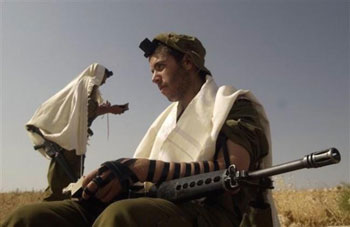
In February, Israel’s Supreme Court ruled the Tal Law discriminatory and unconstitutional in a vote of six to three. The law, which provides exemptions for young men studying in yeshiva full time, has been the subject of much criticism and controversy.
At the conclusion of this week’s parshah, the Torah writes about the mekoshesh eitzim – the individual who desecrated Shabbos in the midbar by gathering wood. The pasuk says that since it was uncertain what the halacha was concerning one who is mechallel Shabbos, the mekoshesh was placed in custody until Hashem gave instructions as to what to do. Hashem then told Moshe Rabbeinu that the man is to be put to death by stoning; and so he was.

By Rabbi Shimshon HaKohen Nadel
In the early days of Statehood, when Rabbi Avraham Yeshaya Karelitz, the famed Chazon Ish, and other leading rabbis reached a compromise with David Ben Gurion to provide military exemptions for yeshiva students, only some 400 students were exempted. Writing about a Milchemet Mitzvah, the Chazon Ish himself recognized that “if there is a need for them, they must come to the aid of their brethren.”
The Rambam, in Hilchos Beis Habechirah 1:12, derives from the pasuk in this week’s parshah, “u’veyom hakim es haMishkan… – and on the day the Mishkan was set up…” (Bamidbar 9:15), that the Beis HaMikdash can only be built by day, not by night. Further in that halacha the Rambam writes that both men and women are obligated in the mitzvah of building the Beis HaMikdash. The Kesef Mishneh explains that the source for the halacha that women are obligated in this mitzvah is from the pasuk in parshas Vayakhel: “v’kol ishah chachmas lev beyada tavu – and every wise-hearted woman spun with her hands.”

Have you noticed that we seem to have preferential memory for the unpleasant things that happen to us? Try as we might to provide our children with good experiences and positive memories, it is the memories that evoke fear, pain, sadness, etc. seem to be the ones that stand out.
In this week’s parshah the Torah writes about the halachos of a sotah. A sotah is a woman whose husband warned her, in the presence of two witnesses, not to go into seclusion with a specific man – but two witnesses saw her in seclusion with that man. Even though the only testimony that we have is that she was secluded with this man, she is nevertheless forbidden to be with her husband as she is an adulteress. This is in effect until she drinks the sotah water.

Mr. Sam Braun stood at the back door of his house with another man dressed in rugged jeans and a baseball cap, surveying the back yard. The man had a tape measure in his hands, and took measurements along the length and width of the yard. The two then walked to the side of the house and again measured and talked, gesticulating with their hands.