יום חמישי, ד׳ חשוון תשפ״זThursday, October 15, 2026



Follow Us


If you ask ten people what the main focus of Chanukah is, nine would probably answer, “lighting the menorah.” While that is certainly an integral part of the chag, the Gemara (Shabbos 21b) tells us, “The next year they established these days as a Yom Tov, l’hodos u’lihalel – to thank and praise.” What an eye opener! There is more to Chanukah than lighting the menorah, playing dreidel and eating latkes? Yes! These are days established primarily to thank and praise Hashem!

Most people remember where they were when they heard the news that Osama Bin Laden had been killed and justice delivered. Many books have already been written about the ten-year search for him, the decision to launch the mission and the actual attack on his compound in Abbottabad. While every aspect of this story is fascinating, I would like to focus on one specific area: Why were the Navy SEALs chosen to execute the mission? When the mission was being planned it was hardly a done deal that the SEALs would be selected as opposed to the CIA’s own paramilitary unit.[1]
It’s been a rough few weeks. It began with the news of a heinous crime just blocks from where I live on Manhatan’s Upper West Side: a nanny viciously took the lives of her two young charges. Hurricane Sandy came next, contributing additional loss of life and financial devastation of a magnitude never before experienced by our East Coast brethren.
By Rabbi Yaakov Klass and Rabbi Gershon Tannenbaum
For Whom The Bell Tolls ‘Royal Children May Go Out With Bells’ (Shabbos 66b)
Certain activities – such as building, tying, weaving, writing, dyeing and sewing – are not prohibited on Shabbat unless they are made to last. For example, one may tie a knot that is not tied in a professional manner and will be untied within seven days, such as shoelaces or the ribbon around the Torah scroll, on Shabbat afternoon. So too a safety pin may be used on Shabbat since it is not a form of permanent sewing.
Question: I was at a brit where the father and grandfather of the boy argued over who should be sandak. The grandfather had served as sandak once before, but he persisted and, as they say, “might makes right.” I am curious as to your view on this matter. M. Renkin (Via E-Mail)

At the age of seventeen, Yosef was wise in the ways of the Torah and in the ways of the world. He was called a “ben zikunim” because even at such a young age he showed the brilliance of an elder scholar. He had already absorbed all the Torah Yaakov had learned in the many years he had spent in the yeshiva of Shem.

Reb Elimelech maintained that just for him alone they will have to make a new Gehinnom, for the one that already exists is not adequate enough. He also commented – in his infinite humility – that the reason people come to him and request his assistance with children, health and parnassah is because it is his sins that are responsible for the absence of these blessings.

The Jews living outside Eretz Yisrael began reciting vesein tal u’matar in the Shemoneh Esrei this week. If one does not say vesein tal u’matar (instead continuing to say “vesein berachah”) and finishes the Shemoneh Esrei, he must repeat the Shemoneh Esrei. If one accidentally does not daven at all, he must daven two Shemoneh Esreis during the following tefillah. If one did not say vesein tal u’matar and finished davening and only remembers this fact at the time of the next tefillah, he must daven two Shemoneh Esreis at the next tefillah.

Yosef, Gad and Benjy headed down to the dining hall in their high school. As they walked along the corridor they noticed a new vending machine had been installed. The three admired the machine, and eyed its beckoning display of treats.

By dvora
Since suffering from colitis as a teen, I finally adopted a strict diet in my 30s that ended my torment. It wasn’t easy to forgo white flour, white sugar and all chemical additives, but it meant that I spend the last 40 years pretty much free of doctors, medications and illness, thank God. Thus, I was surprised when two weeks before Rosh Hashanah, I began to experience increasingly severe stomach discomfort – until I was barely able to move. Despite what I was soon to endure, it helped greatly to focus on the moment-to-moment miracles.
By Rabbi Lord Jonathan Sacks z"l
The deception has taken place. Joseph has been sold into slavery. His brothers have dipped his coat in blood. They bring it back to their father, saying: “Look what we have found. Do you recognize it? Is this your son’s robe or not?” Jacob recognized it and replied, “It is my son’s robe. A wild beast has devoured him. Joseph has been torn to pieces.”

Readers are always asking me how I have the strength to open my heart, to tell my personal story, my struggles, my pain. My saintly father, HaRav HaGaon Avraham HaLevi Jungreis, zt”l, taught us that whenever we have difficult challenges we should share them with others, so that they will be strengthened in dealing with their own tests. My father learned this from our Torah, which relates to us all the painful struggles of our Patriarchs and Matriarchs. “Ma’aseh avos siman la’banim – that which befell our forefathers is a sign for the children” – so that we too might be fortified.
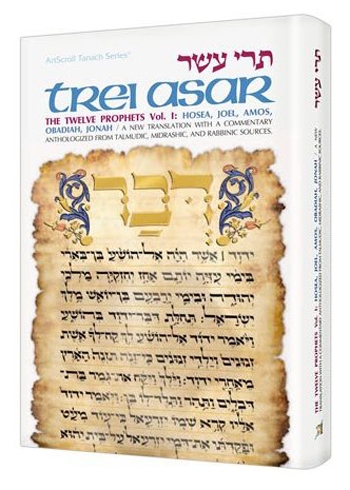
I always wonder about Jewish names. Some make it and some don’t. Some have mazel and others don’t. Some Biblical personalities’ names are very popular amongst the members of Klal Yisrael and then there are those personalities whose names never seem to be used.
By Rabbi Yaakov Klass and Rabbi Gershon Tannenbaum
Do Not Add To Them! ‘Shabbos is not a Time for Tefillin’ (Shabbos 61a)
"Hi, Levi," said his friend Moshe. "I've got a project to work on for the next two months. By any chance, do you have a spare laptop you're willing to lend for the duration?"
You arrive home after shul on Friday night. All the dishes washed before Shabbat are locked in the dishwasher. You have no other eating utensils and you want to retrieve them for the Friday night meal. In order to take them out you have to unlock the door by turning the lever lock to the left. The action of the lever to unlock the door automatically turns off the panel indicator lights that advise you the dishwashing cycle is complete. So you cannot open the door without turning off the lights. What do you do?
Yaakov Avinu received word that his brother Eisav was coming to greet him. He understood fully well that this was not to be a warm family reunion. Eisav came accompanied by a band of four hundred armed men, bent on revenge. The Torah describes Yaakov as “very frightened,” so he prepared for war.
Question: I was at a brit where the father and grandfather of the boy argued over who should be sandak. The grandfather had served as sandak once before, but he persisted and, as they say, “might makes right.” I am curious as to your view on this matter. M. Renkin (Via E-Mail)
At the beginning of this week’s parshah Yaakov sent a message to Eisav. In the message were the words, “im Lavan garti – I lived with Lavan.” Rashi explains that Yaakov was informing Eisav that he had kept the entire Torah, as the word “garti” is the same numerical value as the amount of mitzvos in the Torah: 613. The following strong question concerning this statement has been discussed by the Rishonim and Acharonim: How could Yaakov say that he kept the entire Torah when he married two sisters, Rachel and Leah, which is biblically prohibited? Additionally, the Gemara in Yuma 28 says that Avraham Avinu kept the Torah; presumably the other avos did as well. How then did Yaakov marry two sisters?
Events have been unfolding so rapidly. First it was Hurricane Sandy, which attacked with merciless fury and left multitudes homeless, their cars and belongings swept away. Power failed, not for a day, or for a week, but in some cases for several weeks.
By Rabbi Lord Jonathan Sacks z"l
Jacob and Esau are about to meet again after a separation of 22 years. It is a fraught encounter. Once, Esau had sworn to kill Jacob as revenge for what he saw as the theft of his blessing. Will he do so now, or has time healed the wound? Jacob sends messengers to let his brother know he is coming. They return, saying that Esau is coming to meet Jacob with a force of 400 men. We then read: “Then Jacob was greatly afraid and distressed” (Genesis 32:8).
By Naama Klein
I almost never met the man I married. No, I am not from a very strict chassidishe home where dating is taboo and a brief meeting suffices before the engagement is announced. My husband and I actually dated for a few months, by which time my parents were beginning to grow concerned and the neighbors were having a heyday gossiping about us. But if not for a significant helping of siyata dishmaya, we never would have managed to get together in the first place.
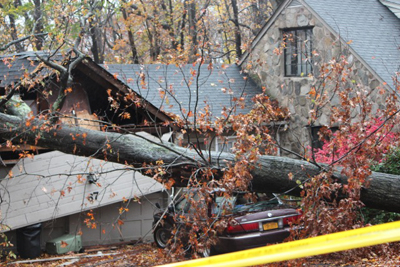
Usually, when I begin a speech, I start with something interesting, lighthearted or funny - to get your attention and lead into the speech itself. Permit me to deviate from that this week, because there is nothing funny, lighthearted or interesting about what so many of us are experiencing, and if not us, than our friends, loved ones and neighbors, and if not them, than people a few miles away from us in Long Beach or Far Rockaway who have lost everything to 14 foot waves, or a little farther away where helpless Senior Citizens are living without water or power in high rises on the Lower East Side.
A week after Hurricane Sandy, the Blums still had no electricity. They had run extension cords to a neighbor's house to power some basic items, like the fridge and telephone, but the protracted living without power was taking its toll on the family.
When Yaakov met Rachel at the well, he experienced conflicting emotions. He felt tremendous joy at having finally met his bashert, yet he raised his voice and cried. Rashi explains that he cried because he came empty-handed. He said, “My father’s servant came with ten camels laden with gifts and finery, and I come with empty hands.”
By Rabbi Yaakov Klass and Rabbi Gershon Tannenbaum
Ball And Bat Substitutes 'Cut Palm Branches' (Shabbos 50a)
Question: I was at a brit where the father and grandfather of the boy argued over who should be sandak. The grandfather had served as sandak once before, but he persisted and, as they say, “might makes right.” I am curious as to your view on this matter. M. Renkin (Via E-Mail)
The link between the laws of Shabbat and the Mishkan not only defines the 39 Melachot but also determines the conditions for liability. One of these conditions is intent. The other is purpose.
The Rambam writes in the 10th perek of Hilchos Ishus (halacha 13-14) that if a man marries a woman, he is obligated to have sheva berachos for seven days. If one marries several women at once, he must have separate sheva berachos for each one for seven days – consecutively. The reason for this is because we cannot mix one simcha with another simcha.
As promised last week, in keeping with the dictum of our sages that “ayn doma” – there is no comparison to that which you hear and that which you see – I am sharing excerpts from a diary my daughter kept during Superstorm Sandy.

By dvora
It is painfully difficult to start and end the hectic day seeing my daughter wander, almost lifelessly, from room to room and sibling to sibling with no desire to venture out into the scary world of society. With her bundle of strengths and weaknesses, and despite my countless pep talks, our 27-year-old daughter chooses to spend most of her time in the comfort and safety of our home. That is until recently, when terrible loneliness finally pushed her out the door.
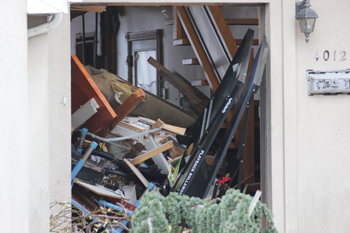
“Sandy gives New York a real thrashing!” screamed the headlines. “Hmmm, who exactly is Sandy and why is she thrashing New York,” I wonder. How about this one: (an exact quote) “For all those left homeless, for all those left scared and frightened, there is an enormous lesson from this hurricane – mother nature will do what she wants, when she wants, and our modern world can only bow before it.” Now I am really confused – who is this mother and why is she acting so mean – aren’t mothers supposed to be nice? And more so – what exactly is this “enormous” lesson? Why should I bow to her?

The theme of my column is leadership. As a general rule I avoid extrapolating leadership lessons from current events. The following is my reasoning. First, the information available from current events is often incomplete and inaccurate. Even when the information is relatively complete and accurate it is unanalyzed. Therefore the basis for lessons learned may prove to be faulty. Second, current events are often too current. To attempt to draw practical lessons in a dispassionate way would be insensitive.
The juxtaposition in the Torah of the laws of Shabbat and the Mishkan, the Sanctuary, not only serves to identify the 39 melachot prohibited on Shabbat but also determines the conditions that must exist before one can be held liable for performing a melachah. One of these conditions is intent.
By Rabbi Yaakov Klass and Rabbi Gershon Tannenbaum
Children And Corpses ‘A Body Lying In The Sun…’ (Shabbos 43b)

Hurricane Sandy had knocked down the power lines to Noach's house. After three days with no electricity, he heard that a neighbor had a spare generator.
And Lavan and Betuel answered and said, “It is from Hashem that this has come forth. We can speak neither for nor against it.” – Bereishis 24:50 Eliezer, the servant of Avraham, went to find a wife for Yitzchak. He approached the city of Charan, waited at the well, and asked Hashem for a sign. […]
Question: I was at a brit where the father and grandfather of the boy argued over who should be sandak. The grandfather had served as sandak once before, but he persisted and, as they say, “might makes right.” I am curious as to your view on this matter. M. Renkin (Via E-Mail)

We learn in this week’s parshah of Eisav’s sale of his birthright to Yaakov Avinu. There are several questions surrounding the legitimacy of this sale. The Rivash (Teshuvos 328) questions why the sale was valid, since Eisav sold something that did not exist at that time. The halacha is that one may not sell anything that is not in the world at the time of the sale. Since the bechor did not yet exist or take effect at that time, how could the sale have been valid?
By Rabbi Lord Jonathan Sacks z"l
Rebecca, hitherto infertile, became pregnant. Suffering acute pain, she went to inquire of the Lord – “vateilech lidrosh et Hashem” (Bereishit 25:22). The explanation she received was that she was carrying twins who were contending in her womb. They were destined to do so long into the future.
As I write these words I am still in my new adopted home. Originally I came to my wonderful friends’ warm apartment with the intention of staying just overnight and I did not even bother packing. My children kept pressuring me – “Ima, you have to go!”

By dvora
I never thought I would see the day when “Yossie” would smile. He was not an unhappy man, but rather very serious in demeanor. He never said hello, or any words, to his customers other than those absolutely necessary.
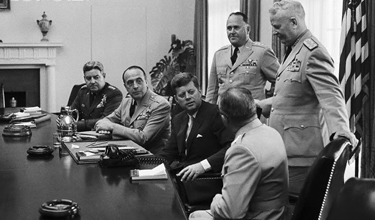
In his book, Thirteen Days (1968), Robert Kennedy publicized the inner workings of the Kennedy White House during the terrible days of the Cuban Missile Crisis. He described how the President’s special advisory group, known as ExComm, debated the options available to defuse the crisis in light of the intelligence presented to them.

Hurricane Sandy ploughed through the eastern seaboard, leaving devastation in its wake: mandated evacuation, flooded houses, power outages, uprooted trees, and smashed cars. The storm also raised serious questions regarded rented properties: Does a tenant have to pay rent for the time his house was affected by the storm?
By Rabbi Yaakov Klass and Rabbi Gershon Tannenbaum
Enjoying A Hot Dish ‘What Was Really Meant Was Replacing It…’ (Shabbos 37a)
Question: I was at a brit where the father and grandfather of the boy argued over who should be sandak. The grandfather had served as sandak once before, but he persisted and, as they say, “might makes right.” I am curious as to your view on this matter. M. Renkin (Via E-Mail)
“And Sarah died in Kiryas Arbah, which is Chevron, in the land of Canaan, and Avraham came to mourn for Sarah and to cry for her.” – Bereishis 23:2 Every word in the Torah is exact and every nuance measured. Therefore, Rashi is bothered that the Torah places the burial of Sarah next to the […]
As has been noted in a previous column, Reb Elimelech – like the Baal Shem Tov before him – asserted that pessimism and depression cause sin and spiritual apathy. Repentance (yes, even repentance!) that causes depression and sadness distances the Holy Presence.

In this week’s parshah we learn of the episode whereby Avraham sent his servant Eliezer to find a wife for his son Yitzchak. Eliezer met Rivka and decided that she was right for Yitzchak. After discussing matters with her parents and her brother, Lavan, Eliezer was ready to return with Rivka to Avraham and Yitzchak. Prior to their departure Rivka’s family blessed her, saying that she should become “thousands of myriad…” and may her offspring inherit the gate of its foes.

By Anonymous
It was the mid ‘60s and I was living with my mother and brother in public housing on Manhattan’s Lower East Side. We moved there from Brooklyn a decade earlier to be near my mother’s family when my father died suddenly of a stroke.
The continuation of my column on the power of prayer was ready to go – but then tragedy hit. Tragedy of a magnitude none of us could have envisioned.
By Rhona Lewis
Children should be seen and not heard. It was a maxim that I heard many times throughout my childhood and which caused me a fair amount of frustration. When, I often wondered, would I cross that invisible line and move out of the periphery to which I was assigned, into the arena of adulthood and be given the chance to express an opinion that people would listen to?

“G-d formed man from the earth and breathed into him a living soul.” The greatest achievement of the biological sciences since that moment in creation has been the Human Genome Project, a massive effort by thousand of biologists, chemists and physicists who isolated and identified the 24,000 genes that Hashem placed in Adam and Eve, […]

When we put away our sukkak and machzorim over a month ago, many of us let out a sigh wishing that these wonderful days of simcha and closeness to Hashem would never end. But in truth Hashem does not want it to be Yom Tov all year long. He wants us to take what we received during those special days and integrate it into our daily life. It sounds nice, but how are we supposed to do that? The answer is through Shabbos! This wonderful day, which comes every week, has the ability to lift us once again to those same spiritual heights and help us recharge our batteries for the coming week.
Question: I was at a brit where the father and grandfather of the boy argued over who should be sandak. The grandfather had served as sandak once before, but he persisted and, as they say, “might makes right.” I am curious as to your view on this matter. M. Renkin (Via E-Mail)

Rabbi Feld headed out to the airport early in the morning. He was flying to the wedding of one of his congregants, Mr. Krauss, who had purchased him a complimentary ticket. Although the wedding was scheduled for late afternoon, they had booked an early flight to allow ample time.
Hashem appeared to Avraham and told him that the people of Sodom were wicked and would be destroyed. The only ones who would be saved were Lot and his family, because of the merit of Avraham. Hashem then sent two malachim, Gavriel and Michoel, to accomplish this task.
When Rabbi Yehuda HaNasi, the redactor of the Mishnah known as “Rebbi,” lay dying, he made his sons promise him that after his death they would set the Shabbat table and light the candles for him every Friday night.

We learn in this week’s parshah about the wickedness and demise of the residents of Sedom. Further, we learn from medrashim that the residents of Sedom did not show much hospitality. Similarly, the mishnah in Avos 5:10 says that there are four different types of middos that people live by. The first is one who says, “What is mine is mine and what is yours is yours.” The mishnah says that this is an intermediate middah; others say that this is middas Sedom. Rashi, in Kesubos 103a, says that the people in Sedom would not allow anyone to benefit from their possessions even if it would be of no loss to them.
By Rabbi Yaakov Klass and Rabbi Gershon Tannenbaum
For Appearance’s Sake ‘Moving Forward At The Word Of G-d’ (Shabbos 31a)

By Naama Klein
As I sit at my home computer typing these words, virtual gale-force winds are blowing through my apartment, filling it with fresh – and free – air. This has not always been the case. In fact the electric bill for the past two months was astronomical, due in large part to our high usage of air conditioning virtually around the clock.

Many trees upstate were damaged by the hurricane that swept through the East Coast at the end of last summer, and I was involved in finding the safest equipment to clean up the mess. I love trees and found the chore of cutting them down very difficult, especially knowing that the stately 60 year old trees would be impossible to replace. Even though we planted new trees, I don't know whether I will be there to enjoy these new saplings when they are 60 years old.

The new Jewish year is still young. The new Parshas HaShavua cycle is but a few weeks old. It is indeed time for new beginnings.
A leisurely Shabbat stroll around town recently turned a calming experience into a rather upsetting one, as graffiti sprayed on quite a few buildings in my neighborhood defaced the beautiful Jerusalem stone with the words; “Dabru Ivrit/Speak Hebrew”!
By Rabbi Yaakov Klass and Rabbi Gershon Tannenbaum
Triple Pray? ‘If He Did Not Say He Must Repeat’ (Shabbos 24a)
And Hashem said to Avram, “Go for yourself from your land, from your birth place, and from your father’s house to the land that I will show you.” – Bereishis 12:1 With these words begins one of the ten great tests of Avraham. The Ramban explains that these were trials by fire, designed to bring Avraham’s greatness to the surface, taking it from the potential to the actual. They helped form him into the singular tzaddik he became.
Question: I am a single mother of young children. Their father has shirked all his responsibilities to them. I do my best for my children, but it isn’t easy. Isn’t their father in serious violation of the Torah by neglecting his children and not making any effort to provide them an education? No Name Please (Via E-Mail)

By Ann Goldberg
Yael was tired of sticking the highchair together with glue or Sellotape. It had lasted through five children, a miracle in itself, but now it seemed to have given up all hope – and decided to self-destruct.
Question: What is unique about Modern Orthodoxy?
By Rabbi Lord Jonathan Sacks z"l
The call to Abraham, with which Parshat Lech Lecha begins, seems to come from nowhere: “Leave your land, your birthplace, and your father’s house, and go to a land that I will show you.”
My column on prayer last week touched sensitive chords in many hearts. It is apparent that in our troubled times people are struggling with the entire concept of prayer. Does it really work? Is there Someone listening, or is it a waste of time?

In this week’s parshah Hashem commands Avraham Avinu to perform the mitzvah of bris milah. The pasuk tells us that Avraham was 99 when he performed the bris milah on himself. The Pirkei D’Rabbi Eliezer (29) and Tosafos, in Rosh Hashanah 11a, say that Avraham’s bris was performed on Yom Kippur. The Pirkei D’Rabbi Eliezer adds that Shem, Noach’s son, performed the bris on Avraham. There are several explanations as to why Avraham had Shem perform his milah.
Twenty-five years ago, when kiruv was still a relatively new concept, a group of four young rabbis left Ner Yisrael with families in tow to head down south to Atlanta, Georgia. Rabbi David Silverman was one of those pioneers who founded the Atlanta Scholars Kollel. He is a powerhouse of kiruv – his charisma, sincerity and broad knowledge have helped him inspire thousands of Jews, including this writer.

Rebbe Nachman of Breslov once revealed what he called a great secret - people eat for free and they work for free. He explained this with the following parable.

"I arranged with Simon Cooper, the plumber, to clear the blockage in the kitchen sink this morning," Mr. Laks told his wife. "Oh, great!" she replied. "I'll clean the kitchen before he comes."
Shabbat candles must be lit by (and preferably 18 minutes before) sunset. Once it is twilight, the time between sunset and nightfall known as bein hashmashot, it is too late to light. Bein hashmashot begins when the sun sets below the horizon and is no longer visible.
By Rabbi Yaakov Klass and Rabbi Gershon Tannenbaum
Crystal Clear As The Waters ‘Speak In The Manner Of One’s Teacher’ (Shabbos 15a)
Question: I am a single mother of young children. Their father has shirked all his responsibilities to them. I do my best for my children, but it isn’t easy. Isn’t their father in serious violation of the Torah by neglecting his children and not making any effort to provide them an education? No Name Please (Via E-Mail)
Question: What is unique about Modern Orthodoxy?
In this pasuk, Hashem appears to Noach, telling him the world has turned to evil and He will now destroy all of life. Noach, his family, and the animals that remained pure will be the core of a new world. The reason for this destruction is stealing – “since the land is filled with robbery.”
By Rabbi Lord Jonathan Sacks z"l
Is there such a thing as an objective basis of morality? For some time, in secular circles, the idea has seemed absurd. Morality is what we choose it to be. We are free to do what we like so long as we don’t harm others. Moral judgments are not truths but choices. There is no way of getting from “is” to “ought,” from description to prescription, from facts to values, from science to ethics. This was the received wisdom in philosophy for a century after Nietzsche had argued for the abandonment of morality – which he saw as the product of Judaism – in favor of the “will to power.”

Where I now work, there is a small kitchen where workers can have lunch. We take our lunch breaks at different times, and I usually take mine at the same time as an unassuming young man named Benny Green, a 25-year-old who works in the company’s stockroom.
Once again I must postpone the continuation of my Oct. 5 column, “Technology, Yom Kippur, Ahmadinejad,” this time due to the heavy reader response to last week’s column.

Toward the end of this week’s parshah Rashi quotes a Medrash that relates the familiar episode of when Avraham Avinu was thrown into a furnace. Rashi recounts that Avraham’s father, Terach, had reported to Nimrod that his son had broken all of his idols. Avraham was then thrown into a fire and was saved. The wording of the Medrash, however, is that Avraham had gone into the fire by himself (kesheyarad Avraham letoch kivshan ha’eish – when Avraham went into the fire, and in another place it says that Nimrod decreed that he should leireid lekivshan ha’eish – go down into the fire).

“Isn’t it ironic that kids whose parents fail to set and enforce limits feel unloved and angry? Although they tend to test and protest, we have learned over and over again that limits are what kids really want. Invariably, when we talk with out-of-control teenagers or adults who were juvenile delinquents and lucky enough to survive, we ask them, ‘If you could go back to when you were a child, what would you change?’ Most of them say something like, ‘I wish my parents had reeled me in when I was a kid. Why didn’t they make me behave?’
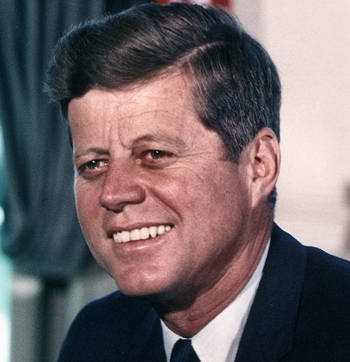
With the campaigns for the presidency of the United States in full swing people are beginning to imagine the inaugural address that will be delivered this coming January 20. Especially this year, when the candidates offer such different visions for America, rhetoric enthusiasts are expecting whoever wins to deliver an inspiring speech designed to provide a strategy and game plan for the country to move forward.
Question: What is unique about Modern Orthodoxy?
By Rabbi Yaakov Klass and Rabbi Gershon Tannenbaum
Where Beis Shammai And Beis Hillel Agree ‘One Must Not Sit Before A Barber Near Minchah’ (Shabbos 9b)
Adom HaRishon was given one mitzvah: not to eat from the Eitz HaDas. When he transgressed it, Hashem gave him the opportunity to do teshuvah. Not only did Adom not repent, he played the blame game – “It was that woman that You gave to me. You gave her to me as a helpmate and she turned out to be my ruination.”
Question: I am a single mother of young children. Their father has shirked all his responsibilities to them. I do my best for my children, but it isn’t easy. Isn’t their father in serious violation of the Torah by neglecting his children and not making any effort to provide them an education? No Name Please (Via E-Mail)
 October 9, 2026