יום חמישי, י״ג תשרי תשפ״זThursday, September 24, 2026



Follow Us


By Vera Kessler
Rebbetzin Toby Bernstein is the co-founder of the Chabad Romano Center in Richmond Hill, Canada.
A Jewish father teaches his daughter about the Torah commandment to burn all remaining bits of bread, etc. before the start of Passover.

Being happy isn’t an emotion we can turn on and off like a light switch. And how can we relate the effect of doing a mitzvah joyfully to the case of Reuven?
It is vital today to educate the Jewish community that cremation is against Jewish law.

Jacob is so much more than the lighthearted veneer he can project.
By dvora
Somehow, though I loved being in Israel, I didn’t feel that way at all.
The answer to this question is based on understanding the connection one Jew has to another.

The Bible's first mitzvah: "And God said to them, "Be fruitful and multiply and fill the earth..."
By JTA
The kindest cut of all might be the one that new father makes at his son’s circumcision.
By JTA
One of Netanyahu’s neighbors noticed that the Prime Minister on a Sabbath stroll, stopped to help an old man take out the trash. One mitzvah leads to another.

Chanukah is just about upon us and Jews across the planet are looking forward to family gatherings, delicious food (you can’t feel too guilty eating oily latkes and high carb donuts on the chag – hey, it’s practically a mitzvah to do so); giving and receiving gifts and in general celebrating our survival – our spiritual continuance as God-fearing Jews. (Our physical survival is an event we acknowledge on Purim.)
By Rabbi Yaakov Klass and Rabbi Gershon Tannenbaum
For Whom The Bell Tolls ‘Royal Children May Go Out With Bells’ (Shabbos 66b)
Question: I was at a brit where the father and grandfather of the boy argued over who should be sandak. The grandfather had served as sandak once before, but he persisted and, as they say, “might makes right.” I am curious as to your view on this matter. M. Renkin (Via E-Mail)

Reb Elimelech maintained that just for him alone they will have to make a new Gehinnom, for the one that already exists is not adequate enough. He also commented – in his infinite humility – that the reason people come to him and request his assistance with children, health and parnassah is because it is his sins that are responsible for the absence of these blessings.
The strength and numbers of Orthodox Jews in America have never been greater, and yet those of us concerned with Judaism’s future must admit we confront a future no less frightening than the future that was evident to Hannah’s noble sons in Modi’in all those centuries ago.

By Tzvi Fishman
The journey from Zichron Yaacov to Jaffa took almost three days. For Tevye, it was a chance to see another part of the Land of Israel, the sandy, swamp-infested coastline bordering the Mediterranean Sea. Most of the landscape was barren, with only an occasional settlement along the way. The colonies of Hadera, Kfar Saba, and […]
I always wonder about Jewish names. Some make it and some don’t. Some have mazel and others don’t. Some Biblical personalities’ names are very popular amongst the members of Klal Yisrael and then there are those personalities whose names never seem to be used.
By Rabbi Yaakov Klass and Rabbi Gershon Tannenbaum
Do Not Add To Them! ‘Shabbos is not a Time for Tefillin’ (Shabbos 61a)
You arrive home after shul on Friday night. All the dishes washed before Shabbat are locked in the dishwasher. You have no other eating utensils and you want to retrieve them for the Friday night meal. In order to take them out you have to unlock the door by turning the lever lock to the left. The action of the lever to unlock the door automatically turns off the panel indicator lights that advise you the dishwashing cycle is complete. So you cannot open the door without turning off the lights. What do you do?
Question: I was at a brit where the father and grandfather of the boy argued over who should be sandak. The grandfather had served as sandak once before, but he persisted and, as they say, “might makes right.” I am curious as to your view on this matter. M. Renkin (Via E-Mail)
By Dov Shurin
As I write this, Defense Minister Ehud Barak has just announced, during a televised press conference, his decision not to run in the coming elections and to leave politics.
By dvora
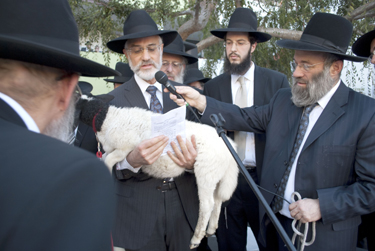
More than 1,200 members of the Los Angeles Jewish community gathered recently to witness the observance of the mitzvah of petter chamor. Organized and led by Rabbi Yehuda Lebovics, a Los Angeles mohel, the event was held in the immense outdoor courtyard of Yeshiva Aharon Yaakov Ohr Eliyahu.

Dear Readers: The following short story is fictitious, but the situation of Jewish children during the Holocaust being raised by gentile families or in Catholic convents and orphanages is not. While some were re-united with family members who survived the death camps – many were not, and remain lost both physically and religiously. This story is in memory of all the lost children. May they be reunited with their families with the coming of Moshiach.
Question: I was at a brit where the father and grandfather of the boy argued over who should be sandak. The grandfather had served as sandak once before, but he persisted and, as they say, “might makes right.” I am curious as to your view on this matter. M. Renkin (Via E-Mail)
By Rabbi Shimshon HaKohen Nadel
Minutes after candle-lighting, sirens rang out in Jerusalem, disturbing the peace and tranquility ushered in by Shabbat. Earlier that day, my wife and I assured our parents that we are far from the rockets in our home in Har Nof, a quiet suburb nestled in the Jerusalem Forest.
By Tzvi Fishman
With the birth of Hodel's baby, the time had come for Tevye to journey onward. Family was a matter of tantamount importance, but a Jew had an even higher allegiance to God. Had not the Almighty warned that life in the Holy Land must be lived according to the commandments of the Torah? That meant observing the laws of the Sabbath and the holidays, eating kosher food, donning tallit and tefillin, guarding the treasures of marital purity, and observing all of the six-hundred and thirteen commandments – most of which were flagrantly ignored by the young pioneers on the kibbutz.
The juxtaposition in the Torah of the laws of Shabbat and the Mishkan, the Sanctuary, not only serves to identify the 39 melachot prohibited on Shabbat but also determines the conditions that must exist before one can be held liable for performing a melachah. One of these conditions is intent.
By Tzvi Fishman
The indefatigable woodchopper, Goliath, provided the posts and slats for the fence which the settlers began erecting around the kibbutz. Ben Zion adamantly opposed the idea, claiming a fence would turn the settlement into a ghetto and curtail any further expansion.
Question: I was at a brit where the father and grandfather of the boy argued over who should be sandak. The grandfather had served as sandak once before, but he persisted and, as they say, “might makes right.” I am curious as to your view on this matter. M. Renkin (Via E-Mail)
As has been noted in a previous column, Reb Elimelech – like the Baal Shem Tov before him – asserted that pessimism and depression cause sin and spiritual apathy. Repentance (yes, even repentance!) that causes depression and sadness distances the Holy Presence.
In this week’s parshah we learn of the episode whereby Avraham sent his servant Eliezer to find a wife for his son Yitzchak. Eliezer met Rivka and decided that she was right for Yitzchak. After discussing matters with her parents and her brother, Lavan, Eliezer was ready to return with Rivka to Avraham and Yitzchak. Prior to their departure Rivka’s family blessed her, saying that she should become “thousands of myriad…” and may her offspring inherit the gate of its foes.
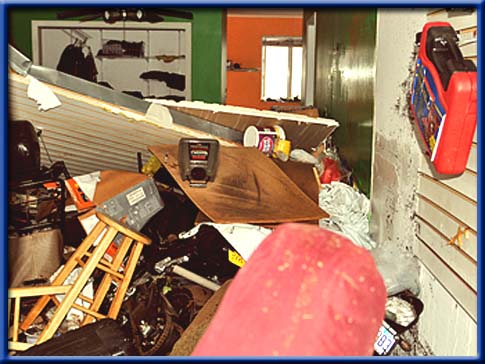
There it was, a backyard full of my basement furniture, and bags and bags of waterlogged papers.

The kinship and love between Jews is one of the cardinal principles and hallmarks of Judaism and none could match Rav Eliezer-Lippa, father of the two great chassidic leaders Reb Elimelech of Lizhensk and Reb Zusha of Hanipoli, when it came to this particular characteristic.

Dear Dr. Yael: I feel extremely guilty about my elderly father and am filled with anger toward my sisters and brothers in regards to his care.
Question: I was at a brit where the father and grandfather of the boy argued over who should be sandak. The grandfather had served as sandak once before, but he persisted and, as they say, “might makes right.” I am curious as to your view on this matter. M. Renkin (Via E-Mail)

The new Jewish year is still young. The new Parshas HaShavua cycle is but a few weeks old. It is indeed time for new beginnings.
Question: What is unique about Modern Orthodoxy?
In this week’s parshah Hashem commands Avraham Avinu to perform the mitzvah of bris milah. The pasuk tells us that Avraham was 99 when he performed the bris milah on himself. The Pirkei D’Rabbi Eliezer (29) and Tosafos, in Rosh Hashanah 11a, say that Avraham’s bris was performed on Yom Kippur. The Pirkei D’Rabbi Eliezer adds that Shem, Noach’s son, performed the bris on Avraham. There are several explanations as to why Avraham had Shem perform his milah.

Where I now work, there is a small kitchen where workers can have lunch. We take our lunch breaks at different times, and I usually take mine at the same time as an unassuming young man named Benny Green, a 25-year-old who works in the company’s stockroom.
By Tzvi Fishman
Tevye decided to stay in Shoshana until the birth of Hodel's baby, which was only a month away. He forbade Bat Sheva to speak to Ben Zion, and asked Goliath to keep his eyes open to make sure there were no rendezvous. Tevye, by nature, had a trusting, good-natured soul, and in the past, it […]
Rabi Yehudah Hanasi (the prince) known as Rebbe had an amazingly warm friendship with the Roman Caesar, Antoninus. The friendship began at the birth of the two men and continued until their dying days.

Adom HaRishon was given one mitzvah: not to eat from the Eitz HaDas. When he transgressed it, Hashem gave him the opportunity to do teshuvah. Not only did Adom not repent, he played the blame game – “It was that woman that You gave to me. You gave her to me as a helpmate and she turned out to be my ruination.”
In this week’s parshah the Torah commands us in the first mitzvah: pru u’revu – be fruitful and multiply. We rule in accordance with Beis Hillel that one fulfills this mitzvah when he has fathered one boy and one girl.

By dvora
Rosh Hashanah and Yom Kippur have come and gone. It is time to return my beloved Machzor to the bookshelf. Gifted to me by my beloved parents, of blessed memory, for my bat mitzvah, it is one of my most precious possessions.
Rav Moshe Sofer (The Chasam Sofer), one of the greatest Gaonim in his generation, always preached and practiced charity and kindness towards his fellow man. His door was always open to the poor and to the needy for help and advice.
How can one fathom the depths of a mother’s pain upon the brutal loss of her child? Sherri Mendell’s first-born son was viciously murdered near their home on May 8, 2001. How does a mother cope with the news that her spirited thirteen-year-old, while hiking in the neighborhood, was bludgeoned to death by rock-yielding Arabs?
By Rabbi Yaakov Klass and Rabbi Gershon Tannenbaum
Lulav, Shofar, Bris “His Hand Is Not At Rest” (Shabbos 3a)
Question: I seem to see a lack of uniformity regarding the mitzvah of sukkah on Shemini Atzeret. What is the proper procedure to follow? Menachem Via e-mail

Team Israel lost in the finals of the World Baseball Classic qualifiers, but the experience should teach an important lesson to Jewish people throughout the world. The fact that Jewish players and players with Jewish roots who don't actually live in Israel played for Team Israel should send a critical message to Diaspora Jewry: Israel is the homeland for all Jews.

By Tzvi Fishman
There is a special mitzvah on Sukkot to be “ach samaoch.” Only joyous. It is a happiness not dependent on anything external, beyond definition and words. Just to be absolutely joyous in one’s love and worship of G-d. Rabbi Kook describes the sukkah as a whirlpool of joyous energy which is constantly changing each second, reaching ever-higher levels of joy and attachment to G-d.
By Tzvi Fishman
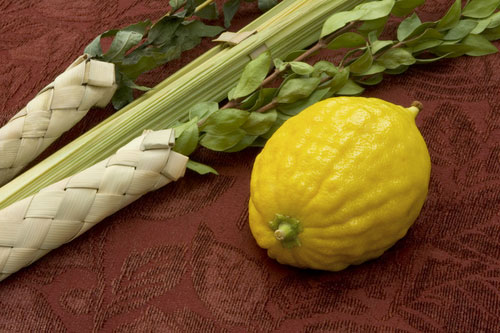
If it did it would die. Just the way the Diaspora is destined to die. The etrog tree doesn’t belong in Brooklyn. The climate isn’t right for it. It’s the same with the lulav, hadasim, and aravot. The four species which we are commanded to take for ourselves on the Festival of Sukkot are indigenous to Eretz Yisrael, just as the Torah is indigenous to Eretz Yisrael, and the Jewish People are indigenous to Eretz Yisrael. We belong in Eretz Yisrael. All of the holidays are intrinsically connected to Eretz Yisrael. The Torah was designed and fashioned by the Almighty to be observed in Eretz Yisrael.

By Pnina Baim
There is a long laundry list of personal goals running through my head that I want to work on. I love taking advantage of a celebratory date to select one of these pressing items and promise myself that this time, I really will begin to do whatever it is that will make my life better. Yet, somehow, after the birthday or New Year passes, my fervent declarations are quickly forgotten and I lapse into my old behavior.

By Bracha Slae
Title: Land of My Past, Land of My Future Author: Michael Kaufman Publisher: Targum Press, 2012
Question: Should a person recite kiddush standing or sitting on Sukkot? If he stands, should he sit down after saying the berachah of leshev ba’sukkah or remain standing?

The Gemara in Sukkah says that the sechach that one must use for his sukkah must be detached from the tree in order for it to be fit for use. The Gemara (Sukkah 11a) discusses what a person must do if one put branches on his sukkah before they were cut off from the tree. The Gemara concludes that branches must be detached from the tree and he then must shake them.
By Rachel Weiss
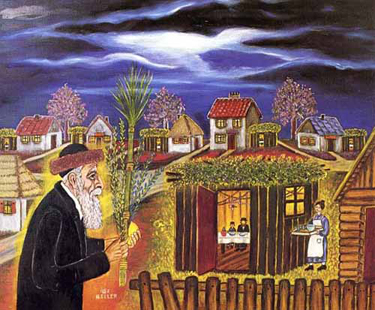
Sukkos comes to us as a beautifully wrapped gift from Hashem, right when we can use some pampering. Having just completed an exhaustive round of appeals to our Father in heaven to forgive our iniquities and grant us yet another chance to prove ourselves worthy of His beneficence and mercy, we emerge as newborns – clean and pure and free of the stain of sin.
By Tibbi Singer
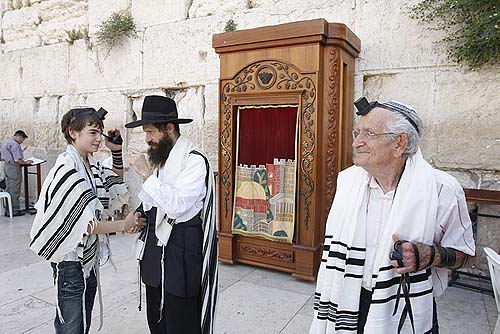
The Al-Aqsa Institute said that Israel invented new methods to Judaize Islamic holy relics in Jerusalem.
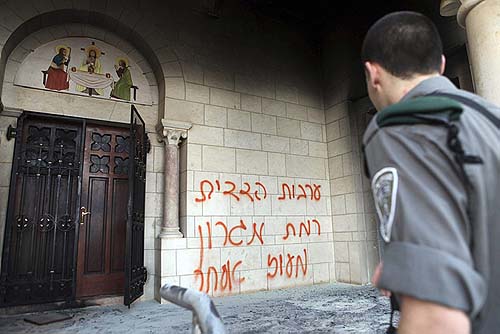
Recent anti-Christian acts are due to a culture of hatred of the goy (non-Jew) that permeates certain circles.

I rarely take the extended warranty when purchasing new electronics. I figure that this warranty must not be worth much if they feel the need to pressure me into buying it. They must know what I have learned the hard way: there is no such thing as a real guarantee. In my more naive days, I purchased this "peace of mind," as they call it, but never cashed in. Usually, by the time the item broke, I had forgotten about the extended warranty and purchased a replacement.
We are used to assuming that Rosh Hashanah is a holiday of repentance and atonement, a holiday of judgment, and the holiday when our fate for the coming year is determined. The Selichot prayers before and after Rosh Hashanah add to the sense of personal days of judgment, an obvious truth.
By Rabbi Yaakov Klass and Rabbi Gershon Tannenbaum
The Lady Of The House ‘One Blesses First On The Wine…’ (Berachos 51)
By Rabbi Lord Jonathan Sacks z"l
By now Moses had given 612 commands to the Israelites. But there was one further instruction he still had to give, the last of his life, the final mitzvah in the Torah: “Now therefore write this song and teach it to the people of Israel. Put it in their mouths, that this song may be My witness against the people of Israel” (Deuteronomy 31: 19).

Being forced to pay taxes does not make us more virtuous people. If it did, our founding fathers would have thanked George III for his coercion.

Just a few short days ago we were in summer mode, vacationing in the mountains, at the cottage, or on the road visiting family, friends or sightseeing. But with the start of September and school, we become all to aware that the Yamim Noraim - the Days of Awe – are upon us, that sobering period of time when a year's worth of our actions and activities will be evaluated by our Creator. His ultimate assessment and judgement will affect the quality and quantity of the days of our lives.
“The life and the death I have given before you…in order that you should live, you and your seed.… And you shall choose life” (30:19). “Choosing life” is one of the highest accomplishments (Shaare Teshuvah III:17). This means that not only does Hashem allow us the free will to choose (a principle that materialist psychologists deny), He also gives us the information that we possess free will.
Many passages in the Torah appear at first glance to be repetitious. Often, each iteration has a unique and deep message. Rabbi Avigdor Miller, zt”l, finds such a case (in the passage of the Blessings and Curses) in the Torah's instruction to keep Hashem’s commandments and walk in His ways. Also in the passage of the Blessings and Curses, Rabbi Miller highlights the great blessing of a long life.
There is a custom to say Selichos before Rosh Hashanah. Sephardim have the custom to say Selichos during the entire month of Elul, while Ashkenazim follow the custom of the Ramah (Orach Chaim 581:1) to only say Selichos for a minimum of four days prior to Rosh Hashanah – beginning with Motzaei Shabbos. The Ramah quotes from the Kol Bo that certain communities had the custom that the ba’al tefillah should also be the chazzan for the remainder of the day. The Magen Avraham explains that this is because of the general rule that when one begins a mitzvah he should complete it.

We asked several experienced mechanchim for their insights on how to shepherd children from their first “Modeh Ani” to the understanding that Hashem alone holds the key to every aspect of their existence. Here are the key principles they shared.
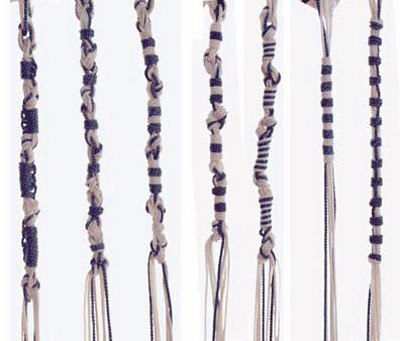
“Rabbi, is there any religious requirement for Jewish men to wear mezuzahs around their necks?” “Rabbi, if you yourself are clean-shaven, why does this inmate claim his Jewish religion prohibits him from using a razor on his face?”
It is hard to believe that Elul is upon us and that the Day of Judgment is only one month away. In a short 30 days we must face our Creator and have our deeds evaluated in the hopes of a receiving a merciful blessing for a good and healthy year. We spend the month of Elul focused on repentance, and we learn the holy books of mussar to inspire us to grow and change.

By Pnina Baim
For my upcoming birthday, instead of waiting for my friends or my husband to make me a “surprise” party, I decided to throw one myself. I settled on a cozy and intimate evening, celebrating my birthday with professional cake decorating and fruity cocktails with my nearest and dearest. But as with every gathering I plan, things started to get out of control.
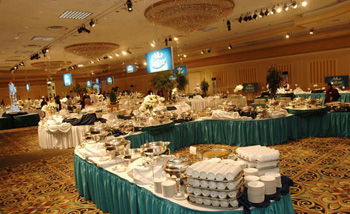
With the Three Weeks and its social restrictions as they pertain to simchas behind us, heimishe Yidden everywhere are "dusting off" their party clothes, taking their jewelry out of the safe and getting ready to attend a multitude of weddings - with some people invited out on an almost daily basis.

By Tzvi Fishman
If a Jew is thrown into prison and he doesn’t have tefillin, then he can’t perform the mitzvah of putting on tefillin. But the mitzvah of tefillin isn’t cancelled because of this. The very first morning that he gets out of jail, he once again must perform the mitzvah of putting on tefillin
By Rabbi Yaakov Klass and Rabbi Gershon Tannenbaum
What About Ma’ariv? ‘The Bridegroom Is Exempt From Kerias Shema’ (Berachos 16a)
In this week’s parshah the Torah teaches the halachos of an ir hanidachas – a city where a majority of the inhabitants serve avodah zarah. The halacha is that all of the city’s inhabitants are killed and all of their possessions are burned.
By Rabbi Yaakov Klass and Rabbi Gershon Tannenbaum
Kerias Shema Twice At Night? ‘When One Reads Shema’ (Berachos 8b)
In this week’s parshah the Torah gives us the mitzvah of tefillah – davening to Hashem – for as the pasuk says, “oso sa’avod – you shall serve Him.” The Torah repeats this mitzvah several times, with another mention further in this week’s parshah: “uleavdo bechal levavchem – serve Him with all of your heart.” The Sifri explains that one serves with his heart by means of tefillah.
With all the well-earned accolades and fanfare that surrounded last week’s monumental Siyum HaShas, one would expect to find numerous direct references in the Torah mandating the study of Torah. It therefore comes as a great surprise that there is not one direct statement in the Torah commanding its study.
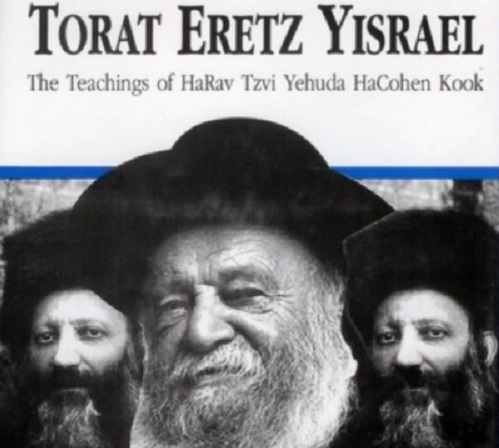
By Tzvi Fishman
We learn from Moshe that the true meaning of Haredi is someone whose fear and reverence of God so fills his being that he rushes to do every mitzvah as speedily and completely as he can. We also find this Haredi quality in Moshe’s great desire to live in the Land of Israel. Moshe wanted to make aliyah more than anything else. This is a sign of a true Haredi Jew – a towering love for the Land of Israel and a passionate desire to live there.
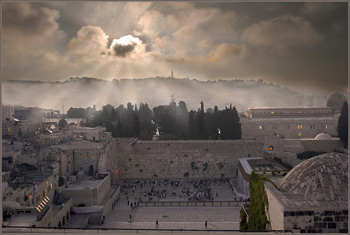
We’ve all seen the ads in the papers. Shabbos Nachamu is one of the biggest getaway weekends of the entire “frum” summer. There has long been a long-standing American tradition for people to go up to the mountains for Shabbos Nachamu.
In this week’s parshah Moshe Rabbeinu recounts ma’mad Har Sinai – the giving of the Torah on Har Sinai. Additionally, the Torah warns us earlier in the parshah not to forget the revelation that we witnessed at Har Sinai, for as the pasuk says: “Only beware for yourself and greatly beware for your soul, lest you forget the things that your eyes have seen and lest you remove them from your heart all the days of your life, and make them known to your children and your children’s children” (Devarim 4:9).

By Tzvi Fishman
"Oy Golda, Oy Golda," Tevya moaned. "Is this to be your reward? To be thrown to the fish? To have your bones scattered to the ends of the seas? Without any dry earth to warm you, or a flower to grow over your head? Is this to be your reward for being Tevye's wife for twenty-eight years and for raising his seven daughters?"

They say that one mother can take care of five children, but five children cannot take care of one mother. One of the most challenging situations, and perhaps the most unnatural, is when children need to take care of aging or infirm parents. Why is this so difficult and why do so many of us fail at caring for our parents when they need us most?
By Rabbi Yaakov Klass and Rabbi Gershon Tannenbaum
Sorrow And Joy ‘Proclaim Your Troubles So That Your Friends Pray For You’ (Niddah 66a)

By Tzvi Fishman
"If you want to read a truly important book, you should read ‘The Jewish State,’ by Theodor Herzl. He was a prophet who spoke to the Jews of today," said Ben Zion. "The Lord has many messengers," Nachman answered. "In our time, God chose Herzl to bring the message of Zion to our exiled people. But it wasn't Herzl who invented the Zionist movement. It comes from our holy Torah and the Jews who have been following its call for thousands of years."

I had the tremendous zechut to attend the wedding of my granddaughter Rachayli Fuchs to Shaul Klein in June, and then, much to my delight I was able to make one of the Sheva Berachot. My guest list was composed and invitations extended. The divrei Torah would be delivered by my grandson Rabbi Raphael Fuchs and my nephew Meir Greenwald.
By Dov Shurin
We’ve just read the Torah portion about Pinchas, an amazing tzaddik who performed an unusual act instinctively and for the sake of Hashem and His honor.
Question: I understand that at a minyan, the chazzan is required to repeat Shmoneh Esreh out loud so that people who may not know how to daven can fulfill their obligation to daven with the chazzan’s repetition. What, however, should the chazzan do when he reaches Kedushah and Modim? I hear some chazzanim say every word of Kedushah out loud and some only say the last part of the middle two phrases out loud. As far as the congregation is concerned, I hear some congregants say every word of Kedushah and some say only the last part. Finally, some chazzanim and congregants say Modim during chazaras hashatz out loud and some say it quietly. What is the source for these various practices? A Devoted Reader (Via E-Mail)

There are 613 mitzvoth – we all know that. We also all know it is impossible for one person to perform all 613. Twenty-five mitzvot can only be performed in the Land of Israel, which leaves many Jews out in the cold, shall we say. After all, the people of Israel and the Land of Israel are inextricably intertwined; they are in fact dependent on one another for survival. But Judaism has a solution or as a modern Israeli would say, a “patent.” Mitzvot can be performed by proxy; by taking a part in a mitzvah one merits a share in the whole.

By dvora
We recently layned Parshas Naso which contains the Biblical source for the obligation of a married woman to cover her hair. An eesha sotah is a woman whose husband suspects her of having acted immorally. The Torah commands the Kohein to take various steps to demonstrate that the sotah has deviated from the modest and loyal path of most married Jewish women (Rashi 5:15-27). Among the procedures, the pasuk clearly states: “ufora es rosh haisha…” and he shall uncover the hair of the head of the woman (5:18).

On the 43rd day of the Omer I asked a child how many days there were to go. He immediately answered that 37 days remained. In response to my inquiry about his calculations, he excitedly announced that there were 37 days left to the school year! While all of us--he included--were counting down to the monumental day of receiving the Torah, he was also counting the days until he would be absolved of learning the very same Torah in the formal school environment!

By Tzvi Fishman
Tevye took the shovel and started to dig. The earth was hard, but after breaking through the frozen topsoil, the ground became looser below. Whoever would have dreamed of Tevye digging up his Golda?

By Tzvi Fishman
When Moshe led the war against Amalek, he didn’t just pray on the mountain – he sent Yehoshua to lead the soldiers of the Molech Israelite Army to fight down below on the battlefield. Yehoshua didn’t merely blow shofars in conquering the Land, he cut off the heads of the enemy. And who was a greater scholar than Rabbi Akiva? To defend the Land of Israel from the Romans, he closed his Gemorah, rushed to the battlefield, and accompanied Bar Kochba into battle!!
Question: Why don’t women wear tzitzit and tefillin?
 September 18, 2026