יום שלישי, ט׳ חשוון תשפ״זTuesday, October 20, 2026



Follow Us


A Hebrew leader must embody the aspirations of his people to the extent that he becomes a microcosm of the entire nation of Israel and his personal identity is absorbed into that of the national collective.
She Ate Unwittingly ‘If She Married A Kohen She Eats Teruma’ (Kiddushin 10b)
Have you ever thought about the hobby of the guy who cleans your street? Or his dreams? The city of Akko – as reported by journalist Yair Kraus – has put up new signs which make its sanitation workers into stars.
In Chassidic tradition, it is said that during this month, “the King (G-d) is in the field,” smiling and accessible to all. On the other hand, once the holidays are upon us, G-d is, so to speak, in His palace. The experience during the holidays is that much more powerful and majestic, but now is the time when anyone can approach G-d with requests and be received.
There may not be another puzzle piece that meshes with mine, and if so, then that is what Hashem wants. Then again, there may be one that does. Who knows?
Why does it not say “reshaim – wicked ones,” or “anashim ra’im – evil people?” Tzila Kleinbart Via email
Moshe took everything that came before and expressed it through his unique lens. The Maharal and Ohr Hachaim describe this process as Moshe’s transformation into a normal Navi.
By Rabbi Lord Jonathan Sacks z"l
It taught me that humility is not thinking you are small. It is thinking that other people have greatness within them.
When Israel fled Egypt, our redemption was not complete and neither was the destruction of the evil that had enslaved us.

This inability to understand others with whom we disagree underlies the polarization in Israel today
A powerful agent is the right word. Whenever we come upon one of those intensely right words... the resulting effect is physical as well as spiritual, and electrically prompt. -Mark Twain
It’s a great feeling to know that we’ve strived to reach this prized closeness to Hashem and spiritual protection.
The Talmud continues that if someone lengthens the word echad in his recitation of Shema, his days and years will be lengthened.
The mitzvos associated with prompt payment apply to a Jewish employee, although a non-Jewish employee should also be paid according to his contractual terms.
By Rabbi Dr. Mordechai Schiffman
Learning alone is valuable, but not ideal. Words of Torah are enhanced through social interaction and social interactions are enhanced through words of Torah.
We often speak about having emunah peshuta – ‘simple faith,’ or some might say blind faith, in G-d. The truth is that we are not charged to merely believe. We are charged to develop faith that stems from knowing the truth in our hearts.
One would think that the Shulchan, a symbol of royalty and material wealth, is there to serve the Menorah, the light of the Torah. However, this is not what the Torah tells us.
By Naama Klein
So we just turned a blind eye to the sorry state of our chairs and prayed that they would hold up in the meantime, and that no one would get hurt chas v'shalom.
By Rabbi Dr. Mordechai Schiffman
While we can be hopeful and optimistic that people will express their naturally benevolent and compassionate sides, we also need powerful external systems in place to curb the also natural human tendency towards maleficence and cruelty.
Filling In The Blanks ‘Esrog Similar To a Tree in Three Ways…’ (Kiddushin 2b-3a)

Question: In the many shuls that I've attended I observe that there are people who recite the Kaddish silently. Is this correct? I’ve also seen Kaddish recited by some at a cemetery without a minyan is there any reason to sanction this? Charles Rosen Via email
We are meant to work hard to support ourselves, and the amount we earn seems proportional to the effort we invest. This leads many to assume that their efforts determine their success.
As we know, tznius is a sensitive topic, and it has to be approached in a very sensitive manner. We see from this story how the Rebbe Maharash approached this topic.
Ultimately, the IRS admitted that the true reason Z Street and other organizations were selected for special scrutiny was because their viewpoints on Israel conflicted with that of the Obama Administration.

We face challenges with technology, social media, and a culture devoid of values. At the same time, we are trying to build character and instill middos and derech eretz within our children.
The essence of Ahavat Yisrael is the willingness to take responsibility for Israel’s future. It is being prepared to sacrifice everything for the defense of the Jewish people and liberation of the homeland.
All of us can identify with one or more of the following scenarios: next to our bed, a pile of books that we began but didn't finish; a computer screen full of open web page tabs scrunched together at the top of the screen...
The gift of money that one usually associates with the word blessing (Rashi, Bamidbar 6:24) could in reality be a curse. Osher shamur leba’alav lera’aso, - wealth can be detrimental to its owner (Koheles 5:12).
We must do our business faithfully, without trouble or disquiet, recalling our mind to God mildly, and with tranquility, as often as we find it wandering from him. -Brother Lawrence
The physical world was naturally seen as an expression of a spiritual reality, and it was easy to source the physical back to the spiritual.
By Rabbi Lord Jonathan Sacks z"l
In Judaism, faith is not a rival to science, an attempt to explain the universe. It’s a sense of wonder, born in a feeling of gratitude.
If you might wonder what the body of the star represents, Rav Yisroel Salanter famously said when you are busy appointing Hashem above, below, and in the four directions, don’t forget to appoint him boss over yourself as well.
In every exile, we are separated from our proper state of concurrence with Hashem, from our own true essence, and we are prevented from performing the tasks and observing the rituals that define our peoplehood.
This is the way Hashem wants us to serve Him, not just according to the letter of the law, but beyond that, out of love, and not only because we are obligated and commanded to.
On some level, we remain skeptical and don’t really believe it. We maintain this inner feeling that we would be different. If only we made it big and had it all we would defy the statistics of high rates of depression, empty lives, and broken homes.

Our sages argue that Menashe ultimately did earn a share in the World to Come because he repented for 33 years of his life and entreated Hashem. Hashem made a special secret pact in Heaven for him to be admitted.
My wife and I used to say that winning a $100,000 lottery would be a real bracha if no one, and I mean no one, knew about it. If one person found out about it, it wouldn’t be worth it.
By T. Gestetner
Bentzy's heart was heavy as he thought of the implications of his tiny careless move… Hashem, he pleaded, help me figure this out!
By Rabbi Dr. Mordechai Schiffman
These negative visualizations can be particularly important when the long-term consequences of our actions are not immediately resonant.
Excluding The Excluded ‘You Are Permitted To Any Man But My Father …’ (Gittin 85a)
Who has not been in an uncomfortable situation where everyone seems to know everyone else except for you?
Rabbi Levi Yitzchak and Rebbetzin Chana endured those heartbreaking days with exceptional strength and fortitude.
Question: In the many shuls that I've attended I observe that there are people who recite the Kaddish silently. Is this correct? I’ve also seen Kaddish recited by some at a cemetery without a minyan is there any reason to sanction this? Charles Rosen Via email
Though we occasionally face difficult situations, we should be optimistic about our future.
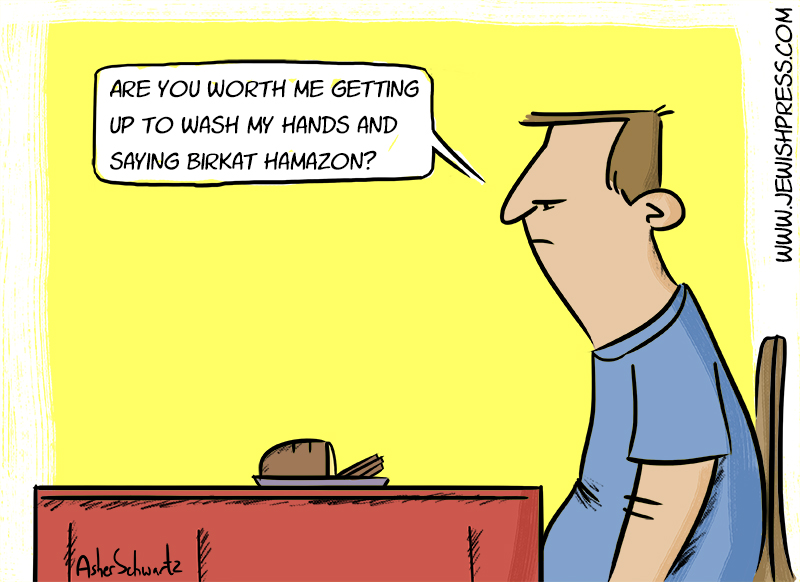
The first to fulfill the mitzvah of Birkat HaMazon, according to our Sages, was Avraham Avinu.

When facing our enemies, it's often necessary to don a ruthlessness seemingly at odds with our inner nature. The 'hands of Esav' can sometimes be utilized to achieve the goals of 'Yaakov's voice.'
By Rabbi Lord Jonathan Sacks z"l
It is through the word – speaking and listening – that we can have an intimate relationship with G-d as our parent, our partner, our sovereign, the One who loves us and whom we love.
The Talmud asks: The people of the city were righteous – why were they punished? Rav Yosef says it was because they did not mourn the destruction of the Temple. In the Talmud Yerushalmi (Taanis 4:5), Rav Yose adds that the people lit lights, indicating unseemly festivities.
What if you find it difficult to forgive someone? Let’s say for example, someone caused you to lose an exciting job opportunity, or perhaps they wrecked your chances at a good shidduch. How could you sincerely forgive someone who hurt you in such a terrible way?
When Israel is redeemed from exile, Ramchal explains, the Divine Presence (Shechina) that was exiled with us rises up to be reunited with her counterpart above the physical universe.
It is clear that we now live in the second stage of history – one of darkness, distance, and seeming disconnect from Hashem. It is also clear that this was not always the case.
The measure of greatness is not when one performs when he's at his best, but how much he is able to produce when his resistance is low and he's not feeling his best.
Mynah birds are very good at adapting to new places and ousting the native bird populations. The crows and sparrows have all but disappeared since the mynah bird invasion of our neighborhood.
By Rabbi Dr. Mordechai Schiffman
The second chapter of Pirkei Avot ends with two related teachings from Rabbi Tarfon, both centering around procrastination and productivity.
He turned around and saw a huge wave heading quickly towards him. Before he knew it, the wave hit the beach and crashed against the shore, spreading up the sand sixty feet. It saturated the towel and unfurled it, sopping the phones with seawater.
Deliberate Humiliation “Take Care of My Father” (Gittin 75b)
Question: In the many shuls that I've attended, I observe that there are people who recite the Kaddish silently. Is this correct? I’ve also seen Kaddish recited by some at a cemetery without a minyan. Is there any reason to sanction this? Charles Rosen Via Email

Ironically, our elevated holiness leaves us vulnerable to Avoda Zara.
Memory is the cabinet of the imagination, the treasury of reason, the registry of conscience, and, the council chamber of thought. -Giambattista Basile
Because Hashem directs the world, things that happen to and around us are more than just coincidental.
Already from a young age, his extraordinary talents were discovered.
By Rabbi Lord Jonathan Sacks z"l
If you want to change the world, start with why.

As characters participating in one of history’s most incredible chapters, we focus our efforts on the specific challenges facing our generation.
Rav Shach asks: Why did Moshe Rabbeinu wish to remain in the world like an animal or a bird? He answers that every living being has a specific mission in life through which the honor of Hashem is increased and spread.
There are times in our lives when we feel distant from Hashem and when we question whether or not Hashem truly cares for us, loves us, or believes in us. It is specifically at these times that we refer to Hashem as Makom.
By Rabbi Lord Jonathan Sacks z"l
Only in Israel was G-d seen not just as a power but as the architect of society, the orchestrator of its music of justice and mercy, liberty and dignity.
The purpose of performing even the most basic mitzvot is in order that they should not be forgotten when we return to Eretz Yisrael.
After the many stages of return from exile and rectification of our spiritual and intellectual state, which we will hopefully encounter in the coming weeks, the last step is to repair the physical body.
It seems that Hashem could have lived in harmony with us and could have looked away from our indiscretions towards Him. He simply could not bear to ‘stick around’ and watch when His children weren’t getting along one with another...
In thanking Hashem for preparing the steps of man, we are essentially admitting and thanking G-d for running our lives according to His Master Plan.
Today’s political left and right share certain policies, but they inhabit a milieu of pain and conflict which forms a very substantive basis for feelings of hatred.
How might Moshe looked back upon his life? Ironically, the man unsurpassed in so many ways may actually have seen himself as a failure. Yet that is certainly the impression one gets from reading through most of this book.
One who accepts tzedakah should not spend money on things that are considered unnecessary luxuries. However, if the things one spends money on are considered normal expenditures in the society one lives in, then it is ok.

It is fascinating to consider that, though He looks at us always, He does not seem too often to intervene, He does not punish or reward us in obvious ways.
What else can we say but , B"H!
A transaction made initially in error is void, replied Rabbi Dayan. However, this does not apply here, since when Mr. Joseph gave the tickets, the concert was still planned as scheduled.
Viewing Competency “A Deaf Person Able to Speak” (Gittin 71a)
I look up from time to time, my eyes focused in the same direction. Six kilometers distant is the Kotel, where people are praying, putting a note between the stones.
Though the Torah commands many mitzvot that guide our relationship with Hashem, the mitzvot that govern interpersonal relationships are the most important. Disregarding them causes churban and subsequent mourning.
Question: In the many shuls that I've attended, I observe that there are people who recite the Kaddish silently. Is this correct? I’ve also seen Kaddish recited by some at a cemetery without a minyan. Is there any reason to sanction this? Charles Rosen Via Email
An individual may bring a Mincha offering, but it may not be offered in partnership, yet it's a communal offering.

Our sages warn us of the possibility that great Torah scholars can lead Israel away from serving HaShem.
Here is some practical advice regarding our current period of mourning as we approach Tisha B'Av.
The Rebbe spoke of the need to shine a beacon of light into these days of darkness through participation in a siyum during each one of the nine days.
In a 2010 Tablet Magazine piece, Lee Smith described how the U.S. counter-intelligence community took up the failed, decades-long effort by media and academics to undermine solid American support for Israel by criminalizing legitimate, pro-Israel advocacy in Washington...
By Rabbi Dr. Mordechai Schiffman
Following his approach that each element of this mishna relates to advice for Torah study, Rabbi Lipschitz explains that knowing before whom you toil will also help with effective learning.
By Rabbi Lord Jonathan Sacks z"l
Age brings the reflection and detachment that allows us to stand back and not be swept along by the mood of the moment or passing fashion or the madness of the crowd.
Perhaps we still call our silent devotion Shemoneh Esrei, or Eighteen, even though in reality it is now nineteen, out of respect for the Anshei K’nesses HaGedolah, or because eighteen is the gematria of chai, life, emphasizing that we are actually praying for our lives and our livelihoods.
In general, in Jewish literature, association with animals is seen in a pejorative light. While certainly not anti-animal, classical Judaism sees humanity unequivocally as superior to the animals, following the account of Creation in the Torah.
There are two different types, or aspects, of perfection. The first is static perfection (sheleimus), where something is, has been, and always will be absolutely perfect. Such a being does not struggle, has no conflicting wills, and never fails.
Why, if we have so many masterful presentations which resonate so deeply and create such a deep impression, do we seem to struggle so much with the very issues these videos are targeting?
In this essay, we explore the verb romes and its etymology, with an attempt at discovering if and how romes differs from its apparent synonyms, dorech and boss.
 October 16, 2026